
COAI's Sudden Price Drop in Early November 2025: A Barometer for AI Sector Volatility


 Aime Summary
Market Sentiment: From Hype to Hesitation
The AI sector, once buoyed by speculative optimism, faced a reality check in late 2025. Companies like C3.ai (AI) exemplified this shift. After a 54% year-to-date drop in its stock price, C3.ai's exploration of a potential sale-triggered by CEO Thomas Siebel's health-related resignation-sparked a 6% after-hours rally as investors speculated on a buyout premium, according to a MarketMinute report. This volatility highlighted a sector grappling with the transition from hype-driven growth to earnings-focused scrutiny.
COAI's price drop, though not directly tied to corporate news, occurred amid similar dynamics. The broader crypto market, where COAI operates, faced headwinds from regulatory developments. For instance, Gemini's disappointing Q3 earnings and losses exceeding expectations contributed to a post-earnings price plunge, as reported by a Futunn News piece. Meanwhile, Nano Labs' early redemption of convertible bonds signaled risk mitigation in a climate of economic and crypto market uncertainty, according to a LookonChain report. These events created a tailwind of pessimism, amplifying COAI's decline.
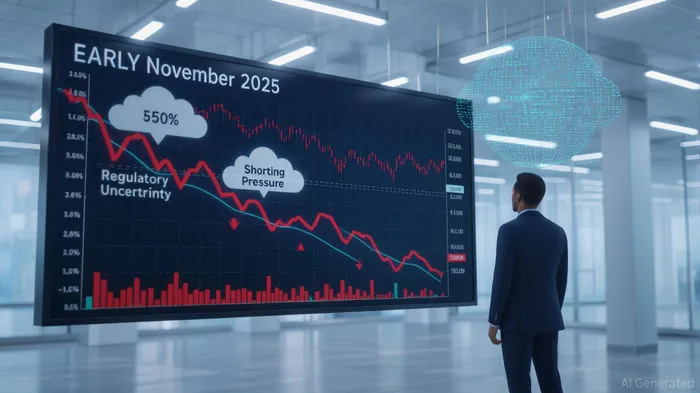
Regulatory Signals and Strategic Shorting
Regulatory ambiguity in the crypto space further exacerbated COAI's woes. The issuance of 230,000 securities by iShares Bitcoin ETP on November 11, 2025, underscored structural shifts in crypto-linked financial products, while Gemini's struggles reflected the sector's vulnerability to regulatory scrutiny, according to a Reuters article. Though COAI itself faced no direct regulatory actions, the sector-wide unease created a self-fulfilling prophecy of declining valuations.
Strategic shorting also played a role. A top Binance Futures Smart Money account generated $3.125 million in profits by shorting COAI in November 2025, leveraging its 91% winning rate to capitalize on the stock's downward spiral, according to a LookonChain report. This institutional bearishness, combined with weak fundamentals-such as COAI's 88% year-to-date decline-further eroded confidence.
Broader Implications for AI Equity Valuations
The COAI episode reveals a critical inflection point for AI and crypto equities. Investors are increasingly prioritizing financial discipline over speculative narratives. For example, C3.ai's $450 million Air Force contract expansion-a positive sign of demand-was overshadowed by its $116.8 million Q1 loss and legal challenges, as reported by a Sahm Capital analysis. Similarly, COAI's operational resilience-such as its role in Bitcoin mining-failed to offset macro-level headwinds.
Analysts now project a 20% downside for AI sector valuations, emphasizing the need for companies to demonstrate profitability and governance stability, according to a Blockonomi report. The potential consolidation in the AI space, as seen in BigBear.ai's $250 million acquisition of Ask Sage, suggests that strategic partnerships or buyouts may become more common, according to a CryptoRank report. For COAI, a similar path-whether through a sale or capital-raising-could determine its long-term viability.
Strategic Opportunities for Investors
For investors, the COAI case underscores the importance of hedging against sector-specific risks. While AI and crypto remain high-growth areas, their volatility demands rigorous due diligence. Companies with strong balance sheets, like BigBear.ai (BBAI), which reported a narrower-than-expected Q3 loss and a robust $456.6 million cash reserve, offer more resilient opportunities, according to a TechS2 report. Conversely, firms with opaque governance or regulatory exposure-such as COAI-require caution.
Conclusion
COAI's November 2025 price drop is emblematic of a sector in flux. Regulatory uncertainty, corporate governance challenges, and strategic shorting have converged to create a landscape where even fundamentally sound companies face existential threats. For investors, the lesson is clear: the AI and crypto markets are entering a phase of consolidation and recalibration. Those who navigate this transition with a focus on earnings, transparency, and macroeconomic resilience will be best positioned to capitalize on the opportunities ahead.

Blending traditional trading wisdom with cutting-edge cryptocurrency insights.
Latest Articles
Stay ahead of the market.
Get curated U.S. market news, insights and key dates delivered to your inbox.


AInvest
PRO
AInvest
PRO



Comments
No comments yet