
COAI's Sharp Price Correction: Contrarian Entry or Warning Signal for Junior Gold Miners?


 Aime Summary
Market Sentiment Shifts: Bearish Pressures and Macroeconomic Headwinds
Junior gold miners have faced significant bearish pressure in late 2025, with the GDXJGDXJ-- ETF declining from above $110 to below $90-a 27% drop in under six months. This correction aligns with broader macroeconomic trends, including the U.S. Dollar Index (DXY) surpassing 100 for the first time since 2022, a psychological threshold that historically weakens gold and mining equities according to market analysis. Analysts attribute this shift to tariff-related inflation fears, Fed rate cut expectations, and a shift in investor sentiment toward value assets as reported by financial analysts.
The sector's underperformance is also tied to overbought conditions. After a 128.8% year-to-date rally in 2025, driven by soaring gold prices (which hit $4,002.92 in October) and strong central bank gold purchases, the market has entered a correction phase according to market data. While this aligns with typical bull market adjustments, the speed and depth of the decline have raised concerns about a potential bearish reversal.
Technical Breakdowns: Divergences and Volume Signals
Technical indicators reinforce the bearish narrative. The GDXJ has pierced through the floor of a rising trend channel, a classic sign of momentum loss as technical analysis shows. Key support levels at $65.00 and resistance at $111.00 remain critical, but the ETF's negative volume balance-with higher volume on down days-suggests weak investor confidence according to trading data. The Relative Strength Index (RSI) also shows a negative divergence, where prices are rising while the RSI declines, signaling potential further weakness as technical indicators indicate.
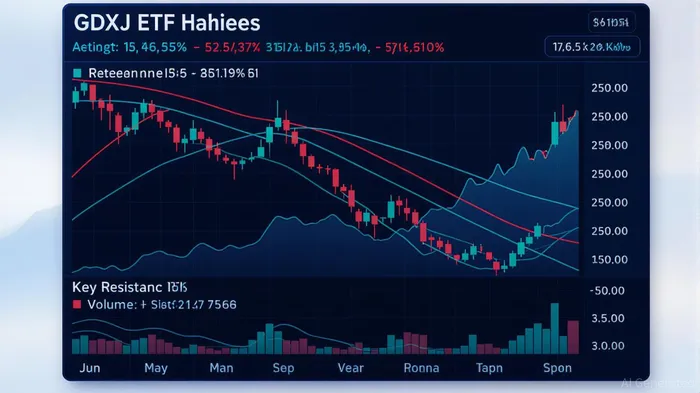
However, the long-term technical picture remains mixed. While the GDXJ is in a short-term bearish phase, it remains within a broader multi-year uptrend, supported by record-breaking Q3 earnings from junior miners and strong operational leverage to gold prices according to performance data. The MACD histogram recently turned positive, hinting at a possible near-term stabilization as market analysis shows.
Contrarian Entry Point or Warning Signal?
The debate hinges on the interplay between short-term volatility and long-term fundamentals. On one hand, junior miners have historically leveraged gold price gains 3x to 4x, yet they've only achieved 1.9x in this cycle, suggesting untapped upside according to industry reports. Central bank gold accumulation, particularly by China, and the "debasement trade"-a shift toward hard assets to hedge fiat currency erosion-also provide strong tailwinds as financial insights indicate.
On the other hand, the sector's recent correction reflects overvaluation concerns. With GDXJ up 163.9% in 9.5 months, the rally has outpaced gold bullion's 25.35% gain, creating a valuation gap as market analysis shows. This overextension, combined with the Fed's pivot to rate cuts and a stronger dollar, could prolong the correction.
Conclusion: A Cautious Bull Case
For long-term investors, the correction in junior gold miners may represent a contrarian entry point, particularly for those who believe in the structural case for gold as a hedge against inflation and currency debasement. However, the bearish technical setup and macroeconomic headwinds necessitate caution. A potential rebound could materialize if the GDXJ holds above $65.00 and the RSI aligns with price action, but investors should brace for further volatility in the near term.
In contrast, ChainOpera AI (COAI)-a separate entity-has seen a 92.30% price drop over three months, with technical indicators like the RSI in the "Sell" zone and a Fear & Greed Index score of 18 (oversold) according to market analysis. While its decentralized AI platform and whale accumulation suggest speculative potential, its structural risks (e.g., 87.9% supply controlled by top 10 wallets) make it a high-risk bet as financial data shows.
For the precious metals sector, the key takeaway is clear: the correction in junior gold miners is part of a broader bull market adjustment, not a definitive bearish signal. Investors who can stomach short-term volatility may find compelling opportunities in this leveraged segment of the gold market.

Blending traditional trading wisdom with cutting-edge cryptocurrency insights.
Latest Articles
Stay ahead of the market.
Get curated U.S. market news, insights and key dates delivered to your inbox.
AInvest
PRO
AInvest
PRO



Comments
No comments yet