
COAI's Sharp Decline: Causes and Implications for Investors


 Aime Summary
Sector-Wide Selloff: C3.ai's Leadership Crisis and Legal Fallout
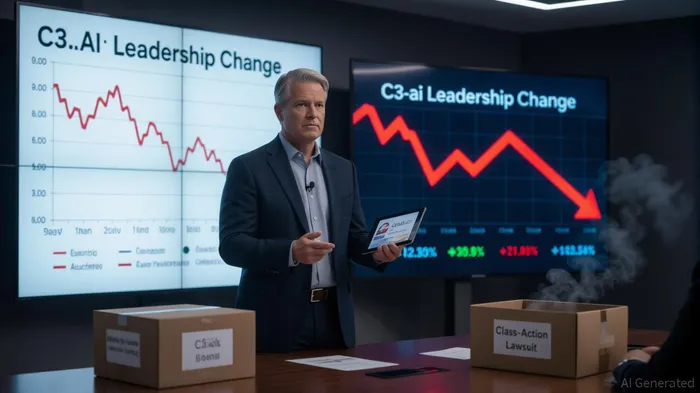
The immediate trigger for COAI's plunge lies in the turmoil at C3.ai, a key player in enterprise AI software. In October 2025, founder Thomas Siebel abruptly stepped down as CEO, replaced by Stephen Ehikian, amid a class-action lawsuit alleging misleading financial disclosures and management instability, as Bitget's analysis reported. C3.ai's Q1 2025 net loss of $116.8 million and a 54% stock price decline since January 2025 further eroded investor confidence, according to the same report. These events created a toxic sentiment across the AI sector, spilling over into crypto AI assets like COAI. As one analyst noted, "The interconnectedness of AI equities and crypto AI tokens means that governance failures at one firm can destabilize the entire ecosystem," the Bitget report notes.
Regulatory Uncertainty: The CLARITY Act's Ambiguous Framework
Compounding these corporate woes is the regulatory uncertainty introduced by the Digital Asset Market Clarity Act (CLARITY Act), passed by the U.S. Senate in mid-November 2025. While intended to clarify oversight roles between the SEC and CFTC, the act's vague language left AI-based crypto projects in a legal gray zone. For instance, the act's focus on "digital commodities" failed to address the unique nature of AI tokens, which often blend data, software, and financial instruments, the Bitget report explains. This ambiguity has discouraged institutional participation, with major crypto exchanges like Binance seeing top smart money accounts profit from shorting COAI at a 91% win rate, as Coinotag's coverage reported.
Market Reactions: Short-Selling and Investor Flight
The sector's vulnerability was further exposed by aggressive short-selling strategies. Binance's top spot market smart money account, for example, generated $3.125 million in profits by shorting COAI within a week, reflecting bearish institutional sentiment, according to the Coinotag report. Meanwhile, broader AI sector valuations are projected to decline by 20% as investors shift toward hardware firms and quantum computing plays, according to the Bitget analysis. This flight of capital underscores a shift from speculative hype to earnings-focused scrutiny-a trend that COAI, with its lack of transparent financial metrics, is poorly positioned to withstand.
Financial and Strategic Risks: COAI's Resilience Tested
Despite COAI's strategic initiatives-such as blockchain-based spam-blocking measures in India's telecom sector, as noted in a Bitget report-its resilience against sector-wide pressures remains unproven. Unlike stablecoin issuer Circle, which reported $739.8 million in Q3 2025 revenue, according to the Bitget report, COAI lacks comparable financial transparency. Analysts warn that without clear revenue streams or profit margins, the index's ability to attract long-term capital is in jeopardy. The CLARITY Act's regulatory ambiguity further complicates its path to growth, as compliance costs and legal risks could deter innovation.
Is This a Buying Opportunity? A Cautionary Outlook
For long-term investors, the question is whether COAI's decline reflects a temporary correction or a fundamental revaluation. Historically, market bottoms in speculative sectors often require catalysts-such as regulatory clarity or technological breakthroughs-to reverse trends. However, the current environment lacks such catalysts. The CLARITY Act's unresolved ambiguities and C3.ai's governance failures suggest that the sector's challenges are structural, not cyclical.
That said, COAI's price drop to $2.40 (from a projected $7–$10 range), according to the Bitget analysis, could appeal to contrarian investors willing to bet on a regulatory resolution or a sector rebound. Yet, given the dominance of short-term bearish sentiment and the absence of verifiable financial metrics, this appears more like a high-risk trade than a sustainable investment.
Conclusion
COAI's sharp decline is a microcosm of the broader AI and crypto AI sector's fragility. While the index's strategic initiatives in telecom and blockchain show promise, they are overshadowed by corporate governance crises, regulatory uncertainty, and a lack of financial transparency. For now, the selloff serves as a warning sign rather than a buying opportunity-until the sector demonstrates resilience through profitability, governance reforms, and regulatory clarity.

Blending traditional trading wisdom with cutting-edge cryptocurrency insights.
Latest Articles
Stay ahead of the market.
Get curated U.S. market news, insights and key dates delivered to your inbox.






Comments
No comments yet