
Why the COAI Index Is Collapsing and What It Means for Tech Investors


 Aime Summary
Market Sentiment: Earnings Warnings and Leadership Turmoil
The COAI's collapse is rooted in the underperformance of its core constituents, particularly C3 AI (NYSE:AI), a dominant player in the index. C3 AI's Q1 2025 financial results revealed a staggering $116.8 million net loss and a 19% year-over-year revenue decline. Compounding these issues, the company faced a class-action lawsuit over alleged misleading financial disclosures and the abrupt departure of CEO Thomas Siebel, creating a governance vacuum. Analysts have since slashed their forecasts, with consensus revenue projections for 2026 at $323 million-a 13% drop from prior estimates-alongside expected per-share losses of $3.20.
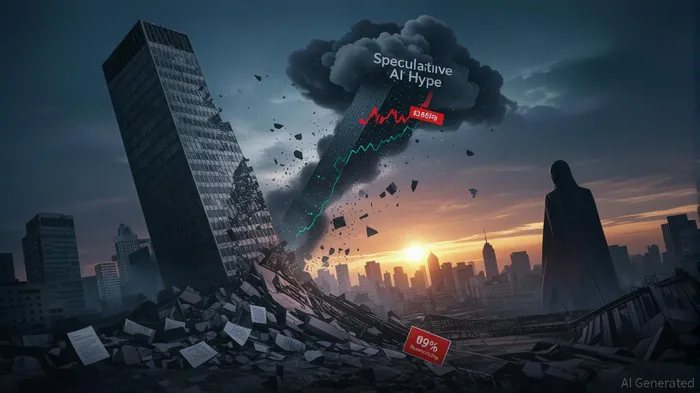 Sell-side analysts have responded with a wave of downgrades. DA Davidson reaffirmed an "underperform" rating with a $13.00 price target in December 2025, while Morgan Stanley reduced its target to $11.00 with an "underweight" rating. Northland Securities downgraded C3 AI from "outperform" to "market perform" in August 2025. These actions reflect a broader shift in sentiment, with 15 firms averaging a "Reduce" recommendation for C3 AI in 2025. The ripple effects of C3 AI's struggles have spilled into the broader COAI Index, as investors reassess the sector's fundamentals.
Regulatory Shifts: Ambiguity and Compliance Burdens
Regulatory uncertainty has further deepened the crisis. The U.S. CLARITY Act, intended to clarify AI token classification, has instead created a legal gray area, deterring institutional investment. Meanwhile, the EU's AI Act, which entered force in August 2024, imposes a risk-based framework with stringent compliance obligations for high-risk AI systems. The GPAI Code of Practice, introduced in July 2025, adds voluntary guidelines for transparency and safety, but its implementation has strained smaller firms already grappling with liquidity challenges.
The EU Digital Omnibus Package, published in November 2025, sought to streamline digital regulations but introduced new compliance costs for SMEs. These overlapping frameworks have created a fragmented landscape, with companies like C3 AI facing dual pressures from U.S. and EU regulators. For instance, C3 AI's Q1 2026 revenue drop to $70.3 million-a 20% decline from the prior year-was partly attributed to rising compliance expenses under the EU AI Act.
AI Sector Volatility: Centralization and Liquidity Risks
The COAI Index's structural vulnerabilities have amplified its volatility. Nearly 97% of COAI's token supply is controlled by the top 10 wallets, raising concerns about market manipulation and liquidity risks. This centralization contrasts sharply with the decentralized ethos of crypto assets and has fueled skepticism about the index's long-term viability. Additionally, the sector's reliance on speculative narratives-such as generative AI's transformative potential-has left it exposed to profit-taking and profit-avoiding behaviors as macroeconomic conditions shift.
Analysts remain divided on the sector's outlook. While some, like UBS's Radi Sultan, maintain a "Neutral" rating with a $17.00 price target for C3 AI, others argue that the COAI's collapse reflects a necessary correction. "The market is overreacting to short-term volatility, but the fundamentals of AI infrastructure remain intact," one analyst noted. However, the growing selectivity of investors toward AI stocks with tangible earnings growth suggests that speculative bets may no longer be rewarded.
Implications for Tech Investors
For investors, the COAI's collapse underscores the importance of distinguishing between innovation and financial performance. While AI infrastructure is undeniably advancing, the sector's current challenges highlight the risks of overvaluing hype over hard metrics. Tech investors should prioritize companies with diversified revenue streams, transparent governance, and regulatory alignment. Additionally, the regulatory landscape's evolution-particularly in the EU-demands a nuanced understanding of compliance costs and market access.
The COAI's 88% drop may yet present a buying opportunity for long-term investors, but only for those willing to navigate the sector's inherent risks. As one analyst put it, "The AI trade is maturing, and the Fed's delayed data on AI adoption will likely determine whether this is a cyclical correction or a structural revaluation." Until then, caution remains the watchword.

Mezclando la sabiduría tradicional en el comercio con las perspectivas más actuales sobre las criptomonedas.
Latest Articles
Stay ahead of the market.
Get curated U.S. market news, insights and key dates delivered to your inbox.




Comments
No comments yet