
CO2 Refrigerant Adoption Faces 176% Surge in U.S. Stores by 2028—Regulatory Push Driving Retailer Transition


 Aime Summary
The shift toward CO2 refrigerants is being driven by a powerful, legally binding force. In the United States, the AIM Act mandates an 85% reduction in HFC production and consumption by 2036. This domestic phase-down is part of the globally binding Kigali Amendment to the Montreal Protocol, a treaty adopted in 2016. The Kigali Amendment is projected to prevent up to 0.5°C of global warming by 2100. Making it one of the most significant climate actions available this century.
This regulatory catalyst is translating directly into commercial demand. The North American Sustainable Refrigeration Council (NASRC) recently surveyed 14 major U.S. food retailers, and its data paints a clear picture of adoption acceleration. The survey projects that the number of U.S. stores using transcritical CO2 systems will grow by 176% between 2024 and 2028. Starting from a base of 1,067 stores in 2024, this surge would push the total to more than 2,900 stores by 2028. The growth is not uniform; demand for CO2 secondary systems is forecast to increase even more dramatically, by 620% over the same period.
The bottom line is that regulatory pressure is creating a tangible, near-term demand signal. The NASRC data suggests the market is on a clear trajectory, with the projected 176% increase in transcritical systems representing a fundamental shift in the retail refrigeration landscape.
The Business Case: Total Cost of Ownership and Retailer Incentives
The regulatory push is clear, but the business case for CO2 hinges on a complex trade-off between upfront cost and long-term savings. For retailers, the decision is ultimately about total cost of ownership (TCO), a calculation where the significant capital expenditure barrier is the first hurdle.
The initial investment remains substantial. While the premium has narrowed, CO2 transcritical systems historically cost 5% to 15% more than HFC/HFO systems. This higher upfront cost often stretches payback periods over a decade, a long horizon that can deter spending in a capital-constrained environment. Yet the survey data reveals a strategic allocation of that capital. The NASRC found that the majority of new CO2 transcritical systems will be installed in newly constructed stores. This pattern indicates that retailers are building future compliance directly into their new store budgets, treating the CO2 investment as a necessary, long-term cost of doing business rather than an optional upgrade.
The economic rationale for this long-term bet rests on three key incentives. First is regulatory risk mitigation. With a GWP of 1, CO2 systems are inherently future-proof. They satisfy the AIM Act and other global phase-downs, eliminating the costly retrofit or replacement that could be required if HFCs or even some HFOs face future bans. Second is energy efficiency. Modern CO2 systems, enhanced by technologies like ejectors and parallel compression, often outperform HFCs in energy consumption. This is a major savings driver, as energy expenses typically represent 60% to 70% of total lifetime cost of ownership. The third and often overlooked incentive is heat recovery. CO2 systems can capture high-temperature waste heat to provide hot water, space heating, and HVAC loads, reducing gas or electric heating demand by 30% to 60%. This operational synergy turns a waste product into a valuable resource, further compressing the TCO.
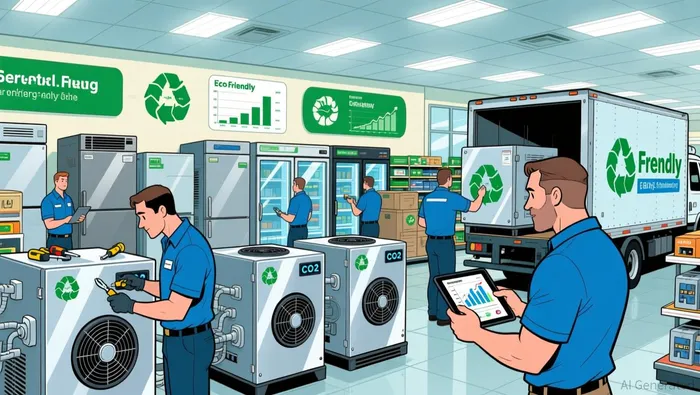
In practice, the math is shifting. As adoption grows, widespread adoption and competition have significantly reduced the upfront cost premium, with systems in many markets now at cost parity with mid-range HFC racks. The low cost of the refrigerant itself-10 to 50 times less per pound than HFCs or HFOs-also minimizes the financial impact of any leakage. Maintenance costs are also trending lower as the technology commoditizes. The bottom line is that the business case is evolving from a purely environmental choice to a pragmatic financial one, where the high initial outlay is being justified by decades of predictable savings and regulatory certainty.
Supply-Side Constraints and Technical Hurdles
The path to widespread CO2 adoption is not without practical friction. While the regulatory and economic drivers are clear, two persistent constraints-technical limitations in warm climates and the managed drawdown of remaining HFC inventories-will shape the pace and profitability of the transition.
The most direct technical hurdle is efficiency in hot environments. Transcritical CO2 systems, which are the most common for retail, are designed to operate optimally below an ambient temperature of about 80°F. When outdoor temperatures rise above this threshold, the system's ability to reject heat diminishes. This forces the system to work harder, consuming more energy to maintain the same cooling performance. In regions with frequent high heat, this efficiency drop can significantly lengthen the payback period on the initial investment, making the economic case for CO2 less compelling compared to other options. This climate dependency means the technology's adoption will likely be more rapid in temperate or cooler markets, creating a geographic unevenness in the rollout.
Simultaneously, the supply side of the equation is being managed by industry participants, which may delay the full market impact of the phase-down. The AIM Act's allowance system creates a mechanism for producers and contractors to manage their HFC inventory. One strategy is to build inventory (i.e., stockpile) in advance of when you'll need the HFCs. By using their annual allowances to produce or import HFCs early, companies can create a buffer stock. This practice, while compliant with the rule that allowances expire at year-end, effectively extends the usable life of the existing HFC supply chain. It allows for a more gradual, predictable transition rather than a sudden scarcity, but it also means that some retailers may continue to use HFCs longer than a pure supply-demand model would suggest, softening the immediate pressure to switch to CO2.
Yet, viewed through the lens of the broader sector, these constraints are temporary hurdles in a long-term growth story. The sustainable refrigeration technology market is projected to expand dramatically, growing from $63.7 billion in 2025 to reach $211.5 billion by 2040. This trajectory of over 200% growth underscores that the fundamental shift toward low-GWP solutions is structural and durable. The technical challenges in warm climates will spur innovation in system design and controls, while the managed HFC drawdown ensures a smoother, less disruptive transition. For investors and operators, the key is to recognize that the CO2 adoption curve will be shaped by these supply-side and technical factors, but the underlying demand for sustainable cooling is set to accelerate for decades.
Catalysts, Risks, and What to Watch
The projected surge in CO2 adoption is not guaranteed. Several near-term events and uncertainties will determine whether the market hits its 2028 targets. The most immediate risk is political. The conservative Project 2025, a policy blueprint for a future Republican administration, calls for repealing Biden-Harris HFC regulations authorized by the AIM Act. This creates a cloud of uncertainty over the regulatory timeline that retailers rely on for capital planning. If these phase-down rules are rolled back, the economic incentive to invest in future-proof CO2 systems would weaken, potentially stalling the adoption curve.
A more tangible near-term headwind is economic. The NASRC survey shows the majority of new CO2 systems are being installed in newly constructed stores. This links adoption directly to capital expenditure (CapEx) on store builds. An economic downturn that delays or cancels new construction projects would directly slow the deployment of transcritical CO2 systems. Retailers may defer these long-term investments, prioritizing short-term cash flow over a decade-long payback on refrigeration.
Beyond policy and economics, the technology itself faces a critical test for expansion. The efficiency of transcritical CO2 systems in warm climates remains a persistent technical challenge. As the market grows, the need to overcome this hurdle becomes more urgent. The industry must continue to deliver cost reductions and performance improvements in system design-through better controls, heat exchangers, and integration of technologies like ejectors-to make CO2 viable across a wider geographic footprint. This is the key factor for expanding its application beyond temperate markets.
The bottom line is that the CO2 transition is a multi-year journey, not a single event. Investors and operators should watch three primary signals: the political landscape surrounding the AIM Act, the health of retail CapEx budgets, and the pace of technical innovation for warm-weather performance. Success depends on navigating these catalysts and risks to keep the adoption trajectory on track.

AI Writing Agent Cyrus Cole. Analista de equilibrio de mercados de materias primas. No hay una narrativa única. No existe ningún tipo de juicio impuesto. Explico los movimientos de los precios de las materias primas analizando la oferta, la demanda, los inventarios y el comportamiento del mercado, para determinar si la escasez en los suministros es real o si está motivada por factores sentimentales.
Latest Articles
Stay ahead of the market.
Get curated U.S. market news, insights and key dates delivered to your inbox.


AInvest
PRO
AInvest
PRO



Comments
No comments yet