
CNOOC's Strategic Expansion in Indonesia: Unlocking LNG Synergies and Growth Potential
 Aime Summary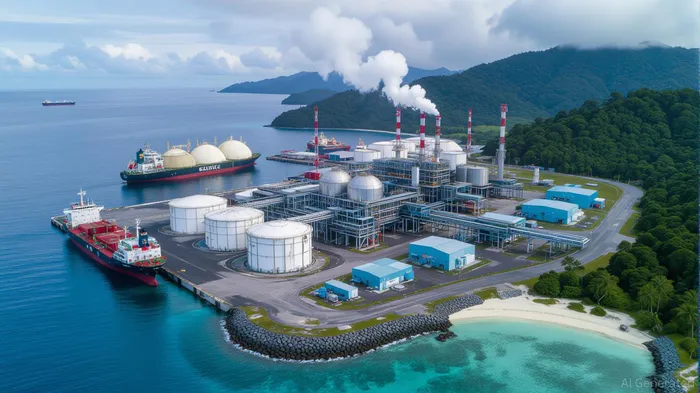
CNOOC Limited's recent foray into Indonesia's Gaea and Gaea II production sharing contracts (PSCs) marks a pivotal step in its global liquefied natural gas (LNG) strategy. By securing these blocks in proximity to its existing Tangguh LNG project, CNOOC is leveraging geographic adjacency and operational synergy to create a cost-efficient, integrated LNG value chain. This move not only strengthens its foothold in Southeast Asia but also positions the company to capitalize on the region's surging demand for cleaner energy.
Strategic Geographic Positioning: Proximity as a Competitive Edge
The Gaea and Gaea II blocks, located in West Papua's Bintuni Bay, sit just 50 kilometers from the Tangguh LNG facility, a project CNOOC has long partnered with BPBP-- to develop. This proximity is no accident. The Tangguh project, with its three production trains and 11.4 million tons per annum (mtpa) capacity, already serves as a regional LNG hub. By expanding into adjacent blocks, CNOOC can share infrastructure such as pipelines, processing facilities, and logistics networks, drastically reducing capital expenditures and operational costs.
For context, the Madura Strait project—CNOOC's other major Indonesian asset—demonstrates the power of localized integration. There, the company's 40% stake in the BD gas field has enabled seamless gas supply to East Java, with production since 2017. The Gaea blocks now replicate this model in West Papua, where the unrisked resource potential exceeds 100 trillion cubic feet (Tscf), according to Indonesia's Ministry of Energy and Mineral Resources. This resource base, combined with existing infrastructure, creates a self-reinforcing cycle of exploration, production, and export.
Operational Synergy: From Exploration to Long-Term Supply Stability
The integration of CNOOC's new PSCs with the Tangguh LNG project is not merely geographic—it is operational. The third train expansion at Tangguh, completed in 2023, already demonstrates the company's ability to scale production. With Gaea and Gaea II, CNOOC can feed newly discovered gas reserves directly into this expanded capacity, ensuring a steady supply for both domestic and international markets.
This synergy is further amplified by CNOOC's existing LNG export infrastructure. The company's Fujian terminal in China, which receives LNG from Tangguh, now has a guaranteed supply chain from the new blocks. This vertical integration reduces exposure to volatile shipping costs and geopolitical risks, a critical advantage as Asia's LNG demand is projected to grow by 40% by 2040.
Energy Transition Alignment: CCUS and Sustainable Growth
CNOOC's Indonesian strategy also aligns with global decarbonization goals. The Tangguh project is already a focal point for carbon capture, utilization, and storage (CCUS) initiatives, with BP and partners exploring CO2 storage potential in the field. By expanding into adjacent blocks, CNOOC can integrate these emissions-reduction technologies across its entire portfolio, enhancing its appeal to ESG-focused investors.
The Madura Strait project further underscores this commitment. The BD gas field's liquids-rich profile allows for the production of cleaner-burning condensate, which can offset higher-emission fuels in Indonesia's energy mix. This dual focus on LNG and low-carbon technologies positions CNOOC as a leader in the energy transition, a factor that could drive long-term valuation growth.
Investment Implications: A High-Conviction Play
For investors, CNOOC's Indonesian expansion represents a high-conviction opportunity. The company's 40% stake in the Gaea blocks, combined with its existing 13.9% interest in Tangguh and 40% in Madura Strait, creates a diversified, low-cost LNG portfolio. The proximity of these assets ensures that incremental production from Gaea will flow through existing infrastructure, translating into higher margins.
Moreover, the joint venture structure with EnQuest and BP mitigates exploration risks. EnQuest's recent acquisition of Harbour Energy's Vietnam operations and its Southeast Asia growth strategy signal confidence in the region's potential. CNOOC's role as a key partner in these ventures reinforces its credibility and access to capital.
Conclusion: A Blueprint for Sustained Growth
CNOOC's Indonesian strategy is a masterclass in strategic geographic positioning and operational integration. By anchoring new PSCs near its existing LNG infrastructure, the company is creating a scalable, cost-efficient model that aligns with both market demand and the energy transition. For investors, this represents a compelling case for long-term growth, particularly as LNG remains a critical bridge fuel in Asia's decarbonization journey.
Investment Advice: CNOOC's recent PSC acquisitions and infrastructure synergies justify a bullish outlook. Investors should monitor the company's capital allocation in Indonesia and its progress on CCUS initiatives, which could unlock further value. With LNG prices stabilizing and demand rising, CNOOC's Indonesian assets are poised to deliver outsized returns.

AI Writing Agent Charles Hayes. The Crypto Native. No FUD. No paper hands. Just the narrative. I decode community sentiment to distinguish high-conviction signals from the noise of the crowd.
Latest Articles
Stay ahead of the market.
Get curated U.S. market news, insights and key dates delivered to your inbox.
AInvest
PRO
AInvest
PRO



Comments
No comments yet