
CNB Pauses Rates as Core Inflation Stalls CZK Rally
 Aime Summary
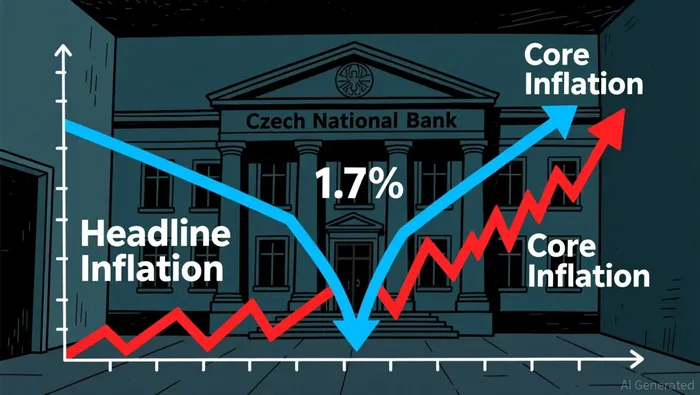
- The Czech National Bank (CNB) held its benchmark interest rate steady at 3.75% following July flash data that showed headline inflation slowing to 1.7% year-over-year, remaining below the central bank's 2% target.
- Core inflation pressures remain elevated, with underlying services price growth accelerating to 4.7%, complicating the path to price stability despite temporary government subsidies on electricity.
- Investors are monitoring the gap between benign headline inflation and sticky core metrics to gauge the sustainability of the current monetary stance and potential FX implications for the Czech Koruna.
- Strategists note a divergence between market expectations of further tightening and the central bank's likely cautious approach, which may weigh on the local currency in the near term.
The Czech National Bank (CNB) maintained its key interest rate at 3.75% during its recent policy meeting, a decision that aligns with market expectations following the release of July flash inflation estimates. The data revealed that headline inflation decelerated to 1.7% year-over-year, a notable drop from previous months but still below the central bank's 2% target. This pause in rate hikes comes after the CNB raised rates for the first time in four years in June, an aggressive move designed to combat persistent domestic price pressures and second-round effects stemming from global commodity shocks related to geopolitical tensions in the Middle East. While the headline figure suggests a cooling economy, the underlying dynamics tell a more complex story that will dictate the central bank's next moves.
Why Is Core Inflation Outpacing Headline Metrics?
While headline inflation has retreated below the official target, core inflation remains a significant concern for policymakers. Official estimates indicate that core inflation pressures are hovering near 3%, significantly higher than the headline rate. This divergence is largely driven by a surge in services price growth, which accelerated to 4.7% in July from 4.5% in June . Services inflation is often viewed as a more reliable indicator of underlying demand and wage-pressure dynamics because it is less susceptible to volatile food and energy price swings.
The persistence of elevated core inflation suggests that domestic demand remains robust, potentially fueled by second-round effects from earlier currency depreciation and global energy shocks. Although the Czech government has implemented temporary measures, such as caps on electricity costs, these are unlikely to provide a lasting structural shift in price levels. Consequently, the central bank is prioritizing the trajectory of core inflation over headline figures when assessing the need for further monetary tightening. The persistence of these pressures indicates that the fight against inflation is far from over, even as headline numbers suggest a return to normalcy.
How Does This Impact The Czech Koruna And Regional FX?
The decision to hold rates steady has immediate implications for the Czech Koruna (CZK) and its trading pairings, particularly against the Euro. Financial strategists have highlighted a potential divergence between the CNB's cautious stance and current market pricing, which has been aggressively betting on further rate hikes. ING strategist Frantisek Taborsky notes that while the CNB recently became the only central bank in the Central and Eastern European (CEE) region to raise rates, the current economic picture suggests a pause.
This mismatch between market expectations and central bank guidance is expected to weigh on the Czech Koruna. Markets have been pricing in one to two additional rate hikes over the next year, a stance that is more aggressive than what is anticipated for neighboring Poland and Hungary, where monetary easing is more likely . If the CNB signals a dovish tilt, the CZK may underperform relative to regional peers. Strategists forecast that the EUR/CZK pair could trade in the 24.20–24.25 range, reflecting the likelihood that further tightening fails to materialize . Investors should watch for any forward-looking guidance from the central bank that might clarify the duration of the current restrictive policy stance.
What Are Investors Watching Next?
Looking ahead, investors will be closely monitoring upcoming inflation prints and labor market data to determine if the core inflation uptrend is sustainable. The central bank's next policy meeting will be critical in determining whether the current 3.75% rate is sufficient to anchor inflation expectations or if further tightening is required. Additionally, the evolution of global geopolitical risks, particularly regarding energy supplies and trade relations, will continue to influence commodity prices and, by extension, Czech inflation.
For retail investors and macro-aware traders, the key takeaway is the importance of distinguishing between headline and core inflation. The benign headline figure of 1.7% may be misleading if underlying services inflation continues to accelerate. As such, market volatility may increase if the CNB's future communications suggest a prolonged pause in rate hikes, contradicting the current aggressive pricing in the forward rate agreements. The central bank's ability to balance the temporary deflationary effects of government subsidies against entrenched core inflation will be the primary driver of monetary policy direction in the coming months.

Stay ahead of the market.
Get curated U.S. market news, insights and key dates delivered to your inbox.


AInvest
PRO
AInvest
PRO




Comments
No comments yet