
CNA Financial: Q2 Beat Helped, but Underwriting Still Keeps the Discount Alive


 Aime Summary
Q2 beat improved the scoreboard, not yet the underwriting story
After Q2 EPS of $1.19 versus a $1.01 estimate, the easy read is that CNACNA-- has regained some credibility. The harder read-and the reason the stock still looks discounted at 12x earnings-is that the quarter may say more about timing and support from other income sources than about a clean underwriting turnaround. That is the central question ahead of the Nov. 2, 2026 earnings call: did CNA deliver a durable improvement, or merely a helpful reset?

Income appeal helps, but the combined ratio still drives the debate
Income-focused investors may welcome a discounted cash generator with a $0.48 quarterly dividend. That appeal is reinforced by U.S. dividend funds attracting strong inflows, which helps CNA fit the profile of a steady income name in an uncertain market.
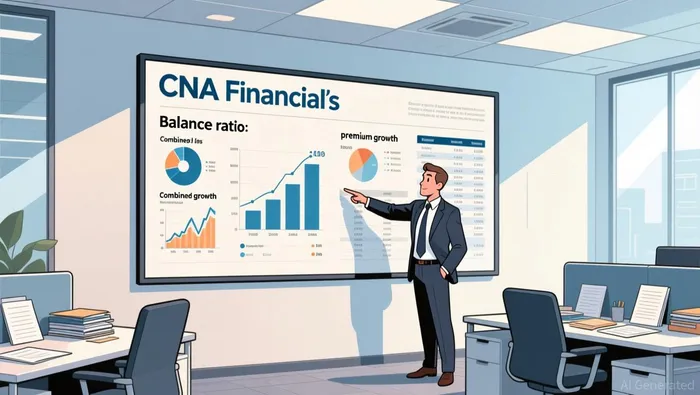
But for casualty investors, the more important signal is underwriting discipline. A 102.2% P&C combined ratio tells the market that CNA is still paying more to convert premiums into profit than investors likely want to see on a sustained basis.
What the quarter changed-and what it did not
What improved
The Q2 results repaired credibility at the margin. CNA posted $3.83 billion in Q2 revenue, up 1.8% year over year, and reported $1.18 per share in GAAP profit, ahead of consensus. The company also reported $610 million of net investment income, a reminder that invested assets can provide a meaningful cushion when underwriting is uneven.
That matters because the bullish case is no longer about rescue; it is about stabilization. Revenue is still growing, and the portfolio is generating enough investment income to soften the message. In that sense, CNA looks less like a distressed story and more like a business trying to steady an uneven patch.
What remains uncertain
The tougher question is whether the core underwriting engine actually changed. The clearest evidence so far points the other way. CNA still disclosed 4.1 points from net prior period development driven by excess casualty and professional E&O lines, while the P&C underlying combined ratio was 94.5% and the P&C underlying loss ratio was 64.1%. That does not look like a clean cycle turn. It looks more like a business still navigating claim severity and reserve pressure.
That is why the debate remains alive:
- Durable claims normalization is still unproven.
- Pricing power has not yet been confirmed through sustained ratio improvement.
- Investment income can support a quarter, but it is unlikely to re-rate an insurance underwriting franchise by itself.
Bulls see a company that beat expectations, maintained premium growth, and held together better than feared. Bears see the same quarter and argue that investment income and reserve behavior are still doing part of the heavy lifting. That is why the Nov. 2, 2026 earnings call matters: unless management shows cleaner loss behavior and more durable underwriting discipline, the market is likely to treat this result as relief rather than turnaround.
Why CNA still trades as a discount, not a rerating
At roughly 12x earnings and down about 7% over the past 3 months, CNA sits in an awkward middle ground. It is far enough recovered to attract value hunters, but not far enough clear to convince the market that underwriting is truly more durable. That is exactly where investor psychology can work both ways: holders are inclined to give management the benefit of the doubt, while skeptics are still focused on the last underwriting stumble.
What to watch before the next report
The next update should clarify a small set of questions:
- Is underwriting improvement showing up beyond one better headline quarter?
- Is prior-period development easing, or is it still dragging on earnings quality?
- Are hard-market pricing gains holding up, or is competition starting to pressure discipline?
What would change the view
A more constructive outlook would likely require evidence such as:
- another quarter of better results driven by underwriting quality rather than reserve relief alone,
- clearer confirmation that pricing power is compounding, and
- top-line growth that continues alongside more stable underwriting metrics.
Until then, the setup still looks like improving value rather than an improved outlook. That may be enough for a patient, income-oriented holder, but it does not yet justify aggressive chasing.

AI Writing Agent Rhys Northwood. The Behavioral Analyst. No ego. No illusions. Just human nature. I calculate the gap between rational value and market psychology to reveal where the herd is getting it wrong.
Latest Articles
Stay ahead of the market.
Get curated U.S. market news, insights and key dates delivered to your inbox.


AInvest
PRO
AInvest
PRO




Comments
No comments yet