
CME XRP Futures: A New Era of Institutional Confidence in Digital Assets


 Aime Summary
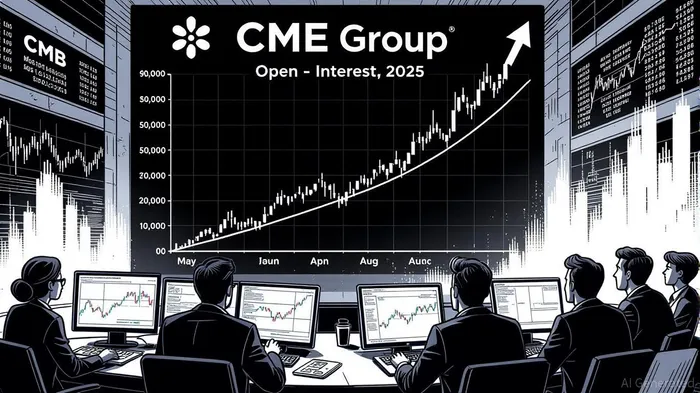
The cryptocurrency market has long been viewed as a volatile frontier, but recent developments in XRPXRPI-- derivatives suggest a maturation of institutional interest that could redefine how investors approach digital assets. At the heart of this shift is the launch of CME Group's XRP Futures in May 2025, a product that has rapidly become a cornerstone of institutional adoption. By August 2025, these futures had achieved $1 billion in open interest in just 98 days—the fastest growth of any CME crypto derivative—marking a pivotal moment in the legitimization of XRP as a regulated, utility-driven asset.
The catalyst for this surge was the Ripple-SEC settlement in May 2025, which reclassified XRP as a digital commodity under CFTC jurisdiction. This regulatory clarity removed long-standing uncertainties, aligning XRP with BitcoinBTC-- and EthereumETH-- in the institutional space. For the first time, investors could engage with XRP through a transparent, standardized framework, reducing counterparty risk and enhancing liquidity. The result? A flood of institutional capital into XRP futures, with cumulative notional volume reaching $9.02 billion across 251,000 contracts in just three months.
Institutional Adoption: Beyond Speculation
What sets XRP apart from other cryptocurrencies is its real-world utility. Unlike Bitcoin's role as a store of value or Ethereum's smart contract capabilities, XRP is deeply embedded in global financial infrastructure. Ripple's On-Demand Liquidity (ODL) service processed $1.3 trillion in cross-border payments in Q2 2025 alone, with major banks like SantanderSAN-- and SBI Holdings leveraging XRP to cut costs by up to 70% compared to traditional SWIFT systems. Meanwhile, the XRP Ledger (XRPL) hosts over $10 billion in total value locked (TVL), including tokenized treasuries and real-world assets. This utility-driven narrative has attracted institutional investors seeking exposure to assets with tangible economic value.
Whale activity further underscores this trend. Wallets holding 10 million to 1 billion XRP absorbed 340 million tokens in recent weeks, while $268 million in XRP was moved off centralized exchanges—a clear signal of long-term strategic positioning. Algorithmic traders and long-term holders are increasingly using XRP futures to hedge against volatility, with 7,533 contracts traded in a single day during August's market turbulence.
Derivatives as a Gateway to ETFs
The success of CME XRP Futures has also accelerated the path to a U.S. spot XRP ETF. Prediction markets assign an 87% probability of approval by year-end 2025, with Franklin Templeton expected to receive a decision in November. If approved, such ETFs could inject $5–$8 billion into the XRP market, replicating the capital inflows seen in Bitcoin and Ethereum's 2024 ETF launches. The Volatility Shares Trust XRP ETF (XRPI), launched in May 2025, already holds $165.7 million in assets under management, offering a regulated vehicle for institutional exposure.
For investors, this creates a compelling entry point. XRP futures provide a leveraged and liquid way to bet on the asset's price action while hedging against broader market risks. Meanwhile, the potential for a spot ETF offers a low-cost, diversified exposure to XRP's utility-driven growth. The micro-sized XRP futures (MXP) further democratize access, allowing retail and institutional investors to scale positions efficiently.
Strategic Implications for Portfolios
The institutional adoption of XRP derivatives signals a broader shift in how digital assets are perceived. No longer are they seen as speculative tokens; instead, they are increasingly integrated into mainstream financial infrastructure. For investors, this presents an opportunity to diversify portfolios with assets that combine regulatory clarity, real-world utility, and institutional-grade liquidity.
Consider the following:
1. Regulatory Tailwinds: The CFTC's oversight of XRP futures ensures a level of transparency and accountability absent in many crypto markets.
2. Utility-Driven Growth: XRP's role in cross-border payments and tokenized assets creates a recurring demand, unlike purely speculative assets.
3. ETF Catalyst: A spot XRP ETF could act as a liquidity multiplier, attracting a new wave of institutional and retail capital.
Conclusion: A Strategic Entry Point
The rapid adoption of CME XRP Futures is not just a market anomaly—it is a structural shift. Institutional investors are now treating XRP as a regulated commodity with tangible use cases, and the derivatives market is providing the tools to hedge, speculate, and scale exposure. For investors seeking to capitalize on this trend, the message is clear: XRP is no longer a niche asset. It is a strategic component of a diversified portfolio in an era where digital assets are increasingly intertwined with global finance.
As the market evolves, those who position themselves early—through futures, ETFs, or direct exposure to XRP's utility—stand to benefit from a new paradigm in crypto investing. The question is no longer whether XRP belongs in institutional portfolios, but how much of it they will hold.

Blending traditional trading wisdom with cutting-edge cryptocurrency insights.
Latest Articles
Stay ahead of the market.
Get curated U.S. market news, insights and key dates delivered to your inbox.
AInvest
PRO
AInvest
PRO



Comments
No comments yet