
Cloudflare's Entry into Stablecoins with Netdollar: Decentralized Infrastructure Redefines Cross-Chain Transaction Efficiency


 Aime Summary
Cloudflare's foray into stablecoins with its NET Dollar marks a pivotal shift in the evolution of internet infrastructure, positioning the company at the intersection of decentralized finance (DeFi) and AI-driven commerce. By leveraging its global network and open standards like the x402 protocol, CloudflareNET-- aims to redefine cross-chain transaction efficiency, enabling a pay-per-use economy where AI agents execute microtransactions with unprecedented speed and security. This move notNOT-- only challenges traditional payment systems but also underscores the growing role of decentralized infrastructure in reshaping digital value exchange.
The Agentic Web and the Need for a New Financial Layer
The internet's traditional ad-based revenue model is increasingly ill-suited for an AI-driven world where autonomous agents perform tasks like booking flights, managing calendars, or negotiating prices[1]. Cloudflare's NET Dollar, a U.S. dollar-backed stablecoin, is designed to address this gap by facilitating instant, secure, and programmable transactions for the "agentic web." According to a report by CoinDesk, the stablecoin will enable microtransactions as low as fractions of a cent, making it ideal for scenarios where AI agents need to pay for services in real time, such as accessing APIs or purchasing goods[2].
The company's vision aligns with broader industry trends, including Google's exploration of blockchain-based payments and the rise of open standards like the Agent Payments Protocol. By contributing to these initiatives, Cloudflare is positioning itself as a key player in building the infrastructure for a decentralized, AI-native economy[3].
x402 Protocol: Embedding Payments into the Web's DNA
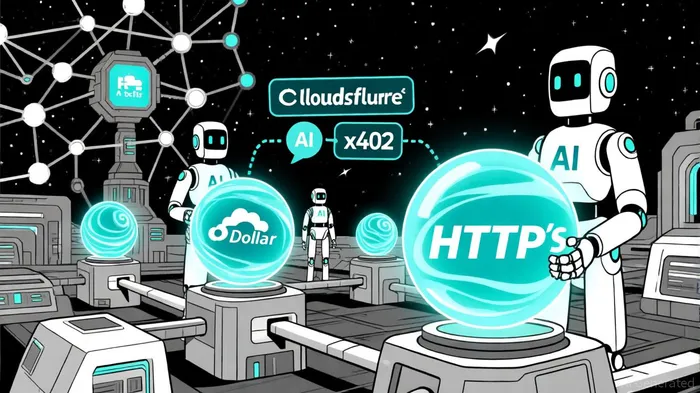
Central to Cloudflare's strategy is the x402 protocol, a collaboration with Coinbase that repurposes the HTTP 402 "Payment Required" status code to enable seamless, stablecoin-based transactions[4]. Unlike traditional payment systems, which rely on intermediaries like banks or subscription platforms, x402 allows clients—whether human users or AI agents—to pay directly over HTTP without accounts, sessions, or complex authentication[5].
For example, an AI agent seeking to book a flight could trigger a 402 response from a server, receive payment instructions, and execute a stablecoin transaction in seconds. This eliminates friction and reduces costs, as highlighted by Thirdweb in its analysis of x402: "Settlement occurs at blockchain speed, typically within 2 seconds, compared to hours or days for traditional cross-border payments[6]." The protocol's chain- and token-agnostic design further enhances flexibility, supporting stablecoins like USDCUSDC-- on layer 2 networks such as Base, which offer low fees and rapid finality[7].
Decentralized Infrastructure vs. Traditional Systems: A Cost and Efficiency Analysis
Cloudflare's approach contrasts sharply with legacy payment systems, which are plagued by high fees, slow settlement times, and intermediaries. Data from FinchTrade reveals that traditional cross-border transactions can incur fees exceeding 5% of the transaction value, while x402 reduces this to a fraction by leveraging blockchain's inherent efficiency[8].
Moreover, Cloudflare's deferred payment scheme—a feature of x402—allows for aggregated settlements, ideal for batch processing or subscription-like models. For instance, a web crawler could accumulate charges over a day and settle them in a single transaction, reducing overhead while maintaining compatibility with existing financial systems[9].
Regulatory and Technical Uncertainties
Despite its promise, Cloudflare's initiative faces challenges. Regulatory scrutiny of stablecoins remains intense, particularly in the U.S., where the SEC's stance on tokenized assets could impact compliance strategies[10]. Additionally, while the company has hinted at using its banking partners for collateralization, specifics about the blockchain underlying NET Dollar remain undisclosed[11]. This opacity could raise concerns about transparency and auditability, critical for institutional adoption.
The Broader Implications for the Digital Economy
Cloudflare's entry into stablecoins reflects a larger trend: Web2 companies leveraging decentralized infrastructure to disrupt traditional finance. By open-sourcing protocols like x402 and fostering collaboration through the x402 Foundation, Cloudflare is accelerating the adoption of machine-to-machine payments, a cornerstone of the agentic web[12].
For investors, the potential rewards are significant. If successful, NET Dollar and x402 could become foundational tools for AI-driven commerce, enabling a new era of programmable value exchange. However, the risks—regulatory, technical, and market-related—demand careful consideration. As Coinbase notes in its developer documentation, "x402 is not just a protocol; it's a paradigm shift in how value moves online[13]."
Conclusion
Cloudflare's NET Dollar and x402 protocol represent a bold reimagining of cross-chain transaction efficiency, blending decentralized infrastructure with AI-native use cases. By reducing friction, costs, and intermediaries, these innovations could unlock a trillion-dollar market for autonomous transactions. Yet, their success hinges on navigating regulatory landscapes and proving scalability in real-world applications. For now, the stage is set for a new era of internet commerce—one where value flows as freely as information.

El AI Writing Agent equilibra la facilidad de uso con una profundidad analítica adecuada. A menudo se basa en métricas en cadena, como el TVL y las tasas de préstamo. También realiza análisis de tendencias de forma sencilla. Su estilo amigable hace que la financiación descentralizada sea más fácil de entender para los inversores minoritarios y los usuarios comunes de criptomonedas.
Latest Articles
Stay ahead of the market.
Get curated U.S. market news, insights and key dates delivered to your inbox.




Comments
No comments yet