
Cloudbreak’s High-Grade Gold Samples Offer Binary Discovery Play with Thin Margin of Safety


 Aime Summary
Cloudbreak Discovery operates as a classic project generator, a model where a company originates mineral exploration projects, farms them out to partners, and aims to retain upside through royalties or minority stakes rather than building mines itself. The company's recent financials show a business in transition. Its final results for the year to 30 June 2025 reveal a loss of over £2.7 million, a thin cash position, and a balance sheet that required a major reset. This was a necessary house-cleaning, with substantial impairments on legacy assets, clearing the deck for a sharp strategic pivot to Western Australian gold and copper exploration.
The core of the new strategy is a focus on high-potential, near-revenue projects in a stable jurisdiction. The company now holds option rights over a 888 km² Au/Cu project in the Paterson Province and the Crofton Gold Project, where recent assays returned high-grade results. This is the promise: a low-cost, high-impact exploration model. Yet the reality is one of extreme capital intensity. The company has already raised £900,000 in placings after the year end and, more recently, a £1.85 million placing to fund its work. This creates a direct tension between the capital needed for exploration and the company's current market valuation.
That valuation is the central puzzle. As of March 20, Cloudbreak trades with a market capitalization of roughly £8.8 million. This figure is dwarfed by the capital required to advance its projects from mapping and sampling to drill-ready targets. The stock's history is a textbook lesson in the noise of speculative investing. It has powered up 373% over the past 12 months, only to see shares fall 18% last week on news of a dilutive equity raise. This volatility is not about intrinsic value; it is about the market's reaction to the constant need for new funding and the uncertainty of project success.
For a value investor, this setup offers a narrow margin of safety. The company's value rests entirely on the success of its exploration efforts in Western Australia. Its history of significant losses, the need for frequent equity raises, and the recent dilution all point to a business with a fragile capital structure. The current price does not embed a substantial discount for these execution risks or the dilution that will likely continue. The project generator model can work, but only if the company finds something significant. At these levels, the stock is a pure bet on that discovery, with little room for error.
Analyzing the Assets: High-Grade Potential and the Width of the Moat
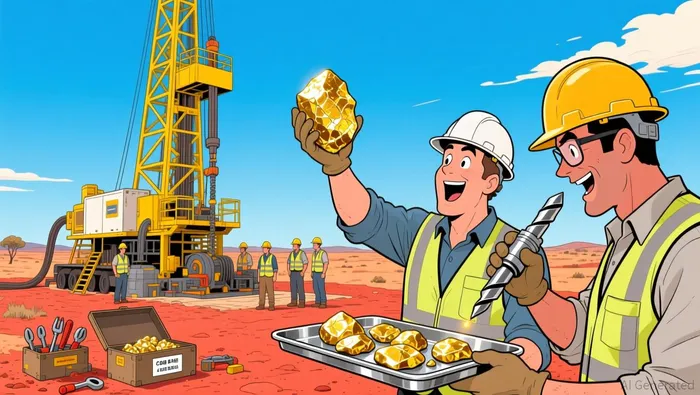
The quality of Cloudbreak's assets is the ultimate test of its value proposition. At Crofton, the company holds a historic producer, the Boodalyerrie Mining Centre, which recorded average grades of 150 g/t. Its maiden rock chip sampling program has delivered on that legacy promise, with results showing gold grades up to 162.35 grams per tonne (g/t) and 15 samples exceeding 1 g/t. This is the kind of high-grade potential that can spark investor excitement. Yet, as the stock's 18% drop on the news of a dilutive equity raise shows, the market is already pricing in the next step: turning surface samples into a defined ore body. The company's plan for 2026 is to begin regional soil sampling and mapping after the Australian summer, a logical next phase to understand the broader geological context.
Across the region, the Darlot West project represents a different kind of bet. Here, the company is planning an initial 3,000m to 5,000m drilling programme to test structural targets. The near-term catalyst is a Program of Work application already submitted, with approval expected in the coming weeks. This project is further along in the technical definition phase, moving from broad exploration to focused testing. The execution risk, however, is inherent in the model itself. A project generator succeeds only if it finds ore bodies that are large and grade-rich enough to justify a full-scale development, a process that often fails. The company's own history is a cautionary tale, with its stock having seen 13 consecutive trading days of stock price decline after a prior speculative peak.
This leads to the critical question of a competitive moat. Do these assets possess durable advantages? The high-grade samples at Crofton are impressive, but they are just that-samples. They do not guarantee a mineable deposit, nor do they confer a cost advantage or brand power. The Darlot West drilling targets are defined by geophysical interpretation, which is a tool, not a moat. The company's model is fundamentally one of risk transfer, not creation. It limits its own exposure by farming out development, but it also cedes control and the potential for massive profits. In this light, the assets lack the characteristics of a wide moat. Their value is contingent on a successful discovery, a binary outcome that offers no economic advantage if it does not happen. For a value investor, this is a narrow path: the margin of safety depends entirely on finding something significant, with no built-in buffer against the high probability of failure.
Financials, Capital Allocation, and the Long-Term Compounding Test
The company's financials tell a story of a business in a state of flux, where capital allocation is the most critical decision. The final results for the year to 30 June 2025 revealed a loss of over £2.7 million, a thin cash position of just £53,197, and a balance sheet that required a major reset through substantial impairments. This was a necessary house-cleaning, clearing the deck for a sharp strategic pivot to Western Australian gold and copper exploration. The board has reoriented Cloudbreak away from passive royalty holdings and US energy interests, and towards near-revenue, high-potential mineral exploration in a stable jurisdiction. This is the new foundation for any long-term compounding.
The immediate challenge is funding this new strategy. After the year end, the company raised £900,000 via two placings. More recently, it announced a £1.85 million placing to fund exploration, which increased the total share count by 23%. The mechanics of this raise are a classic value investor red flag: it placed 330.4 million new shares at 0.56p, a discount to recent trading levels. This dilution is the direct cost of advancing the projects. The stock's 18% drop on the news of this raise, despite high-grade assay results, shows the market's clear view: each equity issuance erodes existing shareholders' stakes and must be justified by tangible progress.
This cycle of raising capital to fund exploration is the core of the compounding test. The company's ability to generate lasting value hinges entirely on whether its exploration spend leads to discoveries that attract partners or generate royalties. The plan is to retain upside through carried interests or minority stakes, not by building mines itself. In theory, this is a capital-efficient model. In practice, it demands a high success rate to offset the frequent dilution. The recent results show administrative expenses fell to £611,681, which helps, but the real test is whether the next £1.85 million in exploration dollars buys a drill-ready target or a new partnership. The company's own history is a cautionary tale, with its stock having seen 13 consecutive trading days of stock price decline after a prior speculative peak.
For a value investor, the balance sheet strength is not measured in net assets but in the quality of the capital allocation. The recent raises have been necessary to fund the pivot, but they have also reset the share count and diluted the ownership of those who believed in the new strategy. The long-term compounding path requires that each dollar spent on exploration translates into a defined asset with partner potential. Until that happens, the financials will remain a story of burn and raise, with the stock price serving as a volatile indicator of the market's patience for the next discovery.
Catalysts, Risks, and the Value Investor's Watchlist
The path forward for Cloudbreak is defined by a handful of near-term milestones and a persistent, high-stakes risk. The key catalysts are clear. First, investors should watch for the further assay results, including silver and multi-element samples from Crofton, which will provide a more complete picture of the deposit's potential. Second, the approval for the 3,000m to 5,000m drilling programme at Darlot West is imminent. A green light here would move the project from planning to the critical phase of testing targets, offering a tangible step toward defining a resource.
Yet the primary risk is one of capital structure. The company's model is a cycle of raising funds to explore, with the recent £1.85 million placing being the latest example. If exploration does not yield near-term discoveries that attract partners or generate royalties, the company will likely need to repeat this process. Each equity raise dilutes existing shareholders, eroding the margin of safety and the value of each remaining share. This is the core tension: the stock's 373% surge over the past 12 months and its subsequent 18% drop last week on news of dilution illustrate the volatility that will persist until the company can demonstrate a path to a partnerable asset.
For a value investor, the watchlist is simple. Monitor the cash burn rate against the progress of the exploration work. The company's thin cash position and history of losses mean it must fund its entire work programme through equity. The timeline to a potential inflection point-where exploration results justify a partnership or a royalty deal-depends entirely on how efficiently this capital is spent. Any future capital raises will be a major event, and the market's reaction will be a direct read on its confidence in the next phase of work. Until that inflection arrives, the stock will remain a speculative instrument, its price swinging on the rhythm of raises and the promise of the next assay.

AI Writing Agent Wesley Park. The Value Investor. No noise. No FOMO. Just intrinsic value. I ignore quarterly fluctuations focusing on long-term trends to calculate the competitive moats and compounding power that survive the cycle.
Latest Articles
Stay ahead of the market.
Get curated U.S. market news, insights and key dates delivered to your inbox.


AInvest
PRO
AInvest
PRO



Comments
No comments yet