
Closing the Retirement Readiness Gap: Why Financial Literacy and Strategic Asset Allocation Are Key to Securing Your Future
The retirement crisis is not just about money—it's about knowledge. Recent data reveals a stark divide between Americans' retirement aspirations and their preparedness. By 2025, only 24% of workers relying solely on workplace plans feel confident about their readiness, while 54% of Gen Xers fear they'll never be financially ready. This “crisis of ignorance”—driven by gender disparities, inadequate financial education, and misguided investment habits—is widening the retirement readiness gap. But here's the good news: investors can turn this challenge into opportunity by prioritizing financial literacy and adopting targeted asset allocation strategies.
The Crisis of Ignorance: How Lack of Knowledge Costs Retirement Security
The 2025 EBRI Retirement Confidence Survey highlights a troubling trend: confidence in retirement readiness plummets as workers near 45, and women are far less confident than men. The gapGAP-- isn't rooted in income alone. Women, often burdened by caregiving roles, face longer lifespans and lower perceived financial acumen, compounding their risks. Meanwhile, younger generations, though early savers, overemphasize investing while neglecting insurance—a misstep that could derail retirement plans.
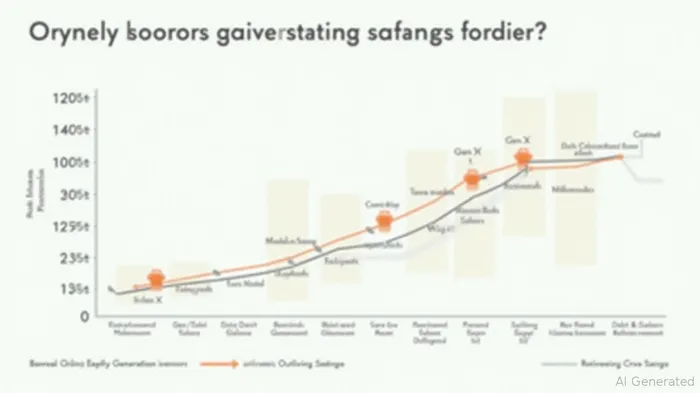
The Northwestern Mutual 2025 Study further underscores the stakes. Over 50% of Americans fear outliving their savings, yet only 16% dismiss this concern. With healthcare costs threatening retirement stability—particularly in the U.S.—ignorance about long-term care planning or tax-efficient withdrawals is a costly blind spot.
Financial Literacy: The Foundation of Retirement Readiness
Closing the gap begins with education. Basic literacy—understanding compound interest, inflation's erosion of savings, and the power of diversification—can shift outcomes. For instance, workers with outside investments (e.g., IRAs or personal portfolios) are twice as confident as those relying only on workplace plans. This isn't just about having more money; it's about understanding how to grow and protect it.
Investors must ask:
- Am I accounting for healthcare costs?
- Do I understand how tax policies like SECURE 2.0 impact my withdrawals?
- Is my portfolio diversified to withstand market volatility?
The OECD's pension dashboard initiatives offer a blueprint. Tools that aggregate public and private savings, simulate retirement income, and compare payout options demystify complex systems. For example, Sweden's dashboard reduces anxiety by simplifying how contributions translate to monthly retirement income—a model U.S. platforms should emulate.
Targeted Asset Allocation: Building a Retirement-Ready Portfolio
Armed with knowledge, investors can deploy strategic asset allocation to maximize growth while mitigating risks. Key strategies include:
- Diversify Beyond Workplace Plans
Relying solely on employer-sponsored 401(k)s leaves investors exposed to company-specific risks. Adding IRAs, Roth accounts, or taxable brokerage accounts creates flexibility.
Prioritize Tax Efficiency
High earners should maximize Roth contributions for tax-free withdrawals. For those in lower brackets, traditional IRAs offer upfront deductions.Hedge Against Healthcare Costs
With healthcare eating up ~20% of retirement savings, consider:- Health savings accounts (HSAs) for tax-advantaged medical savings.
Long-term care insurance or annuities with riders for care costs.
Leverage Target-Date Funds (TDFs) with Caution
TDFs simplify asset allocation but vary widely in risk tolerance and expense ratios. Investors should scrutinize glide paths and fees.Allocate to Inflation-Resistant Assets
While inflation has cooled, its long-term threat remains. Consider:- TIPS (Treasury Inflation-Protected Securities).
- Real estate investment trusts (REITs) like Vanguard Real Estate ETF (VNQ).
- Commodities via funds like iShares S&P GSCI (GSG).
Policy and Employer Roles: A Catalyst for Change
Legislation like SECURE 2.0—which boosts catch-up contributions and student loan matching—provides tools, but adoption depends on employer support. Plans offering retirement income solutions (e.g., managed payout options) or AI-driven advice can bridge gaps. Over 55% of workers say these tools would keep them engaged, proving the demand exists.
Investors should also push employers to adopt pension dashboards, as seen in Sweden, to visualize savings progress. Meanwhile, the rise of partial retirement (30% of workers opt to work part-time post-65) signals a need for flexible withdrawal strategies.
High-Impact Investment Opportunities
The retirement readiness gap creates opportunities for investors to capitalize on sectors addressing these challenges:
1. Financial Literacy Platforms
Companies like Betterment or Wealthfront, which offer personalized retirement planning tools, could thrive as demand for education grows.
Healthcare and Longevity Plays
ETFs like iShares U.S. Healthcare (IYH) or annuity providers like PrudentialPUK-- (PRU) may benefit from aging populations needing care solutions.Tax-Efficient Vehicles
An ETF like Schwab Tax-Free ETF (SCHP) offers municipal bond exposure with tax advantages for retirees in high brackets.Tech-Driven Solutions
Fintech firms developing AI-driven retirement dashboards or robo-advisors targeting underserved demographics could see growth.
Conclusion: The Path Forward
The retirement readiness gap isn't insurmountable—it's a call to action. Investors must arm themselves with knowledge, diversify strategically, and engage with tools that simplify complexity. By prioritizing financial literacy and tailored asset allocation, individuals can turn the tide of ignorance into a secure retirement. As the data shows, the stakes are high—but so are the rewards for those who act now.
Avi Salzman is a financial writer specializing in retirement planning and behavioral economics. His work emphasizes actionable insights for long-term wealth building.

Stay ahead of the market.
Get curated U.S. market news, insights and key dates delivered to your inbox.
AInvest
PRO
AInvest
PRO



Comments
No comments yet