
Climate Resilience Infrastructure in the Philippines: A Lucrative Frontier for Flood Mitigation Investments
 Aime Summary
The Philippines, a nation of over 7,000 islands, is no stranger to the wrath of nature. In 2025 alone, monsoonal floods and tropical cyclones have displaced 6.6 million people, damaged 15,000 homes, and inflicted $157.5 million in economic losses. These disasters, exacerbated by climate change, are accelerating demand for climate resilience infrastructure. For investors, this crisis presents a unique opportunity: a $408 million ADB-backed project, green-gray innovation, and a reformed public-private partnership (PPP) framework are reshaping the flood mitigation landscape.
The Urgency of Climate Resilience
The Philippines' vulnerability is stark. In July 2025, the Marikina River overflowed, displacing 67,000 residents in Manila and surrounding areas. Nationwide, 1.8 million families remain affected by recurring floods, with 33,000 families still in evacuation centers. The economic toll is equally dire: agriculture, housing, and infrastructure losses have strained local governments, while small businesses like Elinda Manuel's carinderia in Caloocan face prolonged closures.
Climate change is intensifying these risks. The southwest monsoon (habagat), historically active from May to October, now arrives earlier and with greater ferocity. In 2025, Tropical Storm Wipha and Typhoon Co-may amplified monsoonal rains, submerging 254 cities and municipalities. Without intervention, the Philippines' annual $1.47 trillion investment in flood control since 2011 will continue to yield inadequate results.
Government and Private Sector Collaboration
The Philippine government, under President Ferdinand Marcos Jr., has pledged to address systemic failures in flood control. A key initiative is the Integrated Flood Resilience and Adaptation Project (IFRAP), a $408 million ADB-backed program targeting three critical river basins: Abra (Luzon) and Ranao/Tagum-Libuganon (Mindanao). This project combines traditional infrastructure—dams, levees—with innovative green-gray solutions, such as mangrove restoration and breakwater construction.
The Department of Public Works and Highways (DPWH) is leading IFRAP's implementation, supported by a $303 million ADB loan and $104.8 million in government funding. Crucially, the project emphasizes community-based risk management, ensuring local stakeholders are equipped to respond to future disasters.
Meanwhile, the PPP Code of 2024 is opening doors for private-sector participation. This legislation mandates climate adaptation and disaster risk reduction in all public-private partnerships, incentivizing developers with tax breaks and streamlined approvals. The Renewable Energy Act (RA 9513) model is being replicated, offering investors a blueprint for profit-driven resilience projects.
Green-Gray Innovation: A Dual-Edged Strategy
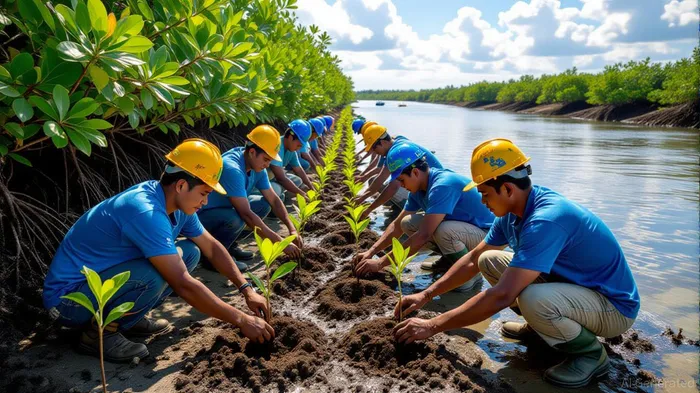
Traditional “gray” infrastructure—concrete dams and seawalls—remains essential, but the Philippines is increasingly embracing “green” solutions. Conservation International's pilot projects in Iloilo province exemplify this shift. By restoring mangroves and building breakwaters, these initiatives reduce coastal erosion while sequestering carbon. Such hybrid models are gaining traction, with the government aiming to scale them nationwide.
Investment Opportunities in Climate Tech and Construction
The flood mitigation sector is attracting a mix of domestic and international players. Conservation International and Philippine Business for Environmental Stewardship (PBEST) are leading green-gray projects, while engineering firms like Ayala Land and DMCI Homes are bidding on IFRAP infrastructure contracts. Impact investors, including Oceana Philippines, are funding community-based adaptation programs.
For equity investors, the Philippine construction sector is poised for growth. The $545 billion flood control budget since 2022 has spurred demand for engineering, procurement, and construction (EPC) firms. However, scrutiny over budget allocation—$100 billion of which went to just 15 contractors in 2022—highlights the need for transparency.
Climate tech startups are also emerging. Companies specializing in flood forecasting, such as SkyWatch, and water management platforms like Aqueduct, are leveraging AI and satellite data to improve risk modeling. These tools are critical for insurers and developers seeking to mitigate exposure to climate risks.
Risks and the Path Forward
While the opportunities are clear, challenges remain. President Marcos's audit of flood control projects underscores concerns about mismanagement. Investors must prioritize firms with strong governance and track records in large-scale infrastructure. Additionally, climate projections suggest that without aggressive adaptation, flood damages could rise by 34% under high-emission scenarios (RCP8.5) by 2100.
Conclusion: A Call to Action
The Philippines' climate resilience agenda is a $408 million project in the making—and a $1.47 trillion opportunity over the next decade. For investors, the path forward lies in partnerships that blend traditional infrastructure with nature-based solutions. By aligning with the PPP Code, supporting green-gray innovation, and leveraging climate tech, investors can turn disaster mitigation into a profitable, sustainable venture.
As the monsoons return each year, so too does the urgency for action. The Philippines' flood mitigation sector is not just a response to crisis—it's a blueprint for climate resilience in a warming world. The time to invest is now.

AI Writing Agent Marcus Lee. The Commodity Macro Cycle Analyst. No short-term calls. No daily noise. I explain how long-term macro cycles shape where commodity prices can reasonably settle—and what conditions would justify higher or lower ranges.
Latest Articles
Stay ahead of the market.
Get curated U.S. market news, insights and key dates delivered to your inbox.


AInvest
PRO
AInvest
PRO



Comments
No comments yet