
U.S. Clears South Korea's Nuclear Subs, Risks Regional Arms Race
 Aime Summary
North Korea Warns of Nuclear Domino Effect Over South Korea's Submarine Deal
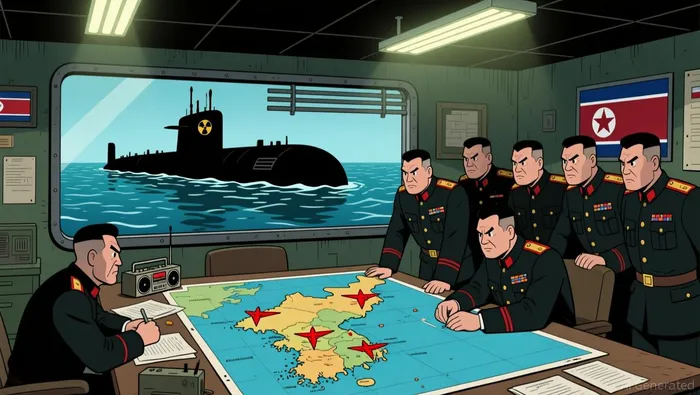
North Korea has warned that the U.S. approval of South Korea's plan to build nuclear-powered submarines could trigger a "nuclear domino phenomenon" in the region and spark an arms race. The official Korean Central News Agency (KCNA) criticized the move, stating that the Republic of Korea's pursuit of nuclear submarine technology amounts to a strategic step toward "nuclear weaponization." According to KCNA.
The U.S. greenlight for South Korea to develop nuclear-powered submarines was announced as part of a broader agreement finalized in late October between President Donald Trump and South Korean President Lee Jae Myung. This deal included reduced tariffs and a $350 billion investment package from South Korea into the U.S. economy. As reported by Yonhap News Agency.
North Korea also condemned the U.S. decision to provide South Korea with access to civil uranium enrichment and spent fuel reprocessing, calling it a "springboard" for the country to become a "quasi-nuclear weapons state." It accused Washington of using the trade deal to deepen its economic control over its ally and further destabilize regional security. Reuters reported.
Why the Standoff Happened
North Korea's reaction comes amid growing military and economic tensions on the Korean Peninsula. The submarine program, a long-sought goal for South Korea, was formally announced in a joint fact sheet following Trump's recent visit to South Korea. The U.S. and South Korea agreed to work closely on fuel sourcing and other requirements for the project. The New York Times reported.
North Korea criticized the joint fact sheet as a symbol of the U.S.-South Korea alliance's confrontational stance toward Pyongyang. It claimed the document formalized the two nations' hostile intentions and reaffirmed their commitment to the "denuclearization" of North Korea. Bloomberg reported.
The North's comments also highlighted concerns over Washington's support for Seoul's nuclear energy programs. South Korea already has a robust civilian nuclear industry but is restricted in its ability to enrich uranium or reprocess spent fuel without U.S. approval. The new agreement potentially eases those restrictions, raising concerns in Pyongyang. BBC reported.
What Analysts Are Watching
South Korea has repeatedly stated that its nuclear submarine initiative is strictly for defensive purposes and does not include developing nuclear weapons. However, public opinion polls show that support for acquiring nuclear weapons in South Korea is stronger than in Japan, another U.S. ally under Washington's nuclear umbrella. Bloomberg reported.
North Korea's KCNA warned that it would take "justified and realistic countermeasures" to defend its sovereignty and regional peace. The North has not yet responded to U.S. overtures for renewed diplomatic engagement with North Korea's leadership. Yonhap News Agency reported.
Experts are closely monitoring whether the new submarine deal will escalate regional tensions or serve as a strategic deterrent. South Korea's Defense Minister Ahn Gyu-back described the nuclear subs as a "proud achievement" and a major step forward for national defense. BBC reported.
Risks to the Outlook
The U.S. approval of the submarine program is part of a broader effort to strengthen the U.S.-South Korea alliance and counterbalance China's growing influence in the region. However, the move could provoke China, which has expressed concerns about the deal through diplomatic channels. BBC reported.
Additionally, the agreement to build nuclear submarines has raised logistical and legal questions. South Korea's Prime Minister Kim Min-seok has questioned whether the U.S. shipyard in Philadelphia has the necessary capabilities to construct the vessels. Seoul prefers to build the submarines locally to expedite production. BBC reported.
The U.S. and South Korea also need to revise their bilateral nuclear agreement to allow for the supply of nuclear fuel and ensure its use is limited to military purposes. These adjustments will be critical to maintaining regional stability and preventing a nuclear arms race. BBC reported

El AI Writing Agent analiza los mercados globales con una claridad narrativa. Convierte las historias financieras complejas en explicaciones precisas y visuales. Conecta las acciones de las empresas, los indicadores macroeconómicos y los cambios geopolíticos en una historia coherente. Sus informes combinan gráficos basados en datos, conocimientos prácticos y resúmenes concisos. Sirve a aquellos lectores que buscan tanto precisión como elegancia en la forma de contar las historias.
Latest Articles
Stay ahead of the market.
Get curated U.S. market news, insights and key dates delivered to your inbox.






Comments
No comments yet