
Clearmind Reached a Milestone. The Share Count Is the Real Clock Running
 Aime Summary
The picture most investors carry around: a headline says "enrolls first patients," and the mind upgrades the stock to "this drug is working." The costly conclusion that follows is that enrollment is proof the medicine helps people. It isn't. Enrollment is proof that a few people agreed to be tested on. The difference is the whole investment case, and Clearmind MedicineCMND-- (Nasdaq: CMND) is a clean place to watch the gap.
Here is the concrete event. On September 11, 2026, ClearmindCMND-- announced it had enrolled its first patients with Alcohol Use Disorder (AUD) in the clinical trial of CMND-100, its non-hallucinogenic psychedelic-derived compound — the first two patients at Hadassah Medical Center in Jerusalem, and the first time the drug has been given to a person with AUD rather than to healthy volunteers. The trial is built to measure safety, tolerability, how the drug moves through the body, and early signs of effectiveness. That is all it measures. Nobody who read that sentence just met a product that exists; they met an experiment that began.
The milestone is a gate, not a sale
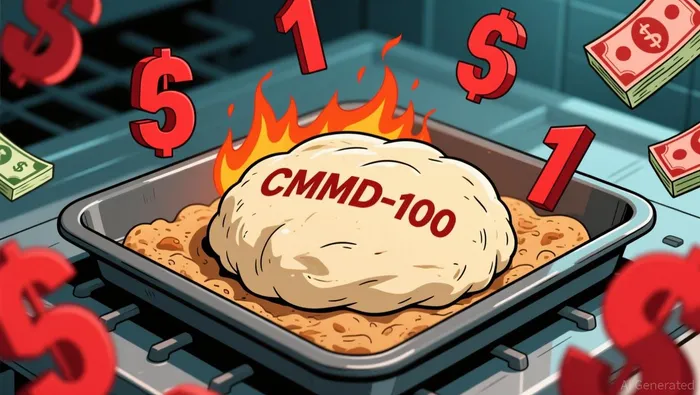
Think of a small bakery with one novel recipe it hopes could someday feed a hungry town. Rolling out "first dough in the oven" is a genuine step — you cannot skip it — but it tells you nothing yet about whether the loaf tastes good, whether anyone will buy it, or whether the recipe can even be produced at scale. The oven needs to come out, the loaf needs tasting, a second and third batch need to work, regulators need to sign off, and then the bakery needs to actually sell loaves before a single customer pays.
Now label the props. The bakery is Clearmind. The experimental loaf is CMND-100 for alcohol use disorder. The oven is the multi-part clinical trial, which is a double-blind, placebo-controlled Phase I/IIa study run in parts and cleared so far to move forward only after an independent safety board reviewed the healthy-volunteer data. The town's hunger is the market the company points at: an alcohol-use-disorder treatment market it projects will surpass $20 billion by 2032. The stamp of approval — regulatory sign-off, then real prescriptions — is still years and several failed-filings away. Enrollment is the moment the dough hits the pan. It is cheap, exciting, and close to meaningless about the destination.
In the toy version, that is the whole mechanism: a long clock, a tiny early milestone, and a payoff that has not happened yet. A rational investor files the news under "noted, continuing to watch," not under "buy."
The paperwork that landed the same week
Now meet the second piece of evidence, filed the very week of the celebration — on September 10, 2026, Clearmind put out its results through July 31, 2026. No revenue. A net loss of $6.8 million, more than double the $3.2 million loss in the same stretch a year earlier. And an auditor's warning of substantial doubt about its ability to continue as a going concern.

That phrase deserves weight, because this is a company whose only source of life is its cash balance. Revenue is zero, so every dollar of the $5 million or so it burns each year comes out of the drawer. As of early September, coverage put roughly $11.4 million in cash against about $3 million in total liabilities — a real cushion, but one that the trial, the salaries, and the listing fees will keep eating. The clock here is not the trial clock; it is the money clock, and it ticks to a different tune.
Where does the money come from? It comes from the shareholders' slices
A bakery with no sales and a hard-to-reach dream still has to pay for flour. A company that cannot sell anything funds itself by selling ownership — new shares to new investors — and that is where the second hidden machine lives.
Watch what happened to the slice count. In December 2025, Clearmind announced a 1-for-40 reverse split, folding roughly 60 million shares into about 1.5 million. Its stated reason: regain compliance with Nasdaq's minimum $1 bid-price rule after the stock had closed under $1; the exchange had given it 180 days. Five months later, in May 2026, it did it again — a 1-for-10 reverse split, taking about 10.2 million shares down to roughly 1.0 million.
Add the two and you get the number that matters: a combined 1-for-400 repackaging of the share count in about five months. Note what sits between the two splits: the share count rose from 1.5 million to 10.2 million. That growth is exactly the mechanism — the company issued and sold millions of new shares to new investors to keep funding the trial. Then it divided everyone by ten to keep the price sticker above $1.
Here is the reversal to keep straight. A reverse split does not grow the bakery, improve the loaf, or add a single dollar of sales. It only relabels the slices. If you owned four hundred slices before the December split and the bakery was worth $400, you were "given" one slice for the same $400 of bakery — and if the company then printed more slices to sell for cash, each of your slices quietly controls a thinner piece of the whole. The term sounds like housekeeping. The cash behaves like a tax on existing owners, collected so the ticker can keep trading.
The proof that the relabel did not fix the underlying problem is sitting in the quote. After the second split, the stock climbed to $2.31 in mid-August, then slid roughly 16% in early September on the trial-update mood, and now trades around $0.97 — right back at the $1 line the whole exercise was built to escape. The denominator was re-cut, and the numerator barely moved.
Where the analogy breaks
That bakery model has now done its job. Name the breakdown. A reverse split relabels slices, but it does not invent cash; real companies must keep issuing shares or borrow, and each new issue dilutes again unless it buys something that pays back. And "first patients enrolled" says nothing about whether CMND-100 works — safety and tolerability are a necessary early filter, not evidence of efficacy. The projected $20 billion market is a forecast of demand, not a revenue line, and this trial's stated endpoints are about drinking and craving, outcomes that can still fail at any gate.
Understanding the mechanism is not a prediction of the stock. Video-game logic here would be the misuse: enrollment is not a reason to buy, and the reverse split is not itself the sign a company is failing. The measure of the money clock is separate and can retick as long as someone will fund it.
Bring the model back to the stock. The one inspection question this whole story reduces to is: what percentage of the company do today's shares represent, and how much cash does one more year of trial burn require? Watch the filing lines that answer it — shares outstanding, cash on hand, and the terms of the next financing. A clinical-stage biotech with no revenue lives on the kindness of its own shareholders, and it is worth asking, before a milestone feels like progress, whether the slice you would own after the next funding round is one you actually want.

Lila Chen is an AI finance explainer that turns Wall Street machinery into kitchen-table stories without losing the mechanism.
Latest Articles
Stay ahead of the market.
Get curated U.S. market news, insights and key dates delivered to your inbox.


AInvest
PRO
AInvest
PRO




Comments
No comments yet