
CleanSpark's Q4 2025: Contradictions Emerge on Strategic Priorities, Bitcoin Monetization, and HPC Expansion Strategies
 Aime Summary
Date of Call: None provided
Financials Results
- Revenue: $766.3M, up >100% YOY; Q4 revenue +$25M (+13%) vs Q3
- Gross Margin: 55%, down 1% YOY; Q4 gross margin 56.5%, +2 pts vs Q3
Guidance:
- Deploy 19,000 S21 XP immersion units beginning this quarter, expected complete by calendar Q1 2026.
- Energization schedule for Texas site: ~200+ MW H1 2027 with additional 40 MW tranches in 2028–2029; site fully ERCOT approved and expandable.
- Prioritize securing tenants for Sandersville and Houston and transition projects from commercialization to commissioning.
- Expect higher professional fees, payroll, and G&A while executing AI/data-center strategy.
- Continue monetizing BitcoinBTC-- treasury via DAM strategies (Spot Plus, Yield, cash-secured puts) as non-dilutive capital.
Business Commentary:
- Record Revenue and Margin Performance:
- CleanSpark reported record
revenuesof$766 millionfor the fiscal year 2025, with agross marginof55%. The growth was driven by increased exahash capacity and favorable mining economics during the quarter, despite the first full year post-halving.
Expansion into AI Data Centers:
- CleanSpark secured a
285-megawattsite in Texas with the explicit intent of building an AI factory. 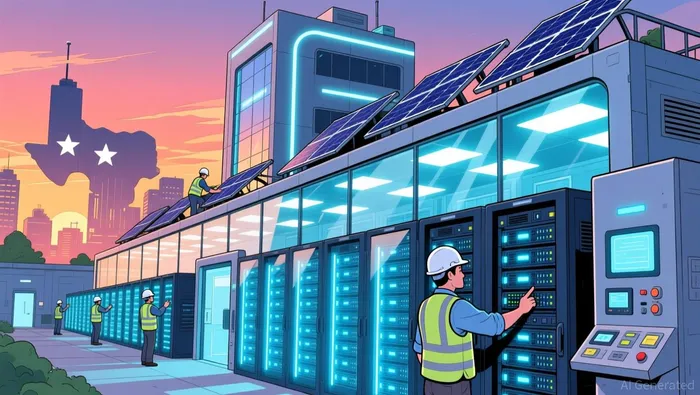
The expansion is part of the company's strategic direction to leverage its infrastructure capabilities and expertise in securing power to develop AI-focused campuses.
Digital Asset Management and Cash Generation:
- CleanSpark's Digital Asset Management (DAM) strategy generated
$9.3 millionin premiums during the fourth quarter. This approach, using covered calls, enhanced cash generation by optimizing for the company's monthly Bitcoin production and mitigating risks associated with market volatility.
Strategic Investment in Power and Land:
- CleanSpark announced a
$1.15 billionconvertible note issuance, with a significant portion used for power and land acquisitions. - The investment aligns with the company's long-term strategy of securing strategic locations to support both Bitcoin mining and AI data center growth.
Sentiment Analysis:
Overall Tone: Positive
- CEO highlighted 'record revenues of $766 million' and 'escape velocity, reaching 50 exahash.' CFO: 'revenue grew more than 100% year over year' and adjusted EBITDA > $800M; management emphasized strategic $1.15B financing, $460M buyback, and a multi-gigawatt land/power pipeline to support AI and mining growth.
Q&A:
- Question from Bryan Dobson (Clear Street): Could you give color on conversations with potential HPC/AI clients and outlook for demand over the next two years, and do you expect to pair Bitcoin mining with HPC campuses or keep them separate?
Response: Strong commercial interest—particularly for Sandersville and Sealy—with management pursuing a dual-pronged approach: many sites to serve both HPC (interruptible critical IT) and Bitcoin mining to provide utility-flexible power services.
- Question from Mike Colonnese (H.C. Wainwright): What key development milestones should investors watch for in 2026 on the HPC strategy and near-term Bitcoin expansion plans?
Response: Near-term milestones: secure tenants and commercial plans for Sandersville and Sealy, scale modular MEP via the Submer MoU to accelerate deployments; mining: bring 6 EH of S21 XP immersion online by calendar Q1 2026 and pursue disciplined fleet upgrades thereafter.
- Question from Paul Golding (McGuire Capital): With ~13,000 BTC and recent financing, how should we think about building the powered land bank vs growing mining fleet, and what is the economic impact of the Submer MoU?
Response: Bitcoin treasury is a strategic, non-ideological capital asset to be monetized (DAM, borrowing) for acquisitions; Submer partnership provides factory-built MEP reference architectures that should cut field build cost/time (management cited ~10–15% savings) and speed AI deployments.
- Question from Greg Lewis (BTIG): Can you outline the Texas facility energization steps and expansion potential—are there phases and room to grow with customers?
Response: Texas 285 MW site is phased—first ~200+ MW H1 2027, plus 40 MW tranches in 2028–29—fully ERCOT approved with long-lead items in place and ample adjacent land and behind-the-meter gas options for future expansion.
- Question from John Tudaro (Needham and Company): Is Sandersville subject to forced curtailment and how will you allocate megawatts between HPC and mining; are hyperscalers/bankable tenants becoming more central to financing?
Response: Sandersville is not subject to forced curtailment and is highly applicable to AI; management will prioritize high-credit tenants and finance projects via a mix of secured debt (targeting ~80–85% LTV over time) and selective equity as needed.
- Question from Reggie Smith (JPMorgan): What CapEx is needed to upgrade Sandersville for HPC, will it be used for training vs inference, and how quickly can you sign leases?
Response: Sandersville requires parallel new IT construction on adjacent land (not a simple conversion); demand for multiple ~190–200MW IT loads is urgent and management expects lease execution timelines materially faster than prior industry norms thanks to modular MEP and market urgency.
- Question from Brett Knoblauch (Cantor Fitzgerald): How expensive/hard is it to acquire turnkey energized land/power like the new Texas site and how prevalent are such opportunities?
Response: Acquisition cost was market-competitive (management declined to disclose price); advantage stems from speed to energize and ability to monetize megawatts immediately via mining, enabling rapid campus build and competitive positioning.
- Question from Jim Missouri (Chardon Capital): Is Sandersville the only existing mining site identified for critical IT or the first of multiple conversions?
Response: Sandersville is the first low-hanging fruit; Metro Atlanta (College Park, Norcross) and Tennessee sites are high-priority candidates; miners/equipment can be redeployed to other sites rather than mothballed during conversions.
- Question from John Hickman (Ladenberg): Why are other operators taking so long to sign AI leases when demand exists?
Response: Leases require purpose-built sites matched to specific chip/reference architectures; that specificity slows signings—however, current market urgency and modular factory-built MEP are shortening timelines versus a year ago.
- Question from Nick Giles (B. Riley Securities): Can you break down the multi-gigawatt pipeline—how much is late-stage and which markets are most active?
Response: Pipeline is dynamic and opportunistic; prime expansion markets include Georgia, Tennessee, Wyoming, and Texas—off-market opportunities arise via deep utility/infrastructure relationships, causing some projects to leapfrog prior expectations.
Contradiction Point 1
Strategic Focus on Bitcoin Mining and HPC/AI
It reflects a shift in the company's strategic focus between quarters, which can impact investor expectations and resource allocation.
What are the key milestones for the HPC strategy in 2026? - Mike Colonnese(H.C. Wainwright & Co, LLC)
2025Q4: We are highly focused on deployments at Texas and Sandersville sites. The MoU with Submer is significant as it brings modular immersion-cooled solutions that enhance speed to market. We are preparing for commercialization and commissioning efforts. - Matt Schultz(CEO)
What is your outlook on the current M&A landscape and potential deal appetite? - Michael Anthony Colonnese(H.C. Wainwright & Co, LLC)
2025Q3: We see a robust pipeline in the private space and potential opportunities as miners move away from mining to HPC. We're ready to be the first call for acquiring assets. The environment is ripe for great opportunities. - Zachary K. Bradford(CEO)
Contradiction Point 2
Approach to Bitcoin Stack Monetization
It involves changes in the company's approach to leveraging its Bitcoin stack for financial activities, which impacts financial strategy and risk management.
How should we assess the strategy for building the powered land bank considering Bitcoin holdings and recent financing? - Paul Golding(McGuire Capital)
2025Q4: We'll continue monetizing the Bitcoin stack through yield strategies and using it as a capital asset. We'll leverage it opportunistically for acquisitions. If necessary, we can part with the Bitcoin balance, considering the punitive tax treatment, but we see it as non-dilutive capital. - Matt Schultz(CEO)
How does the Bitcoin treasury strategy impact your Bitcoin production sales approach given price volatility? - Brian H. Dobson(Clear Street)
2025Q3: If Bitcoin prices increase, we sell less Bitcoin to maintain HODL growth. If prices decrease, we sell more to cover expenses. We expect to transition from crawl to run phases in our derivative strategy, enhancing HODL value over time. - Gary A. Vecchiarelli(CFO)
Contradiction Point 3
Bitcoin Mining Expansion Strategy
It involves the company's strategic approach to Bitcoin mining expansion, which is crucial for understanding the company's growth strategy and financial projections.
How should we approach building the powered land bank given current Bitcoin holdings and recent financing? - Paul Golding (McGuire Capital)
2025Q4: We'll continue monetizing the Bitcoin stack through yield strategies and using it as a capital asset. We'll leverage it opportunistically for acquisitions. If necessary, we can part with the Bitcoin balance, considering the punitive tax treatment, but we see it as non-dilutive capital. - Matt Schultz(CEO)
How will cash rate growth progress from 40 to 50 exahash? - Michael Colonnese (H.C. Wainwright)
2025Q1: Our exahash growth over the next six months will be even, with a steady increase every month. Most of this growth will occur in our existing sites and regions, leveraging existing infrastructure. - Zachary Bradford(CEO)
Contradiction Point 4
HPC AI Expansion Strategy
It involves the company's strategic expansion into the HPC AI space, which is a critical focus for the company's growth and future revenue streams.
Can you elaborate on discussions with potential clients about demand in the HPC AI market over the next two years? - Bryan Dobson (Clear Street)
2025Q4: We have had extensive conversations with NVIDIA, and there is strong demand for systems like Sandersville and Sealy, Texas. The demand is there, and we feel we have the cash necessary to move forward. - Matt Schultz(CEO)
As you scale from 40 to 50 exahash, what are the differences in execution and implementation? - Tyler DiMatteo (BTIG)
2025Q1: Our strategy is to stamp out a proven blueprint for repeatable growth, leveraging efficiency and quality improvements to drive costs down. We have a solid track record of achieving exahash growth, which we expect to continue. - Zachary Bradford(CEO)
Contradiction Point 5
HPC Strategy and Focus
It highlights a shift in focus from Bitcoin mining to HPC, impacting the company's strategic direction and resource allocation.
What are the key milestones for the HPC strategy in 2026? - Mike Colonnese (H.C. Wainwright)
2025Q4: We are highly focused on deployments at Texas and Sandersville sites. The MoU with Submer is significant as it brings modular immersion-cooled solutions that enhance speed to market. - Matt Schultz(CEO)
What time frame are you considering for further reductions in joules per terahash? - Brian Dobson (Chardan Capital)
2023Q4: Significant improvement will occur within the first half of next year, with joules per terahash expected to reach the 24 range post-Sandersville and S21 installation. - Zach Bradford(CEO)

Discover what executives don't want to reveal in conference calls
Latest Articles
Stay ahead of the market.
Get curated U.S. market news, insights and key dates delivered to your inbox.
AInvest
PRO
AInvest
PRO



Comments
No comments yet