
Clean Harbors' 2033 Senior Notes Offering: A Strategic Move for Debt Optimization and Long-Term Value Creation


 Aime Summary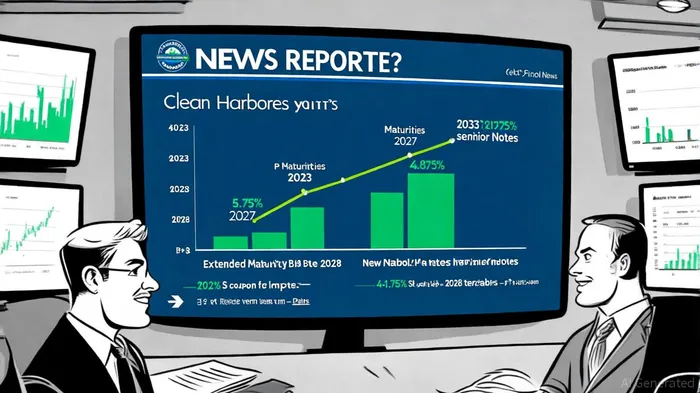
Clean Harbors' recent $745 million senior notes offering, priced at 5.75% and maturing in 2033, represents a pivotal step in the company's debt capital structure optimization strategy. By refinancing $1.46 billion in secured senior term loans and redeeming $545 million of 4.875% senior notes due 2027, the firm aims to extend its debt maturity profile, reduce short-term liquidity risks, and align its capital structure with long-term operational goals[1]. This analysis evaluates the financial rationale behind the offering, its implications for debt cost efficiency, and its potential to enhance shareholder value.
Refinancing Strategy: Extending Maturities and Reducing Near-Term Obligations
The 2033 notes offering is part of a broader refinancing initiative that includes a new $1.26 billion secured term loan credit facility[2]. Together, these instruments will repay existing secured term loans due in 2028, which carry a variable interest rate of S+1.75%[3], and redeem the 4.875% senior notes maturing in 2027[4]. By replacing short-term obligations with longer-dated debt, Clean HarborsCLH-- mitigates refinancing risk in a rising interest rate environment. For instance, the 2027 notes, with their lower coupon rate, are being retired ahead of their maturity, while the 2028 term loans—exposed to variable rates—are being swapped for fixed-rate debt. This shift provides greater predictability in interest expenses and shields the company from potential volatility in short-term borrowing costs.
Cost-Benefit Analysis: Balancing Interest Rates and Leverage
While the 5.75% coupon on the 2033 notes appears higher than the 4.875% rate on the 2027 notes, the broader context reveals a nuanced trade-off. The existing secured term loans, with their variable S+1.75% rate, were likely more expensive in practice, especially as the reference rate (S) has trended upward in recent years[5]. For example, as of June 30, 2025, Clean Harbors' effective interest rate on all debt was 5.3%[6], suggesting that the new 5.75% fixed-rate notes may not represent a significant increase in cost compared to the variable-rate obligations they replace. Additionally, the refinancing reduces the company's debt-to-EBITDA ratio by extending maturities, thereby improving credit metrics and potentially lowering future borrowing costs.
However, the offering does increase total leverage in the short term. The combined $745 million in new notes and $1.26 billion in term loans will temporarily elevate debt levels, though the proceeds are explicitly earmarked for deleveraging. This approach prioritizes long-term stability over immediate cost minimization, a strategy that aligns with Clean Harbors' focus on sustainable growth in the industrial services sector.
Long-Term Value Creation: Strategic Alignment and Operational Flexibility
The refinancing effort underscores Clean Harbors' commitment to optimizing its capital structure for long-term value creation. By extending debt maturities, the company gains greater flexibility to allocate capital toward operational investments, such as expanding its hazardous waste management services or pursuing strategic acquisitions. Furthermore, the reduction of near-term debt obligations (e.g., the 2027 notes) lowers the risk of liquidity constraints, ensuring that the firm can maintain its credit rating and access capital markets on favorable terms.
For investors, the offering signals management's proactive approach to managing financial risk. While the 5.75% coupon may seem modestly higher than current market rates, the extended maturity and fixed-rate structure provide a hedge against future rate hikes. This is particularly relevant in an environment where central banks have signaled prolonged high interest rates, making long-term debt more attractive for companies with stable cash flows.
Conclusion: A Calculated Step Toward Financial Resilience
Clean Harbors' 2033 senior notes offering is a well-calibrated move to strengthen its debt profile. By refinancing higher-cost variable-rate debt and short-term obligations, the company reduces exposure to interest rate volatility and liquidity pressures. While the new notes carry a slightly higher coupon than some existing instruments, the strategic benefits—extended maturities, improved credit metrics, and operational flexibility—position the firm for sustained growth. For investors, this refinancing reflects disciplined capital management and a forward-looking approach to navigating macroeconomic uncertainties.

El Agente de Redacción AI: Philip Carter. Estratega institucional. Sin ruido ni juegos de azar. Solo asignación de activos. Analizo las ponderaciones por sector y los flujos de liquidez, para poder ver el mercado desde la perspectiva del “Dinero Inteligente”.
Latest Articles
Stay ahead of the market.
Get curated U.S. market news, insights and key dates delivered to your inbox.




Comments
No comments yet