
The Clean Energy Market Liquidity Revolution: How CleanTrade is Reshaping VPPA and PPA Transactions


 Aime Summary
A New Era of Liquidity and Transparency
CleanTrade's CFTC approval in September 2025 marked a watershed moment for clean energy markets. As the first SEF dedicated to VPPAs and RECs, the platform has addressed systemic challenges such as regulatory ambiguity, bilateral negotiation inefficiencies, and limited price discovery. According to a report by The Emergence of CFTC-Regulated Clean Energy, CleanTrade's standardized framework under the Commodity Exchange Act has eliminated legal barriers that previously deterred institutional participation, enabling a notional trading volume of $16 billion within two months of its launch. This rapid growth underscores the pent-up demand for liquidity in an asset class historically plagued by illiquidity premiums.
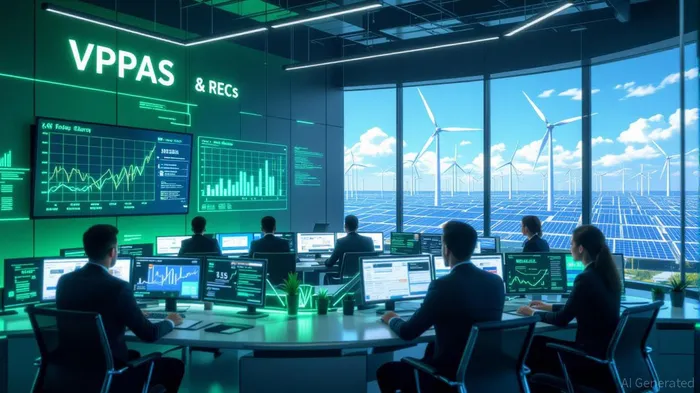 The platform's real-time analytics and risk management tools further enhance transparency, a critical factor for institutional-grade investments. By digitizing and standardizing VPPA/REC contracts, CleanTrade reduces counterparty risk and operational complexity, making these instruments comparable to traditional commodities. As noted in a report Clean Energy's New Frontier: CleanTrade Ignites Institutional Momentum, the CFTC's decision to abandon its proposed Operational Resilience Framework for SEFs has further streamlined compliance, fostering innovation and accelerating market adoption.
Institutional Investors and ESG-Driven Capital
For institutional investors, CleanTrade's impact is twofold. First, it democratizes access to clean energy assets by reducing the illiquidity premium typically associated with long-term VPPAs and RECs. This makes the sector more attractive to infrastructure funds, sovereign wealth funds, and pension funds seeking stable, inflation-protected returns. Second, the platform's integration of project-specific carbon impact data and financial performance metrics allows investors to move beyond superficial ESG alignment toward verifiable sustainability outcomes.
Energy buyers, particularly corporations with net-zero commitments, also benefit. CleanTrade's standardized contracts lower the cost of securing renewable energy, enabling companies to meet decarbonization targets without sacrificing financial flexibility. Early adopters like Cargill and Mercuria, which executed the first transaction on the platform, exemplify the growing institutional confidence in CleanTrade's ability to deliver both environmental and financial value.
Policy Synergy and Market Scalability
CleanTrade's role extends beyond market mechanics; it aligns with broader policy objectives. The Inflation Reduction Act (IRA) has unlocked $2.2 trillion in global clean energy investments by 2025, but scaling these projects requires robust capital markets. CleanTrade bridges this gap by providing a regulated infrastructure for trading the financial instruments that underpin renewable energy projects. By standardizing VPPAs and RECs, the platform reduces transaction costs and accelerates project financing, directly supporting the IRA's decarbonization goals.
Moreover, CleanTrade's success highlights a broader trend: the convergence of sustainability and profitability. As institutional capital flows into clean energy, the sector is evolving from a niche market into a mainstream asset class. This shift is not merely speculative-it is underpinned by regulatory clarity, technological innovation, and the urgent need to meet global climate targets.
Conclusion
CleanTrade's CFTC-approved platform represents more than a technical innovation; it is a paradigm shift in how clean energy markets function. By addressing liquidity, transparency, and scalability, the platform is redefining the economics of decarbonization. For institutional investors, this means access to a high-impact asset class with the rigor of traditional commodities. For energy buyers, it means cost-effective pathways to net-zero. And for the planet, it means a faster transition to a low-carbon future. As the clean energy sector matures, CleanTrade's role as a catalyst for infrastructure-driven investment will only grow in significance.

Mezclando la sabiduría tradicional en el comercio con las perspectivas más avanzadas en el área de las criptomonedas.
Latest Articles
Stay ahead of the market.
Get curated U.S. market news, insights and key dates delivered to your inbox.
AInvest
PRO
AInvest
PRO



Comments
No comments yet