
Clean Energy Market Infrastructure and Liquidity: How CFTC-Approved Platforms Are Reshaping Institutional Investment
 Aime Summary
A New Era of Market Infrastructure
CleanTrade, authorized as a Swap Execution Facility (SEF) by the Commodity Futures Trading Commission (CFTC) in September 2025, represents a breakthrough in clean energy market infrastructure. As the first platform to facilitate trading in Virtual Power Purchase Agreements (VPPAs), Power Purchase Agreements (PPAs), and Renewable Energy Certificates (RECs) under CFTC oversight, it has established a regulatory framework that institutional investors demand for scalability and compliance. Prior to CleanTrade, the lack of a centralized marketplace meant that transactions were often negotiated bilaterally, exposing participants to counterparty risk and limited price discovery. CleanTrade's SEF designation addresses these issues by enforcing standardized contract terms, real-time price transparency, and robust compliance protocols.
This institutional-grade infrastructure has already demonstrated its appeal. Within two months of its launch, CleanTrade facilitated over $16 billion in notional value, a testament to its ability to attract capital from entities seeking both financial and environmental returns. The platform's integration of real-time analytics further enhances its value proposition, enabling investors to track carbon impact metrics and verify ESG alignment-a critical tool in an era where greenwashing remains a persistent concern. 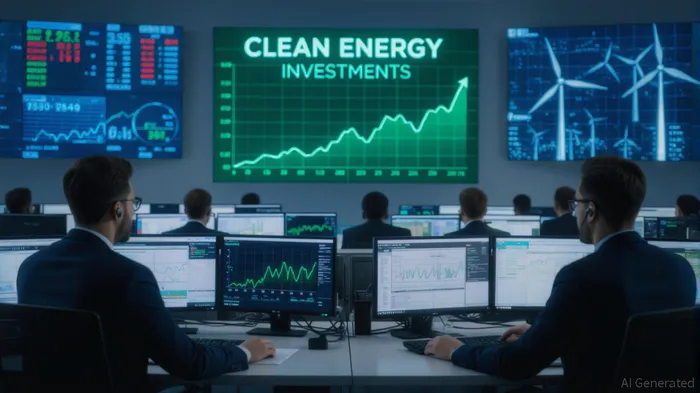
Liquidity and the Democratization of Clean Energy Assets
One of the most significant barriers to institutional investment in clean energy has been liquidity. Unlike traditional commodities or equities, renewable energy assets such as solar farms or wind projects were historically illiquid, making them unsuitable for large-scale portfolios. CleanTrade's SEF model introduces liquidity by creating a centralized marketplace where buyers and sellers can transact with confidence. This is particularly transformative for VPPAs and RECs, which are now tradable instruments with clear pricing benchmarks.
The implications for investors are profound. By enabling the hedging of energy price risks and the diversification of portfolios with clean energy assets, CleanTrade allows institutions to treat renewable energy as a core component of their investment strategies rather than a niche add-on. For example, a pension fund can now purchase VPPAs to lock in long-term energy costs while simultaneously generating returns from the underlying renewable asset, all while contributing to measurable carbon reduction targets.
Strategic Implications for ESG Portfolios
The rise of CFTC-approved platforms like CleanTrade is not merely a technical innovation-it is a strategic inflection point for ESG investing. According to a report by Bloomberg, global clean energy investments surpassed $2.2 trillion in 2025, driven by regulatory tailwinds and corporate net-zero commitments. Platforms that provide institutional-grade access to these markets are poised to capture a significant share of this capital inflow.
For investors, the key strategic advantages include:
1. Risk Mitigation: CleanTrade's compliance tools and standardized contracts reduce operational and regulatory risks, which have historically deterred institutional participation. According to the report, this addresses long-standing concerns about governance and transparency.
2. Scalability: The platform's ability to handle large notional values means investors can scale their clean energy exposure without sacrificing transparency or control. This scalability enables strategic portfolio positioning.
3. ESG Verification: By offering verifiable data on carbon impact, CleanTrade combats greenwashing and ensures that ESG claims are backed by auditable metrics. This verification process provides investors with confidence in their ESG reporting.
Moreover, the integration of clean energy assets into institutional portfolios is no longer a moral imperative but a financial one. As energy prices remain volatile and decarbonization becomes a regulatory inevitability, investors who fail to allocate capital to clean energy risk underperformance relative to peers. CleanTrade's infrastructure enables them to participate in this transition with the same rigor and confidence they apply to traditional asset classes.
Conclusion: The Future of Clean Energy Investing
The approval of CleanTrade by the CFTC marks a watershed moment in the institutionalization of clean energy markets. By addressing liquidity constraints, enhancing transparency, and aligning with ESG objectives, it has created a blueprint for how renewable energy can be integrated into mainstream portfolios. For investors, the strategic imperative is clear: platforms like CleanTrade are not just facilitating access to clean energy-they are redefining the parameters of sustainable investing itself. As global clean energy investments continue to surge, those who leverage these institutional-grade tools will be best positioned to capitalize on the dual imperatives of profitability and planetary stewardship.

Blending traditional trading wisdom with cutting-edge cryptocurrency insights.
Latest Articles
Stay ahead of the market.
Get curated U.S. market news, insights and key dates delivered to your inbox.


AInvest
PRO
AInvest
PRO



Comments
No comments yet