
Another Clean Bullish Technical Setup Takes Shape as Gold Consolidates, Where Positive Surprises May Emerge This Week
The market once again demonstrated resilience after an initial pullback triggered by a sharp selloff in gold/silver. Instead of cascading lower, equities stabilized quickly and formed another potential higher low, keeping the broader bullish technical structure intact. Against this backdrop of steady equity strength, a cooling precious metals complex, and several major earnings releases ahead, investors can afford to lean more optimistic at current levels. Equities still favor a cautious bullish stance, gold calls for patience rather than urgency, and crypto remains an area best left on the sidelines for now. The divergence across asset classes is becoming clearer, and it offers useful signals for positioning into the week ahead.
From a technical standpoint, both the S&P 500 and the Nasdaq 100 pulled back from recent highs following gold's historic selloff, yet the response from equities was constructive. Dip buying emerged quickly, reinforcing the idea that underlying demand remains firm, supported by a resilient economic outlook and a long term commitment to the AI growth narrative. The retracement formed another higher low, setting the stage for a renewed push toward key resistance levels. This recurring higher low and higher high pattern continues to define what remains a textbook bullish structure. Momentum indicators also support this view. The S&P 500 maintains a clean alignment with MA(3) above MA(7) and MA(10), while the Nasdaq 100 briefly saw MA(3) cross MA(7) but remain comfortably above MA(10), signaling healthy short term momentum rather than trend fatigue. The RSI on the Nasdaq sits near 53, a neutral reading that suggests ample room before any overbought concern enters the picture.
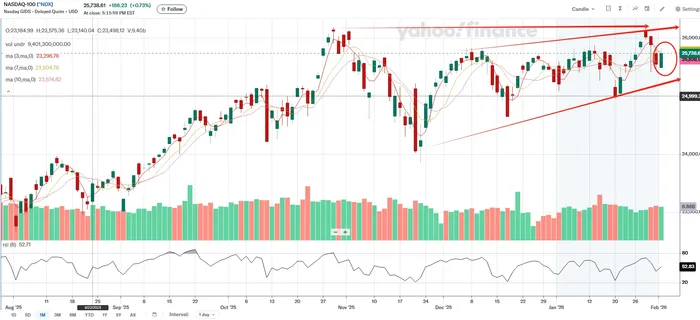
Potential catalysts for the next leg higher arrive with earnings from Google and Amazon. What unsettled investors last week was the sharp selloff in software stocks, driven by fears that advanced AI platforms are already capturing market share while forcing incumbents such as Microsoft into aggressive spending cycles with softer cloud growth. We continue to view this not as a collapse in the AI story, but as a structural transition within the tech sector. Traditional software models are being pressured to evolve, adopt more AI driven innovation, and compete more aggressively. That competitive intensity ultimately reinforces demand across the semiconductor supply chain, where compute capacity remains the true bottleneck.
Google's earnings may help clarify this shift. Gemini has demonstrated meaningful competitive strength, particularly in software integration and user adoption, with commercialization appearing more mature than many expected. This positions Google as a direct challenger not only to OpenAI and Claude, but also as a platform owner that can fully internalize the value of its AI ecosystem. Unlike Microsoft, Google controls its own flagship AI model, allowing it to maximize monetization across search, cloud, and partnerships. Its growing alignment with Apple and other ecosystem players further strengthens this advantage. At the infrastructure level, Google's continued investment in its custom TPU chips stands to benefit Broadcom, reinforcing the theme that deeper AI integration drives incremental demand for specialized silicon. A strong earnings showing could offer investors a clearer glimpse into the real trajectory of AI adoption and reinforce confidence in the long term bullish case.
Amazon represents a complementary angle on the same theme. AWS continues to benefit from broad based AI and core infrastructure demand, and its positioning differs meaningfully from Azure. AWS operates as a more neutral cloud platform, serving nearly all major AI developers without the same internal resource conflicts. Microsoft's need to balance internal AI development with external customer demand has contributed to persistent capacity constraints. In contrast, AWS and Google Cloud may be better positioned to capture accelerating workloads as enterprises scale AI adoption. If this dynamic continues, growth at AWS and Google Cloud could offset concerns raised by Microsoft's recent results and support a healthier, more diversified AI ecosystem.
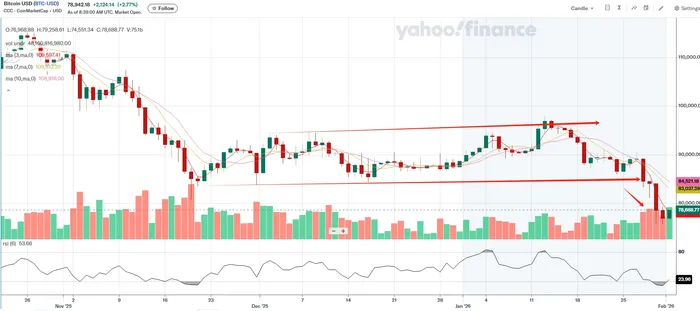
Crypto remains the weakest link in this environment. We have repeatedly emphasized caution, and recent price action reinforces that stance. BitcoinBTC-- continues to decouple from traditional risk assets, failing to respond even as equity sentiment improves. While declining markets in gold and silver may attract dip buyers elsewhere, they also divert speculative interest away from crypto. Despite improving risk appetite broadly, Bitcoin remains below the $80,000 level and has broken below a key resistance zone that held for roughly three months. This lack of participation from larger pools of capital suggests that crypto is not currently aligned with the dominant risk on narrative.
Gold, by contrast, is beginning to stabilize after two sharp down sessions. The recent selloff was largely driven by deleveraging, as excessive speculative positioning was forced out of the market. The backdrop was complicated further by commentary surrounding new Federal Reserve chair Kevin Warsh, who favors a stronger dollar, supports rate cuts, and also advocates balance sheet reduction. While balance sheet shrinkage could cap gold's upside over time, it was not the primary driver of the recent decline. Excess leverage and speculative excess played a larger role. Technically, gold has ended its consecutive decline and entered a consolidation phase, making a short term bounce more plausible. The RSI has cooled significantly from extreme levels near 96 to a far more balanced range, and trading volume has gradually declined, signaling a normalization of sentiment. From here, buying the dip may become the base case, but patience remains warranted until consolidation matures.

In conclusion, the broader market continues to send constructive signals. Equity indices are respecting bullish technical structures, dip buying remains consistent, and upcoming earnings from key technology leaders could deliver positive surprises that reinforce the AI driven growth narrative. The recent software selloff reflects structural adjustment rather than systemic weakness, while semiconductors remain central beneficiaries of rising compute demand. Crypto continues to struggle with relevance in a warming risk environment, and gold is transitioning from excess toward balance rather than offering an immediate opportunity. In this setting, discipline matters. Staying aligned with technical strength, focusing on earnings driven confirmation, and avoiding crowded or premature trades offers the best path to navigating the week ahead.

Independent investment research powered by a team of market strategists with 20+ years of Wall Street and global macro experience. We uncover high-conviction opportunities across equities, metals, and options through disciplined, data-driven analysis.
Latest Articles
Unlock Market-Moving Insights.
Subscribe to PRO Articles.
Already have an account? Sign in
Unlock Market-Moving Insights.
Subscribe to PRO Articles.
Already have an account? Sign in
Stay ahead of the market.
Get curated U.S. market news, insights and key dates delivered to your inbox.


AInvest
PRO
AInvest
PRO



