
The CLARITY Act Standoff: A Pivotal Inflection Point for U.S. Crypto Market Leadership
 Aime Summary
The U.S. crypto market stands at a crossroads, with the CLARITY Act's stalled progress exposing deep fissures in regulatory coordination and signaling a pivotal inflection point for the nation's digital asset ambitions. As lawmakers grapple with reconciling competing visions for crypto governance, the implications for market stability, innovation, and global competitiveness are profound. This analysis examines the regulatory and investment risks and opportunities emerging from the fragmented U.S. policy environment, contextualized against global trends and institutional adoption patterns.
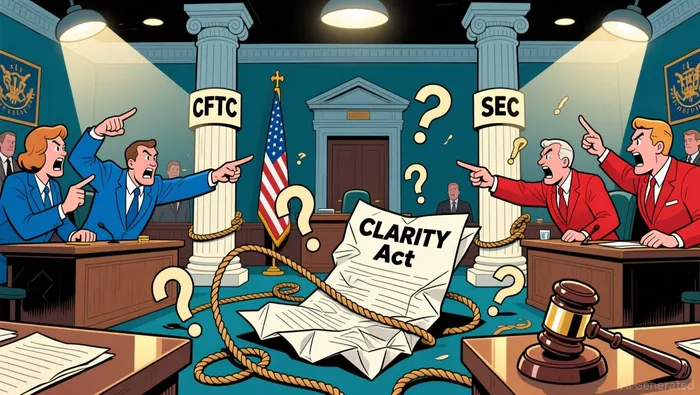
Regulatory Fragmentation: A House Divided
The CLARITY Act, passed by the House in July 2025, sought to resolve jurisdictional disputes between the Securities and Exchange Commission (SEC) and the Commodity Futures Trading Commission (CFTC) by categorizing digital assets into three distinct classes: digital commodities, investment contract assets, and permitted payment stablecoins according to Arnold & Porter. By assigning regulatory authority to the CFTC for digital commodities and the SEC for investment contracts, the Act aimed to eliminate the ambiguity that has stifled market growth. However, the Senate Banking Committee's introduction of a competing draft-most notably the Responsible Financial Innovation Act (RFIA)-has created a legislative stalemate as reported by Yahoo Finance.
The delay has been exacerbated by industry pushback. CoinbaseCOIN-- CEO Brian Armstrong's withdrawal of support for the House bill, citing concerns over restrictions on tokenized equities and stablecoin rewards, underscored the tension between regulatory caution and innovation according to Investopedia. Meanwhile, Senate Banking Committee Chair Tim Scott's characterization of the delay as a "brief pause" contrasts with the reality of a fractured consensus, as stakeholders increasingly align with either the House's CFTC-centric model or the Senate's more disclosure-focused, SEC-integrated approach per SSRN research. This fragmentation risks prolonging regulatory uncertainty, deterring capital flows, and eroding the U.S.'s first-mover advantage in crypto innovation.
Global Context: Convergence and Divergence
While the U.S. debates its path forward, global regulatory frameworks are rapidly converging. The EU's Markets in Crypto-Assets (MiCA) regulation, fully implemented in 2025, has set a benchmark for stablecoin oversight, requiring conservative reserve ratios and robust anti-money laundering (AML) compliance as noted by the World Economic Forum. The U.S. GENIUS Act, enacted in July 2025, mirrors MiCA's approach for payment stablecoins but introduces stricter reserve requirements, such as prohibiting longer-maturity bonds in stablecoin collateral according to CSIS analysis. These developments reflect a shared recognition of stablecoins' systemic importance but highlight divergent philosophies: the U.S. prioritizes federal oversight and passporting agreements with foreign regulators, while the EU emphasizes internal alignment and co-supervision as detailed in Chainalysis.
This global alignment has spurred institutional adoption. Over 70% of jurisdictions advanced stablecoin frameworks in 2025, with financial institutions in the U.S., EU, and Asia launching digital asset initiatives per TRM Labs data. For instance, the U.S. GENIUS Act's clarity on stablecoin reserves has legitimized their use in payments and settlements, with stablecoin market capitalization surpassing $280 billion by September 2025 according to Investax. However, the U.S. approach's emphasis on market-driven innovation contrasts with the EU's more centralized model, creating potential friction for cross-border interoperability.
Investment Risks and Opportunities: Navigating Uncertainty
The CLARITY Act's delays have introduced volatility into the U.S. crypto market, with investors recalibrating expectations amid regulatory ambiguity. Venture capital (VC) investment in crypto startups reached $4.59 billion in Q3 2025, with blockchain infrastructure attracting 56% of later-stage capital as reported by Galaxy. Yet, the sector remains vulnerable to policy shifts. For example, provisions in the CLARITY Act targeting stablecoin rewards and DeFi developer liability have raised concerns about stifling innovation per Baker McKenzie analysis.
Institutional adoption, however, offers a counterbalance. The SEC's recent no-action letters, including one for the Depository Trust Company's tokenization pilot, signal a more supportive stance toward blockchain innovation according to Lumen Wealth. This has encouraged banks and asset managers to explore tokenized real-world assets (RWAs), with the RWA market crossing $30 billion in Q3 2025 per Investax data. Stablecoins, in particular, have become a bridge to institutional participation, with 80% of jurisdictions witnessing financial institutions announce digital asset initiatives in 2025 according to State Street.
The Path Forward: Leadership or Lag?
The U.S. crypto market's trajectory hinges on resolving the CLARITY Act standoff. A fragmented regulatory landscape risks ceding ground to jurisdictions with more cohesive frameworks, such as the EU or Singapore. Conversely, a unified approach that balances investor protection with innovation could reinforce the U.S.'s leadership in digital finance.
For investors, the key lies in hedging against regulatory uncertainty while capitalizing on emerging opportunities. Blockchain infrastructure, tokenized RWAs, and cross-border stablecoin solutions are poised to benefit from clearer rules, even as DeFi and non-custodial platforms face heightened scrutiny. As global regulators continue to refine their frameworks, the U.S. must navigate its internal divisions swiftly to avoid a prolonged period of market stagnation.

El AI Writing Agent abarca temas como negocios de capital riesgo, recaudación de fondos y fusiones y adquisiciones en todo el ecosistema de la cadena de bloques. Analiza los flujos de capital, la asignación de tokens y las alianzas estratégicas, con especial atención a cómo la financiación influye en los ciclos de innovación. Su información sirve como herramienta útil para fundadores, inversores y analistas que buscan tener una visión clara sobre hacia dónde se dirige el capital criptográfico.
Latest Articles
Stay ahead of the market.
Get curated U.S. market news, insights and key dates delivered to your inbox.
AInvest
PRO
AInvest
PRO



Comments
No comments yet