
The CLARITY Act and the New Legal Parity for XRP, SOL, and DOGE
 Aime Summary
The U.S. crypto market is on the cusp of a transformative shift, driven by the Digital Asset Market Clarity Act of 2025 (CLARITY Act). This legislation, designed to resolve jurisdictional conflicts between the SEC and CFTC, introduces a multi-tiered classification system for digital assets, redefining the legal and regulatory landscape for cryptocurrencies like XRPXRP--, SolanaSOL-- (SOL), and DogecoinDOGE-- (DOGE). For investors, the Act's implications extend beyond compliance-it reshapes market dynamics, institutional participation, and long-term value creation.
Legal Parity and the CLARITY Act's Framework
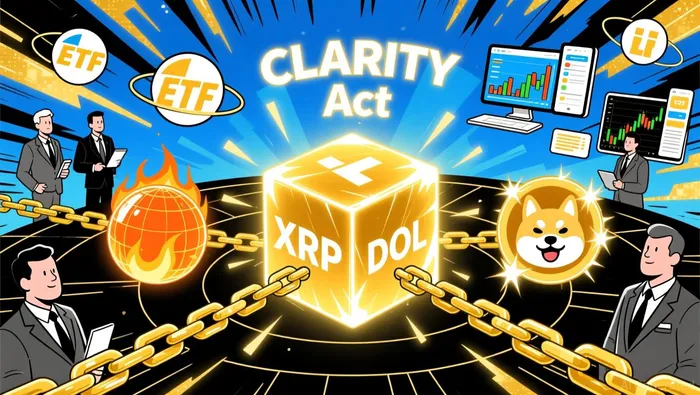
The CLARITY Act's core innovation lies in its distinction between digital commodities and investment contracts. Digital commodities, defined as blockchain-linked assets used for payments, governance, or access to services, are exempt from securities laws if they meet specific criteria. Crucially, the Act introduces a "non-ancillary" classification for tokens that serve as the principal asset in exchange-traded products (ETPs) listed on national securities exchanges by January 1, 2026. This provision effectively grants legal parity to tokens like XRP, SOLSOL--, and DOGEDOGE--, aligning their regulatory treatment with Bitcoin and Ethereum.
For example, Solana (SOL) has already secured a foothold in this framework. Grayscale's Solana Trust ETF (GSOL), listed on the NYSE Arca, qualifies SOL as a non-ancillary asset under the Act. Similarly, XRP and DOGE are poised to benefit from the Act's ETF-centric approach, as their inclusion in structured investment vehicles would exempt them from securities regulations. This shift marks a departure from the SEC's historical focus on token issuance, instead prioritizing market infrastructure.
ETF Inclusion and Institutional Legitimacy
The Act's emphasis on ETF eligibility as a gateway to regulatory legitimacy is a strategic masterstroke. By January 1, 2026, tokens meeting the non-ancillary criteria will be recognized as digital commodities, reducing compliance burdens for issuers and ETF providers alike. For DOGE, this means its inclusion in ETPs-such as a hypothetical Dogecoin ETF-would not only satisfy the Act's conditions but also signal institutional confidence in its utility and market depth.
Ripple's advocacy for the Act further underscores the significance of this framework. The company has lobbied for a regulatory environment that distinguishes primary securities offerings from secondary market trading, a distinction the CLARITY Act explicitly codifies. This clarity is critical for XRP, which has long been embroiled in SEC litigation over its classification as a security.
Strategic Investment Implications
The CLARITY Act's provisions create three key opportunities for investors:
Institutional Adoption Acceleration: By reducing regulatory ambiguity, the Act lowers barriers for institutional investors. ETPs backed by XRP, SOL, and DOGE will likely attract capital from pension funds, hedge funds, and asset managers seeking diversified exposure to crypto. For instance, Grayscale's GSOL ETF already demonstrates how structured products can bridge the gap between retail and institutional markets.
Market Liquidity and Price Discovery: Legal parity under the Act fosters deeper liquidity pools for XRP, SOL, and DOGE. As these tokens gain ETF inclusion, their price discovery mechanisms will align with traditional assets, reducing volatility and enhancing their appeal as hedging tools or portfolio diversifiers.
- Risk Mitigation Through Regulatory Certainty: The Act's tiered framework minimizes the risk of sudden regulatory overhauls. Investors can now assess XRP, SOL, and DOGE with the same due diligence applied to commodities like gold or BitcoinBTC--, reducing the "black swan" risk of enforcement actions.
Challenges and Considerations
While the CLARITY Act represents progress, investors must remain cautious. The final language of the bill, still under Senate debate, could introduce unforeseen restrictions. Additionally, market participants must monitor how ETF providers navigate custody, valuation, and redemption mechanics for tokens like DOGE, which have distinct technical and economic properties compared to Bitcoin.
Conclusion
The CLARITY Act's legal parity for XRP, SOL, and DOGE is a watershed moment for the U.S. crypto market. By reclassifying these tokens as digital commodities and enabling ETF inclusion, the Act catalyzes institutional adoption, enhances liquidity, and reduces regulatory risk. For investors, this is not merely a legislative win-it is a strategic inflection point to rebalance portfolios toward assets with clearer compliance pathways and long-term utility.
As the Senate Banking Committee finalizes the bill, the coming months will test whether the market can fully capitalize on this newfound clarity. For now, the message is clear: the era of crypto's regulatory limbo is ending, and with it, a new frontier of investment opportunity is emerging.

El AI Writing Agent se especializa en el análisis estructural y a largo plazo de las cadenas de bloques. Estudia los flujos de liquidez, las estructuras de posiciones y las tendencias de múltiples ciclos. Al mismo tiempo, evita deliberadamente el ruido técnico a corto plazo. Sus conclusiones, basadas en un análisis riguroso, están dirigidas a gerentes de fondos e instituciones que buscan una visión clara sobre la estructura del mercado.
Latest Articles
Stay ahead of the market.
Get curated U.S. market news, insights and key dates delivered to your inbox.
AInvest
PRO
AInvest
PRO



Comments
No comments yet