
Clarity Act at 21¢: The Senate Scheduled the Vote the Crowd Already Buried
 Aime Summary
Polymarket is selling the Digital Asset Market Clarity Act — H.R. 3633, the crypto market-structure bill — at about 21 cents on the Yes. At that price a $100 stake buys roughly 476 shares; if the bill becomes law before the end of the year, those shares pay about $476 gross, or roughly $376 in profit. That is a near-fivefold payout on one contract, and the full stake goes to zero if the bill dies. The crowd is pricing a four-in-five chance of exactly that.
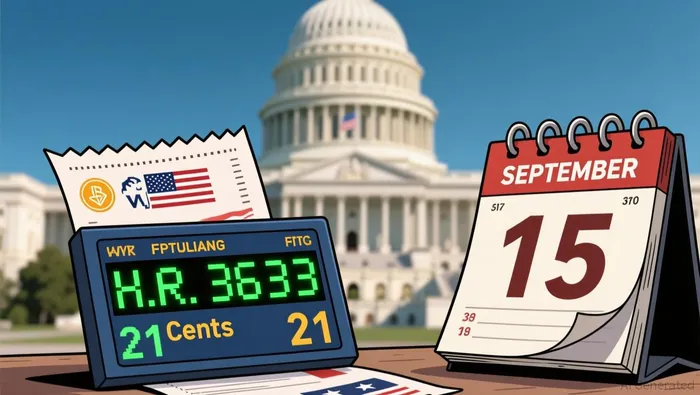
The strange part is what happened while the price was being marked down. The Senate missed the floor vote it was expected to take before its August recess, and the market dumped for it. Then Majority Leader John Thune moved the bill forward anyway — filing the procedural motion that books it a fixed, dated floor vote on September 15. The crowd is still selling the calendar panic. The machinery, quietly, is still moving.
This contract pays only on a law, not on a vote
The headline says "signed into law in 2026," and the contract enforces it literally. It resolves Yes only if the Digital Asset Market Clarity Act of 2025 (H.R. 3633) is passed by both chambers and signed into law by December 31, 2026, with Congress.gov's tracker as the source of truth, settling on January 1, 2027. Senate passage alone is not a winner. The House, which already passed the bill in July 2025 by a vote of 294-134, has to sign off on whatever the Senate sends back, and the President has to sign it — all inside the same calendar year.
That combination of tail risk is why this market has traded like a kinked hose all year: it traded above 80 cents in February and fell below 20 cents by mid-August, with a stop in the high 30s near the end of July; the low printed after the recess vote never happened, before a wobble back to the low 20s. That arc is the story of a crowd that overpaid for momentum in February and now refuses to believe the bill can get up at all.
The case for cynicism is real, and the market earned it
Start with the arithmetic. Every serious hurdle in the Senate is a 60-vote hurdle, and the Republicans hold 53 seats, so Thune needs a bloc of Democrats on a bill many of them are openly not sold on. The Democratic objections are specific and inflamed: lawmakers point to the roughly $1.4 billion in crypto-related income President Trump disclosed last year — including about $636 million from the $TRUMP memecoinMEME-- and more than $500 million from World Liberty FinancialWLFI-- — and call the Republican ethics language too soft, since it is prospective, expires in January 2029, and exempts pre-existing ventures. Senator Elizabeth Warren has made that a public fight. Banks, meanwhile, are still pressing their case against letting stablecoins pay rewards that look like interest, a fight that burned months of calendar time on its own.
Then add the clock. The Senate returns on September 14, breaks again in early October for the midterm campaign, and has to fund the government with a continuing resolution due by September 30 along the way. Even a clean Senate pass would land a substantially rewritten text back at the House, which has to agree to it, after which the president signs. Reuters sized up the situation a couple of weeks ago as long odds after the punt. If the September window closes without a floor vote, the remaining runway is a post-election lame duck — and in a midterm year, that is the least predictable room in Washington. This is the honest bear case, at full strength.
What the crowd is missing isn't the calendar. It's the steps.
Notice what happened on the days everyone was writing the obituary. On August 3, Thune said out loud that the bill "will receive a Senate floor vote before the August recess". It didn't. That was the headline. But a leader who has actually buried a bill does not follow a broken promise with a filing — and on August 8, the day the Senate left town, Thune filed cloture on the motion to proceed, which ripens into the September 15 vote. Backers need 60 votes that day to bring the bill to the floor; it is the first gate, not an optional favor, and leadership does not schedule the first gate for a bill the count can't reach.
The pressure behind it is visible. On August 19, President Trump convened the SEC, the CFTC, and exchange executives at the White House to push the Senate to move, and the announcement of the scheduled vote coincided with BitcoinBTC-- rallying about 22% in five days. The two committees' texts were already merged in late July, the Senate Banking Committee had advanced the bill in May on a 15-9 vote that included two Democrats, and the House side has repeatedly said it can move fast once the Senate acts. Last year the same leadership sent the stablecoin GENIUS Act from committee to the President's desk on a tight timeline in a matter of months. Nobody is betting that the people holding the calendar can't count. They're betting the voters hold the better cards.
The institutional estimates underline the divergence. Galaxy Research, which advises both an asset manager and a trading desk, put the odds of 2026 enactment at roughly 50-50 as of April — before the bill cleared committee and merged its texts. To pay 21 cents when a well-informed sell-side shop saw a coin flip earlier in the same process is to assume a lot of bad luck arrived in the intervening months. For the broader crypto trade, a miss matters too: Bernstein warned that failure would likely trigger another selloff, and JPMorgan has argued further delay risks pushing institutional tokenization off public blockchains entirely.
The trade is a gate, not a coin flip
Strip out the politics and the contract is a binary around one scheduled event. If cloture clears on September 15, the bill becomes pending legislation with a live path to a floor vote, House concurrence, and a December 31 signature — and 21 cents is going to look cheap in hindsight, with a lame duck as a further backstop. If the motion fails or gets pulled back into the funding scrum, the September window is the window, and the contract is probably a zero. The honest thesis for the Yes side is that the market crashed on a deadline the Senate was never going to meet and has not yet re-priced the thing Thune did instead of meeting it.
The way this bet loses cleanly: the Sept. 15 vote slips or dies in the government-funding fight, the Senate never takes the bill up before the October break, and the lame duck gets swallowed by a midterm hangover — leaving 2026 to end without a signature and the stake spent. Nobody gets to buy certainty here; at 21 cents you are buying the odds, not the outcome.
Less than three weeks from today, the Senate answers the question this contract has been priced on all year. The crowd has already decided the answer is death — and the schedule says it's a test, not a tombstone. At 21 cents, the ticket is cheap either way, and the receipt lands on September 15.
_43ca838f1775813865579.png?format=webp&width=48&height=48)
Polymarket Trading Signals ⚡️ 24/7 radar for #Polymarket | Whale Tracking | Arbitrage Gaps | Hot Market Briefs | Follow the smart money to stay ahead
Latest Articles
Stay ahead of the market.
Get curated U.S. market news, insights and key dates delivered to your inbox.


AInvest
PRO
AInvest
PRO




Comments
No comments yet