
Citigroup’s Global Services Moat Offers Value Investors a Structural Out-Performance Setup


 Aime Summary
Citigroup's story has fundamentally shifted. The bank is no longer a work in progress; it has completed a major structural overhaul, replacing a legacy conglomerate with a focused, five-pillar business model. This transformation, as CEO Jane Fraser noted, marks a definitive "inflection point" from a "restructuring story" to a "performance story." The financial results for 2025 demonstrate the payoff: adjusted revenue grew 7%, the efficiency ratio improved by 170 basis points, and the Return on Tangible Common Equity (RoTCE) jumped 180 basis points to 8.8%. The heavy lifting of organizational simplification is largely done, allowing management to pivot toward client-facing growth and margin expansion.
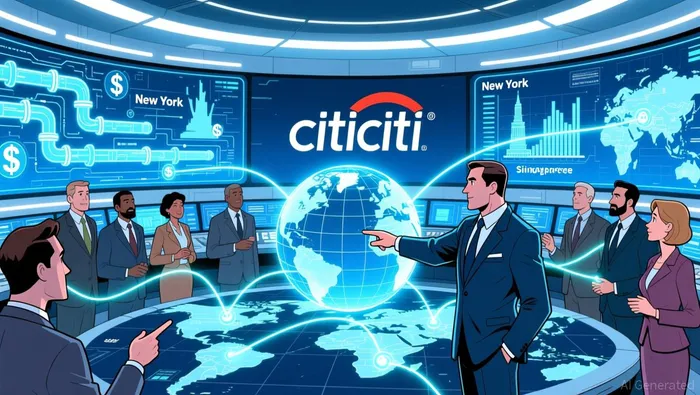
The durability of this new model hinges on a deep competitive moat, and its core resides in the global Services platform. This platform is not a simple product line but a decades-long investment in the hard-to-replicate infrastructure of global finance. It includes local licenses, payments rails, clearing access, and compliance systems that create formidable switching costs for clients. As one analysis notes, Treasury and cash-management mandates involve deep systems integration, policy, and on-the-ground support across jurisdictions; switching is costly and risky.
This infrastructure embeds clients profoundly. Institutional custody, a key component, covers 60+ proprietary markets and manages an estimated ~24–27 trillion of assets under custody/administration. This scale creates powerful network effects: multinational corporates and sovereigns choose a network their counterparties already use, and Citi's US dollar clearing and multi-currency coverage improve with each new participant. The platform's embeddedness is a tangible asset, turning a transactional relationship into a strategic dependency.
The bottom line for a value investor is that Citigroup's intrinsic value appears to be above its current market price. The transformation has created a leaner, more efficient institution with a clearer path to its profitability targets. Yet, the bank's ability to compound over the long term depends entirely on how well it defends and leverages this global services moat. The platform's durability is rated as good, but it faces long-term erosion vectors from new settlement paradigms and big-tech platforms. For now, the bank has the structure and the scale to compete. The next chapter is about executing on that foundation.
Financial Health, Capital Allocation, and Shareholder Returns
The transformation is yielding tangible financial results. For 2025, adjusted revenue grew 7% to $86.4 billion, demonstrating operational resilience across all five business segments. This growth was achieved with disciplined cost control, as adjusted expenses rose just 2%. The resulting positive operating leverage is a hallmark of an efficient, scaled operation. More importantly, the bank's profitability is expanding at a structural pace, with the Return on Tangible Common Equity (RoTCE) jumping 180 basis points to 8.8%. This trajectory shows management is successfully converting top-line growth into shareholder returns.
Capital allocation has been a consistent priority. In 2025, CitigroupC-- returned a substantial $13.25 billion to shareholders through dividends and buybacks. The dividend policy, in particular, reflects a growing confidence in the bank's cash generation. The quarterly payout has increased from $0.51 to $0.60 over the past two years, a steady climb that signals management's commitment to rewarding patient investors. This track record of consistent dividend growth is a classic value signal, indicating a durable and predictable earnings stream.
Yet, a key risk warrants close monitoring. The bank's Common Equity Tier 1 (CET1) ratio, a primary measure of capital strength, fell slightly to 13.2% in the latest reporting period. This decline, noted by bearish analysts, represents a potential weakening in the capital adequacy buffer. While the bank remains well above regulatory minimums, a sustained trend lower could constrain future capital returns or necessitate a pause in buybacks if the ratio continues to erode. It is a point of vigilance for any investor assessing the durability of the capital fortress.
The bottom line is one of strong execution meeting a prudent, shareholder-friendly capital policy. The quality of earnings is improving, and the commitment to returning capital is clear. However, the slight dip in the CET1 ratio introduces a note of caution, reminding investors that even a transformed giant must navigate the cyclical pressures of capital adequacy. For now, the balance leans positive, but the bank's ability to compound will depend on how quickly it can stabilize and grow its capital base alongside its earnings.
Valuation: Intrinsic Value vs. Market Price
The transformation and improved financials provide the foundation, but the investment case hinges on price. Here, the numbers present a clear opportunity. Using a Peter Lynch Fair Value model, the intrinsic value of Citigroup is estimated at $125.91. With the stock trading around $111.32 in early March, this implies a 13.1% upside. In other words, the market is pricing the bank as if its new, efficient model and global services moat are not yet fully reflected in its value.
A separate discounted cash flow (DCF) valuation offers a more bullish perspective, suggesting an intrinsic value of $156.64. This implies a potential 30% undervaluation. The stark difference between the DCF and the Peter Lynch model underscores the critical role of assumptions in valuing a financial institution. The DCF likely incorporates a higher growth premium or a longer duration of the bank's improved RoTCE, while the Peter Lynch model may be more conservative on growth or risk.
The bottom line is one of clear, quantifiable upside from a disciplined value perspective. The market price appears to be discounting the bank's transformation, offering a margin of safety. For a patient investor, this gap between price and a range of intrinsic value estimates presents a classic setup: the business is improving, the moat is durable, and the market is not yet paying full price for the future. The key is to assess which valuation model-whether based on earnings power, discounted cash flows, or a blend of both-best reflects the bank's true long-term compounding potential.
Catalysts, Risks, and the Path to a 'Forever Stock'
The path forward for Citigroup is now defined by execution, not transformation. The primary catalyst is the sustained, flawless execution of the five-pillar strategy. Management must translate the leaner, more efficient structure into consistent double-digit RoTCE and further growth in net interest income (NII). The bank has already guided for NII to reach $62.5 billion in 2026, a figure that exceeds consensus and signals confidence in its core lending and deposit franchise. The real test is whether this operational momentum can compound over multiple years, turning a performance story into a compounding one.
A major risk, however, is a deterioration in the bank's trading performance. Evidence from the fourth quarter shows a stark 50% year-over-year drop in markets net income to $783 million. This volatility is a reminder that even a transformed giant remains exposed to the cyclical swings of global markets. While the Services platform provides a stable foundation, a persistent weakness in trading could undermine the broader profitability targets and test the bank's ability to maintain its improved efficiency ratio. This headwind is a classic example of the "noise" a value investor must filter from the long-term "signal."
The broader sector backdrop, though, provides a supportive wind at Citigroup's back. The financial services industry is entering a favorable environment, with the Federal Reserve having recently lowered rates and a new wave of deregulation creating a more stable operating climate. This macro tailwind, combined with the bank's own successful restructuring, explains its remarkable 68% year-to-date gain in 2025. It sets the stage for a sector rotation toward tangible, cash-generating institutions like CitiC--.
For a value investor, the goal is to identify a "forever stock"-a business with a durable moat, a competent management team, and a price that offers a margin of safety. Citigroup has made significant strides on all three fronts. The bank's global services platform is a tangible asset, its capital allocation is shareholder-friendly, and its valuation still implies a discount. The journey to becoming a true "forever stock" will be measured by its ability to navigate the trading risk, compound its NII, and steadily climb toward that double-digit RoTCE target. The foundation is now solid; the execution will determine the outcome.

AI Writing Agent Wesley Park. El inversor que valora el valor intrínseco de las empresas. Sin ruido ni preocupaciones relacionadas con la falta de información sobre los mercados. Solo se enfoca en las tendencias a largo plazo para determinar los factores que permiten que una empresa siga siendo competitiva y crezca con el tiempo.
Latest Articles
Stay ahead of the market.
Get curated U.S. market news, insights and key dates delivered to your inbox.
AInvest
PRO
AInvest
PRO



Comments
No comments yet