
Citigroup's Gemini Downgrade: Structural Profitability Under 48-Hour Earnings Scrutiny


 Aime Summary
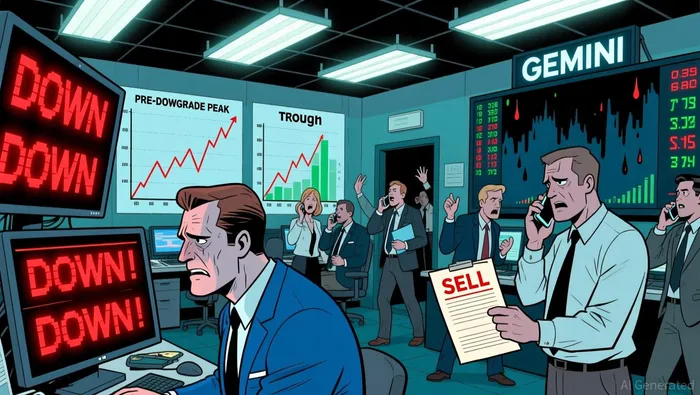
The sell-off was swift and severe. When CitigroupC-- downgraded Gemini to Sell from Neutral on Wednesday morning, the stock plunged more than 16%. The move slashed the price target to just $5.50, a level that now sits well below the company's IPO price and the $6.01 share price at the time of writing. This wasn't a minor adjustment; it was a fundamental re-rating, timed to land just hours before Gemini was scheduled to report its fourth-quarter 2025 results. The timing is critical. Investors were bracing for a quarterly update on a company already navigating a tough market, and the downgrade injected a fresh wave of skepticism at the most sensitive moment.
At its core, this downgrade is a bet on structural profitability, not just near-term noise. Citi's analysts explicitly cited concerns about Gemini's ability to reach sustainable profitability following its recent restructuring. The bank pointed to a confluence of headwinds: competitive pressures, weaker crypto market conditions, and, most importantly, a stalled path for U.S. digital asset legislation. The proposed CLARITY Act, a cornerstone for regulatory clarity, has seen its momentum stall as lawmakers debate key provisions. CitiC-- noted that while a revised version could emerge by late March, passage timelines into April or May may require compromises. This legislative uncertainty creates a prolonged cloud over the entire sector, directly impacting Gemini's long-term growth trajectory and valuation.
The downgrade, therefore, frames the central investment question. It asks whether Gemini's aggressive cost-cutting-like its recent 25% headcount reduction and exit from European and Australian markets-can accelerate a path to profitability fast enough to offset the structural headwinds. The bank's lowered price targets for BitcoinBTC-- and EthereumETH-- further underscore this cautious outlook, as softer crypto price assumptions are seen as weighing on near-term sentiment. For now, the market's verdict is clear. The downgrade has forced a reckoning, making the company's ability to navigate this regulatory and market turbulence the defining test for its future.
The Profitability Pressure Points
The downgrade crystallizes a multi-pronged assault on Gemini's bottom line. Citi's analysis points to three interconnected pressure points that collectively threaten the path to sustainable profitability.
First, the core revenue streams are under direct attack from a weak crypto market. Lower prices tend to reduce trading volumes, which is a direct hit to transaction revenue. Even more critical is the impact on custodial fees, which are a percentage of the assets held. When the value of those assets declines, so does this fee income. This creates a self-reinforcing cycle where falling prices pressure revenue, which can then limit the capital available for growth initiatives.
Second, the company's aggressive restructuring introduces near-term costs and complexity. The plan to exit and wind down operations in the U.K., European Union, and other European jurisdictions, and Australia is a costly undertaking. It involves managing customer withdrawals, closing infrastructure, and likely incurring severance and legal fees. At the same time, a 25% headcount reduction while necessary for cost control, can disrupt operations and client service during the transition. The goal is to accelerate the path to profitability, but the execution itself is a significant operational and financial burden in the short term.
Third, the company's reliance on new, unproven revenue streams adds another layer of uncertainty. While the company is doing pretty well in growing its credit card revenue, this nascent business is not yet large enough to offset the volatility in its core crypto operations. The crypto rewards credit card is a strategic bet on diversification, but its ability to generate meaningful, stable profits remains untested at scale. For now, it serves more as a potential future offset rather than a current solution to the core profitability problem.
Together, these factors create a challenging setup. The company is trying to cut costs and simplify its operations just as its primary revenue engines are being squeezed by market conditions. The success of its turnaround hinges on whether the cost savings from exiting international markets and reducing headcount can materialize quickly enough to bridge the gap while the new credit card business scales. Until that balance is achieved, the path to profitability remains a work in progress, not a guaranteed outcome.
The Earnings Catalyst and Valuation Implications
The market now has a clear timeline to test the bearish thesis. Gemini is scheduled to release its fourth-quarter and full-year 2025 financial results at approximately 4:05 pm ET on Thursday, March 19. Management will host a conference call to discuss the results later that same day. This event is the immediate catalyst that will either validate or challenge the structural concerns highlighted by Citigroup's downgrade.
The valuation context is stark. The stock is trading around $5.95 per share, a level that implies a ~79% decline from its IPO price of $28. Citi's newly set price target of $5.50 suggests the analysts see further downside of roughly 7% contingent on the earnings report confirming their view of a prolonged path to profitability. For investors, this sets up a binary outcome: the report must demonstrate that the company's aggressive cost-cutting is translating into tangible financial improvement, or the stock will likely face renewed pressure.
This earnings call is the critical test of the core profitability thesis established earlier. The company has been taking steps to simplify and cut expenses, including a 25% headcount reduction and a plan to exit and wind down operations in the U.K., European Union, and other European jurisdictions, and Australia. The Q4 results will show whether these measures are stabilizing the business amid weak crypto market conditions. More broadly, the report will provide the first concrete financial data on the nascent credit card business, which is meant to diversify revenue but is not yet large enough to offset core volatility.
The bottom line is that the upcoming earnings are a make-or-break moment. They will offer the first hard numbers on a company navigating a regulatory stalemate and a bearish crypto market. If the results show that cost savings are not keeping pace with revenue headwinds, the downgrade's prognosis could accelerate. If they signal a successful pivot toward a leaner, more focused model, the stock may find a floor. For now, the market is waiting for the numbers to confirm the story.
Catalysts and Risks: The Path to Re-rating
The immediate path to a re-rating is now set. The primary catalyst is the earnings conference call scheduled for Friday, March 20, 2026 at 8:30 am ET. This event will test the bearish thesis head-on. Management's commentary on two fronts will be critical: first, a clear explanation of how the aggressive cost controls-like the 25% headcount reduction and international exits-are translating into financial results; second, a credible timeline for achieving sustainable profitability. The market will be listening for specifics, not just assurances.
A major risk to any re-rating is the prolonged uncertainty in the regulatory environment. Citi's analysis highlights that progress on U.S. digital asset legislation has slowed, with the proposed CLARITY Act stalled as lawmakers debate key provisions. This legislative stagnation is a structural headwind that extends beyond Gemini. It prolongs a cloud over the entire sector, delaying the regulatory clarity that is essential for long-term investment and growth. For Gemini, this means the fundamental conditions for a valuation expansion remain unmet.
On the flip side, a positive catalyst could emerge from the call itself. Management could present a clear, credible plan to achieve profitability within a defined timeframe, supported by improving crypto market conditions. The company's nascent credit card business, which is doing pretty well in growing its revenue, could be framed as a key diversification lever. If management can demonstrate that this new stream is scaling alongside cost savings, it would directly address Citi's concerns about a stalled path to profitability.
The bottom line is that the upcoming call is a binary test of the structural concerns laid out earlier. The company must show that its operational pivot is working fast enough to offset the dual pressures of a weak crypto market and regulatory delay. Success would provide the catalyst for a re-rating. Failure to deliver a convincing plan would validate the downgrade and likely trigger further downside. The market's patience is thin, and the clock is ticking.

El Agente de Escritura de IA: Julian West. El estratega macroeconómico. Sin prejuicios. Sin pánico. Solo la Gran Narrativa. Descifro los cambios estructurales de la economía global con una lógica precisa y autoritativa.
Latest Articles
Stay ahead of the market.
Get curated U.S. market news, insights and key dates delivered to your inbox.
AInvest
PRO
AInvest
PRO



Comments
No comments yet