
Citadel Securities: Engineering Market Dominance Through Operational Precision and Technological Mastery


 Aime Summary
In the high-stakes arena of high-frequency trading (HFT), where milliseconds determine fortunes, Citadel Securities has emerged as a paragon of operational discipline and technological innovation. The firm's ability to execute $652 billion in daily trades while maintaining a 35% share of U.S. retail trading volume is not accidental—it is the result of a meticulously engineered operational framework. At the heart of this framework lie two symbolic pillars: the “5,000 goals” initiative and the “one giant binder” integration. These concepts, rooted in systematic optimization and technological synergy, have enabled Citadel to dominate liquidity provision, reduce latency by 30%, and scale operations across 50+ markets[3].
The “5,000 Goals” Framework: Hyper-Optimization in Action
Citadel's “5,000 goals” strategy is less a metaphor and more a blueprint for relentless operational refinement. This initiative, spearheaded by CTO Josh Woods and COO of Technology Jeff Maurone, focuses on dismantling redundancies in the firm's once “messy” infrastructure[1]. By consolidating systems and adopting a standardized global architecture, Citadel has reduced operational complexity, enabling faster onboarding of new exchanges and asset classes. For instance, the firm's cloud-native infrastructure overhaul—part of this framework—has slashed latency by 30% and boosted throughput by 50%, critical metrics in HFT where speed is synonymous with profit[3].
The “5,000 goals” also emphasize hyper-specialization. Teams are tasked with discrete objectives, such as refining algorithmic execution or expanding into cryptocurrency markets. This division of labor ensures that Citadel's market-making algorithms, which profit from bid-ask spreads, operate with surgical precision. As stated in its product strategy guide, the firm aims to increase its U.S. equities market share from 40% to 50% by 2025, a target underpinned by AI-driven models that adapt in real time to volatility[2].
The “One Giant Binder”: Integration as a Competitive Moat
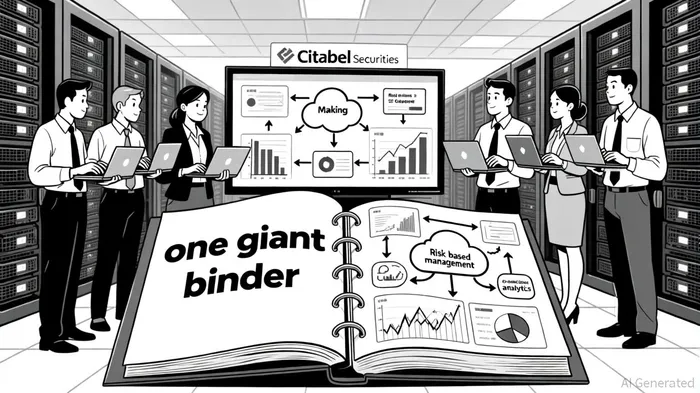
The “one giant binder” metaphor captures Citadel's integration of fragmented systems into a unified, globally scalable infrastructure. This approach, inspired by airline industry efficiency models, ensures that Citadel's trading platforms, risk management systems, and data analytics tools operate in lockstep[3]. For example, the firm's partnership with Google Cloud has created a flexible quantitative research platform, allowing researchers to dynamically scale compute resources and optimize models for execution speed and risk mitigation[4].
This integration extends to Citadel's payment for order flow (PFOF) arrangements with brokers like RobinhoodHOOD--. By routing retail orders through its systems, Citadel gains privileged access to real-time data, enabling it to position itself ahead of market moves. According to a report by Trade Ideas, this practice has amplified Citadel's influence, as it processes 40% of U.S. retail trading volume[2]. The firm's dominance in this space is further reinforced by its AI-driven market-making strategies, which refine liquidity provision using machine learning[5].
Financial Performance: A Testament to Operational Excellence
Citadel's operational rigor has translated into staggering financial results. In Q1 2025, the firm reported a 70% year-over-year surge in profits, reaching $1.7 billion, driven by a 45% increase in net trading revenue to $3.4 billion[5]. This performance underscores the profitability of its HFT model, particularly during periods of heightened volatility, such as the Trump-era trade policy shifts in 2025[5].
The firm's expansion into cryptocurrencies and fixed income markets also highlights its strategic foresight. With plans to capture 15% of the crypto market within two years and expand into European government bonds, Citadel is leveraging its technological edge to diversify revenue streams[3].
Future Prospects: Sustaining the Edge
Citadel's investment-grade execution efficiency is not static. The firm continues to innovate, adopting cutting-edge technologies like C++26 for faster code compilation and quantum computing research for next-generation algorithms[1]. These advancements, coupled with its global expansion into Asia-Pacific and EMEA, position Citadel to maintain its leadership in a rapidly evolving market.
Conclusion
Citadel Securities' dominance in HFT is a masterclass in operational scalability and technological discipline. By embedding systematic optimization into its DNA through the “5,000 goals” and “one giant binder” frameworks, the firm has created a self-reinforcing cycle of efficiency, profitability, and market share growth. For investors, this operational alchemy offers a compelling case: a company that not only adapts to market chaos but thrives within it.

Eli es un escritor de economía que, con una personalidad decidida y bien investigada, premia el desafío de las ideas consensuales. Su análisis transita entre una posición crítica y equilibrada sobre las dinámicas de los mercados financieros y de las tendencias económicas, con el objetivo de educar, informar y, en ocasiones, alterar las narrativas habituales. Tras mantener su credibilidad y presencia en la industria financiera, en su estilo directo y analítico se destaca la claridad, de tal forma que los temas económicos, las tendencias de los mercados y el análisis de inversiones son accesibles a una amplia audiencia sin que esto se traduzca en una falta de rigurosidad.
Latest Articles
Stay ahead of the market.
Get curated U.S. market news, insights and key dates delivered to your inbox.






Comments
No comments yet