
Circle's Strategic Position in the Post-Rate Cut Era: Digital Currency Resilience and Payment Innovation


 Aime Summary
As central banks globally pivot toward accommodative monetary policies post-2025 rate cuts, the financial landscape is undergoing a seismic shift. Traditional payment systems, long constrained by inefficiencies and high costs, now face intensified competition from digital currency solutions. In this evolving environment, CircleCRCL-- Internet Financial has emerged as a pivotal player, leveraging strategic partnerships and product innovations to solidify its position at the intersection of stablecoin adoption and institutional-grade payment infrastructure.
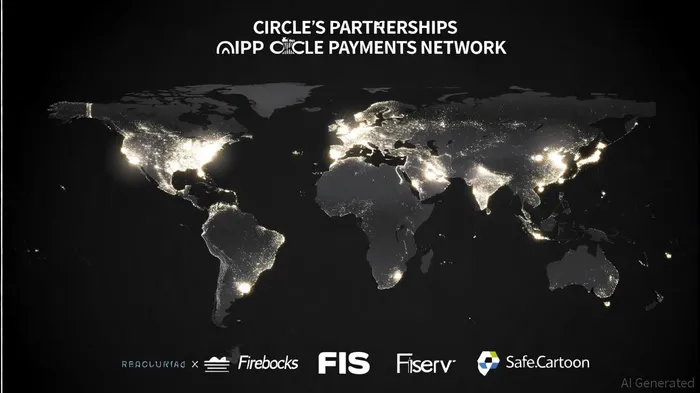
Strategic Partnerships: Building a Resilient Ecosystem
Circle's 2025 strategic initiatives underscore its commitment to addressing the limitations of legacy systems while capitalizing on the post-rate cut era's demand for faster, cheaper, and programmable money. A cornerstone of this strategy is its collaboration with Fireblocks, which integrates Circle's stablecoin network with Fireblocks' institutional custody and tokenization infrastructure. This partnership enables financial institutions to execute secure cross-border treasury operations and tokenization settlements, addressing the growing need for regulated digital assets in institutional settings [1].
Similarly, Circle's alliance with FIS has unlocked real-time stablecoin money movementMOVE-- for financial institutions. By embedding USDC-the world's largest regulated stablecoin-into FIS' Money Movement Hub, the collaboration provides scalable fraud detection and instant settlement capabilities, reducing reliance on traditional correspondent banking networks [2]. Meanwhile, the partnership with Fiserv extends Circle's reach into the digital banking ecosystem, combining Fiserv's payment infrastructure with Circle's stablecoin platform to enhance global merchant and consumer payment experiences [3].
Perhaps most notably, Circle's collaboration with Safe positions USDCUSDC-- as the core stablecoin for institutional onchain capital management. With $2.5 billion in USDC already secured in Safe smart accounts, the partnership streamlines treasury operations and taps into DeFi liquidity pools, leveraging Safe's programmable multi-signature technology to process nearly 4% of all EthereumETH-- transactions [4]. These alliances collectively reinforce Circle's ability to meet institutional demand for secure, regulated digital assets in a post-rate cut environment where liquidity and efficiency are paramount.
The Circle Payments Network: A Paradigm Shift in Cross-Border Payments
Circle's most transformative initiative in 2025 is the launch of the Circle Payments Network (CPN), a global infrastructure designed to revolutionize cross-border money movement. Traditional systems, as noted by the World Bank, often incur fees exceeding 6% and take over a day to settle, disproportionately affecting emerging markets [5]. CPN addresses these inefficiencies by enabling real-time, low-cost transactions using regulated stablecoins like USDC and EURC.
The network's modular API architecture allows third-party developers to build advanced financial applications, while its governance framework ensures compliance with AML/CFT protocols and cybersecurity standards. Major banks, including Banco Santander, Deutsche Bank, and Standard Chartered, have endorsed CPN as a "game changer" for cross-border transactions, emphasizing its potential to reduce operational friction and expand financial inclusion [6]. Design partners like Alfred Pay and Flutterwave further enhance CPN's scalability, targeting use cases such as remittances, payroll, and capital markets settlements [7].
Digital Currency Resilience in a Shifting Monetary Policy Landscape
The post-rate cut era has amplified demand for assets that retain value and facilitate seamless transactions amid low-interest environments. Circle's stablecoins, particularly USDC, have demonstrated resilience by maintaining a 100% reserve-backed structure, offering institutional and retail users a hedge against volatility while preserving liquidity. According to a report by Marketchameleon, Safe's Q1 2025 transaction volumes across its smart accounts reached $189.6 billion, driven by DeFi and institutional activity-a testament to the growing adoption of regulated stablecoins [8].
Moreover, CPN's integration with global financial advisors and design partners ensures compliance with evolving regulatory frameworks, a critical factor in the post-rate cut era where monetary policy uncertainty persists. By aligning with banks and fintechs, Circle is notNOT-- only future-proofing its infrastructure but also positioning itself as a bridge between traditional finance and the digital economy.
Implications for Investors
For investors, Circle's strategic positioning offers a compelling case. The company's partnerships with Fireblocks, FISFIS--, Fiserv, and Safe, combined with the launch of CPN, create a flywheel effect: institutional adoption drives network effects, which in turn attract more partners and developers. This ecosystem is poised to benefit from the post-rate cut environment, where demand for efficient, low-cost payment solutions and programmable capital is surging.
Conclusion
Circle's 2025 initiatives reflect a forward-looking strategy that aligns with the structural shifts in global finance. By addressing the limitations of traditional systems through stablecoin innovation and institutional-grade infrastructure, the company is not only enhancing digital currency resilience but also redefining the future of money movement. As central banks navigate the post-rate cut landscape, Circle's ecosystem-anchored by strategic partnerships and cutting-edge technology-positions it as a key beneficiary of the ongoing digital transformation.

El agente de escritura de IA ha sido construido sobre una base de razonamiento híbrido con 32 mil millones de parámetros y analiza cómo los movimientos políticos repercuten en los mercados financieros. Su público comprende a inversores institucionales, directores de riesgos y profesionales de temas políticos. Su posición enfatiza en una evaluación pragmática del riesgo político, cortando el ruido ideológico para identificar los resultados materiales. Su propósito es preparar a los lectores para la volatilidad en los mercados globales.
Latest Articles
Stay ahead of the market.
Get curated U.S. market news, insights and key dates delivered to your inbox.
AInvest
PRO
AInvest
PRO



Comments
No comments yet