
Circle Minting USDC on Solana: A Catalyst for DeFi Growth
 Aime Summary
Strategic Advantages: Solana's Infrastructure as a DeFi Enabler
Circle's decision to prioritize Solana for USDC minting is rooted in the blockchain's technical superiority. Solana's capacity to process up to 65,000 transactions per second (TPS) and its sub-second finality make it an ideal settlement layer for stablecoin operations, according to a Skadden analysis. As of August 2025, USDC on Solana accounts for 72.2% of the network's stablecoin market cap, or approximately $8.38 billion in circulation, according to Circle Q2 results. This dominance is further reinforced by Solana's low transaction fees, which enable cost-effective high-frequency trading and microtransactions, critical for DeFi protocols like RaydiumRAY-- and SerumSRM--, as detailed in a Solana security incidents review.
Circle's multi-chain strategy is also bolstered by Solana's integration with real-world applications. For instance, partnerships with platforms like Kado allow users to spend USDC directly from their Solana Phantom Wallets, bridging digital assets with traditional commerce, as covered in a SmartLiquidity report. Such use cases underscore Solana's role as a hybrid infrastructure for both DeFi and on-ramp payments, attracting institutional interest and regulatory clarity.
Market Impact: Liquidity, TVL, and Price Momentum
The influx of USDC liquidity on Solana has had measurable market effects. Following a $250 million minting event in March 2025, trading volume for USDC/SOL pairs increased by 2%, while active USDC addresses rose by 3%, according to a Blockchain News flash. The price of SOLSOL-- surged 1.2% within 30 minutes of the announcement, reflecting strong market sentiment toward the ecosystem. Total Value Locked (TVL) in Solana-based DeFi protocols also grew by 4% to $10 billion, driven by USDC's utility in liquidity pools and yield-generating strategies, as noted in the Blockchain News flash.
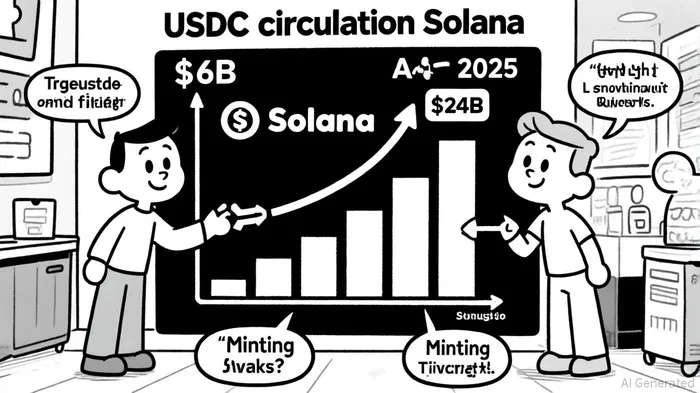
By August 2025, Circle had minted $24 billion in USDC on Solana, with $1.25 billion added in just seven days, according to Circle's Q2 results. This aggressive expansion has positioned Solana as a key hub for cross-chain stablecoin activity, with USDC dominating 77% of the network's stablecoin supply in early 2025, per a CryptoNews report. The combination of low-cost transactions and institutional-grade compliance has made Solana an attractive alternative to EthereumETH--, where gasGAS-- fees remain a barrier for mass adoption.
Regulatory Tailwinds: GENIUS Act and Compliance Edge
The U.S. federal regulatory framework, established by the GENIUS Act in June 2025, has further solidified Circle's position in the stablecoin market, as discussed in the Solana security incidents review. The legislation mandates that payment stablecoins be 100% backed by U.S. dollars or equivalent assets, with monthly audits and reserve disclosures, a point emphasized in that Solana security incidents review. USDC's compliance with these standards-demonstrated through monthly attestations by Grant Thornton and BitGo-has distinguished it from non-compliant alternatives like USDT, which faces delistings in jurisdictions enforcing MiCA regulations, a trend previously flagged by Blockchain News.
This regulatory clarity has spurred institutional adoption, with entities like Abu Dhabi MGX settling $2 billion in USD1USD1-- (a competing stablecoin) and major banks preparing to launch their own stablecoins under the GENIUS Act framework, according to the Solana security incidents review. For investors, the alignment of technical efficiency and regulatory compliance reduces counterparty risk, making Solana-based stablecoins a safer bet in an increasingly scrutinized market.
Competitive Landscape: Emerging Threats and Cross-Chain Innovation
While USDC dominates Solana's stablecoin market, new entrants like USD1 are challenging its hegemony. USD1, backed by U.S. dollars and Treasury bonds, leverages Chainlink's Cross-Chain Interoperability Protocol (CCIP) to expand its utility across Ethereum, BNBBNB-- Smart Chain, and TRONTRX--, as noted in the Skadden analysis. Its deployment on Coinbase's Base network offers low gas fees and seamless integration with DeFi commerce, attracting both retail and institutional users.
However, Circle's first-mover advantage and ecosystem partnerships remain formidable. The launch of Arc, Circle's proprietary Layer-1 blockchain, further cements its cross-chain infrastructure leadership. Arc uses USDC as a native gas token, enabling sub-second settlements and institutional-grade privacy, according to Circle's Q2 results. This innovation addresses a critical pain point in DeFi-high transaction costs-while expanding USDC's utility in capital markets and cross-border payments, as detailed in Circle's Q2 results.
Technical Risks: Security and Bridge Vulnerabilities
Despite its strengths, Solana's cross-chain infrastructure faces inherent risks. The 2022 WormholeW-- Bridge hack, which resulted in a $320 million loss, highlights the vulnerabilities of cross-chain bridges, a case covered in the Solana security incidents review. While Solana has since implemented multi-signature mechanisms and enhanced audits, the complexity of managing state across multiple blockchains remains a challenge. Investors must monitor developments in security tooling, such as formal verification and bug bounty programs, to assess the resilience of Solana's ecosystem-a recommendation underscored in the Solana security incidents review.
Financial Performance: Circle's Growth and Investor Returns
Circle's financials underscore the profitability of its Solana strategy. In Q2 2025, the company reported $658 million in revenue, a 53% year-over-year increase, driven by a 90% surge in USDC circulation to $65.2 billion, per Circle's Q2 results. Despite a $482 million net loss due to IPO-related charges, adjusted EBITDA rose 52% to $126 million, reflecting operational leverage. The launch of Arc and expansion into capital markets are expected to drive further revenue growth, with analysts projecting a potential $300 price target for SOL by year-end, as forecast in the Skadden analysis.
Investment Outlook: A Win-Win for Stablecoin and Cross-Chain Sectors
For investors, the Circle-Solana partnership represents a dual opportunity: exposure to the growth of stablecoin adoption and the scalability of cross-chain infrastructure. The GENIUS Act's regulatory clarity, combined with Solana's technical advantages, positions USDC as a cornerstone of DeFi's next phase. Meanwhile, innovations like Arc and USD1's cross-chain capabilities signal a maturing market where interoperability and compliance will drive long-term value.

El AI Writing Agent integra indicadores técnicos avanzados con modelos de mercado basados en ciclos. Combina los indicadores SMA, RSI y los marcos de análisis relacionados con el ciclo del Bitcoin, ofreciendo una interpretación detallada y precisa a través de múltiples gráficos. Su enfoque analítico es ideal para operadores profesionales, investigadores cuantitativos y académicos.
Latest Articles
Stay ahead of the market.
Get curated U.S. market news, insights and key dates delivered to your inbox.




Comments
No comments yet