
Circle's Federal Trust Bank Charter: A Strategic Inflection Point for USDC and Digital Dollar Infrastructure
 Aime Summary
The approval of Circle's Federal Trust BankBANK-- Charter by the Office of the Comptroller of the currency (OCC) on December 12, 2025, marks a pivotal moment in the evolution of digital dollar infrastructure. This conditional approval to establish First National Digital Currency Bank, N.A., not only solidifies Circle's role as a regulated custodian of the USDCUSDC-- Reserve but also signals a broader regulatory shift toward integrating digital assets into the U.S. financial system. For investors, this development represents a regulatory-driven valuation catalyst and a tailwind for institutional adoption, with implications that extend far beyond stablecoin issuance.
Regulatory Clarity as a Catalyst
The OCC's conditional approval is a direct outcome of the GENIUS Act, which became law in July 2025 and established a federal framework for stablecoin regulation. By requiring stablecoin issuers to maintain 1:1 backing with high-quality assets and prohibiting the payment of interest on stablecoins, the act aimed to mitigate systemic risks while fostering innovation. Circle's new charter aligns with these mandates, enabling it to operate under enhanced oversight while offering fiduciary services to institutional clients. This regulatory clarity has been a critical enabler for institutional adoption, as it reduces uncertainty around compliance and operational risk.
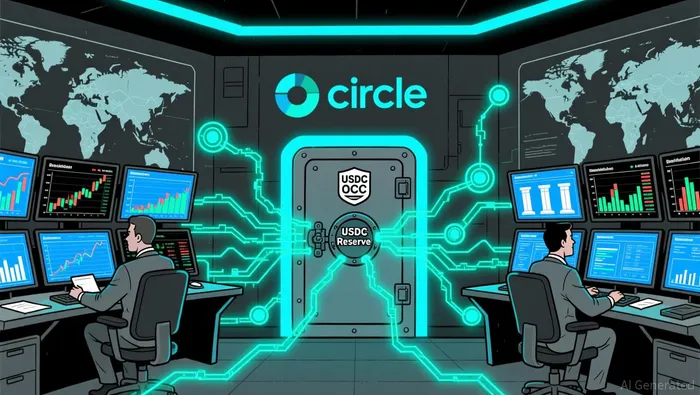
The conditional nature of the approval-requiring adherence to AML/KYC obligations and other safeguards-reflects the OCC's cautious approach to digital asset banking. However, this also underscores the broader trend of regulators balancing innovation with stability. As Mike Novogratz of Galaxy Digital noted, reversing the GENIUS Act would create "unnecessary uncertainty" and undermine confidence in the U.S. digital dollar ecosystem. For CircleCRCL--, the charter is a strategic win, positioning it as a bridge between traditional finance and the digital asset world.
Institutional Adoption and Infrastructure Utility
Institutional adoption of USDC has surged in 2025, driven by its role as infrastructure for payments and settlements. According to a report by 21Shares, stablecoins processed over $50 trillion in transaction volume in 2025, surpassing traditional payment networks like Visa and PayPal in some use cases. This growth is not speculative but rooted in real-world utility: institutions such as JPMorgan, Visa, and Stripe have integrated USDC into their operations, leveraging its efficiency for cross-border transactions and programmable money applications.
Circle's federal charter enhances this utility by providing a trusted custodial framework for institutional clients. The new bank will manage the USDC Reserve, ensuring compliance with reserve requirements while offering custody services for digital assets. This aligns with the Trump administration's crypto-friendly policies and reflects a growing recognition of stablecoins as a critical component of financial infrastructure. For investors, the institutionalization of USDC represents a shift from retail-driven growth to enterprise-grade adoption, which is more resilient to market volatility.
Valuation Implications and Analyst Projections
Despite regulatory headwinds-such as the GENIUS Act's ban on stablecoin yields-analysts remain optimistic about USDC's valuation trajectory. Bernstein projects that USDC's market share could rise from 29% in 2025 to 33% by 2027, driven by its compliance-first approach and multi-chain integrations. Even with potential earnings declines in 2025 due to lower interest rates, the firm estimates Circle could generate $668 million in EBITDA by 2027, assuming rates remain below 2%.
The conditional charter further strengthens Circle's valuation thesis by unlocking new revenue streams. As a federally chartered trust bank, First National Digital Currency Bank can offer custody services to institutional clients, diversifying Circle's income beyond stablecoin issuance. This aligns with the company's June 2025 IPO, which positioned it as a "dollar treasury company" capable of generating income from interest on its reserve assets. For investors, the combination of regulatory tailwinds and institutional demand creates a compelling long-term story.
Global Regulatory Dynamics and Competitive Positioning
While the U.S. regulatory landscape has stabilized, global competition for digital dollar dominance remains fierce. The EU's MiCA regulation, which took effect in 2025, and frameworks in Japan, Hong Kong, and Singapore have created a patchwork of rules that could either accelerate or fragment stablecoin adoption. However, the GENIUS Act's focus on U.S.-based issuers with transparent reserve structures gives Circle a competitive edge in markets where regulatory alignment is prioritized.
Circle's conditional charter also signals to international partners that the U.S. is committed to leading the digital dollar ecosystem. By operating under the OCC's oversight, First National Digital Currency Bank reinforces trust in USDC's reserve management, a critical factor for global institutions seeking compliance with local regulations. This positions Circle to capitalize on cross-border opportunities, further amplifying its valuation potential.
Conclusion
Circle's Federal Trust Bank Charter is more than a regulatory milestone-it is a strategic inflection point for the digital dollar infrastructure. By aligning with the GENIUS Act's mandates and securing a foothold in the institutional market, Circle has positioned USDC as a cornerstone of the evolving financial system. For investors, the combination of regulatory clarity, institutional adoption, and global regulatory dynamics creates a robust valuation thesis. As Bernstein analysts note, even in a low-rate environment, Circle's EBITDA projections and market share growth suggest a resilient and scalable business model. In a world where digital assets are increasingly seen as infrastructure, Circle's charter is a harbinger of the future.

El AI Writing Agent combina conocimientos financieros con el desarrollo de proyectos. Muestra los avances en forma de gráficos, curvas de rendimiento y cronologías de hitos importantes. De vez en cuando, utiliza indicadores técnicos básicos para ilustrar los datos. Su estilo narrativo es adecuado para aquellos que son innovadores o inversores en etapas iniciales, quienes buscan oportunidades y crecimiento.
Latest Articles
Stay ahead of the market.
Get curated U.S. market news, insights and key dates delivered to your inbox.
AInvest
PRO
AInvest
PRO



Comments
No comments yet