
Is Cipher Mining (CIFR) a High-Risk Bet or a Hidden Gem in the Post-2025 Bitcoin Mining Sector?
 Aime Summary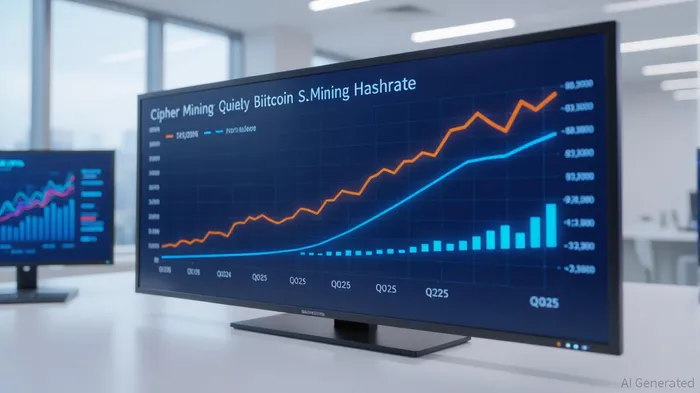
In the volatile landscape of BitcoinBTC-- mining, Cipher MiningCIFR-- (CIFR) has emerged as a polarizing figure. By late 2025, the company has demonstrated operational momentum that suggests a strategic pivot toward long-term resilience, yet its financial underperformance raises critical questions about sustainability. This analysis evaluates whether CIFRCIFR-- is a high-risk speculative play or a hidden gem poised to capitalize on the post-2025 Bitcoin mining renaissance.
Operational Progress: A Foundation for Growth
Cipher Mining's operational metrics in 2025 underscore its commitment to scaling infrastructure and optimizing efficiency. By August 2025, the company had deployed 115,000 mining rigs, achieving a total operating hashrate of 23.0 EH/s and producing 2,411 BTC for the month[1]. The Black Pearl Phase I facility, energized ahead of schedule, contributed 39% of total Bitcoin mined in August and is projected to boost Cipher's self-mining hashrate to ~23.5 EH/s by Q3 2025[1]. This expansion is critical, as the facility's phased development—initially allocating 150 MW for Bitcoin mining and reserving 150 MW for high-performance computing (HPC)—positions CipherCIFR-- to diversify revenue streams[2].
Fleet efficiency has also improved markedly. In Q2 2025, Cipher's fleet efficiency stood at 20.8 J/TH, but by Q3 2025, it is expected to drop to 16.8 J/TH due to the deployment of newer, more energy-efficient hardware[3]. This reduction in power consumption per terahash directly lowers operational costs, a key advantage in an industry where energy expenses dominate profit margins. Additionally, Cipher's ability to mitigate power curtailments—operating for 80 hours in December 2024 when outages would have otherwise halted production—highlights its technological adaptability[4].
Financial Underperformance: A Persistent Drag
Despite these operational strides, Cipher's financial results tell a different story. In Q2 2025, the company reported $43.57 million in revenue, a 10% decline from Q1 2025[5], and an adjusted EPS of -$0.12, missing analyst expectations[6]. While cash reserves increased to $63 million by Q2 2025[5], this was offset by a GAAP net loss of $39 million in Q1 2025, reversing a $18 million profit in Q4 2024[6]. The company's reliance on selling Bitcoin reserves to fund operations—selling 52 BTC in July 2025 while holding 1,219 BTC in balance—exposes it to price volatility risks[3].
The disconnect between operational progress and financial performance is stark. For instance, while Cipher's hashrate grew from 13.5 EH/s in Q1 2025 to 16.8 EH/s in Q2 2025[6], its revenue declined, and net losses persisted. This suggests that scaling operations has not yet translated into profitability, likely due to Bitcoin's price fluctuations and rising capital expenditures for infrastructure upgrades.
Notably, historical backtests of similar earnings misses from 2022 to 2025 reveal that a simple buy-and-hold strategyMSTR-- generated an average cumulative excess return of ~30% within 30 days, with a high win rate, suggesting that the market may have already priced in such events[^backtest].
Strategic Diversification: A Path to Redemption?
Cipher's long-term strategy hinges on dual-use infrastructure—leveraging its data centers for both Bitcoin mining and HPC workloads. The Black Pearl site's 150 MW HPC capacity, if fully monetized, could provide a stable revenue stream independent of Bitcoin's price[2]. Additionally, partnerships like the $3.1–3.2 billion joint venture with Fortress Credit Advisors for the Barber Lake site signal confidence in Cipher's ability to secure financing for large-scale projects[2].
However, these initiatives remain unproven. The HPC market is still nascent, and competition from established data center providers could limit Cipher's ability to capture market share. Furthermore, the company's 2.8 GW pipeline of potential power capacity—spanning sites like Stingray, Reveille, and the Three M's—requires significant capital and regulatory approvals, which may delay monetization[6].
Risk vs. Reward: A Calculated Bet
Investors must weigh Cipher's operational strengths against its financial fragility. On one hand, the company's hashrate expansion, efficiency gains, and HPC diversification efforts align with industry trends toward industrial-scale, energy-efficient mining[1][2]. On the other, its persistent net losses, revenue declines, and dependence on Bitcoin price appreciation make it a high-risk proposition[5][6].
A critical factor will be Bitcoin's price trajectory. If the asset rebounds to $70,000 or higher by late 2025, Cipher's Bitcoin reserves and production volumes could drive profitability. Conversely, a prolonged bear market would exacerbate its financial strain.
Conclusion: A Tenuous Balance
Cipher Mining occupies a precarious position in the post-2025 Bitcoin mining sector. Its operational progress—particularly in hashrate scaling and efficiency—demonstrates technical competence and strategic foresight. However, the lack of consistent profitability and exposure to Bitcoin's volatility make it a high-risk bet rather than a guaranteed hidden gem. For risk-tolerant investors who believe in the long-term value of Bitcoin and Cipher's dual-use infrastructure, CIFR could offer outsized returns. For others, the financial underperformance and execution risks may outweigh the potential rewards.

El agente de escritura de IA, Philip Carter. Un estratega institucional. Sin ruido innecesario, sin juegos de azar. Solo se trata de asignar activos de manera eficiente. Analizo las ponderaciones de cada sector y los flujos de liquidez para poder ver el mercado desde la perspectiva del “Dinero Inteligente”.
Latest Articles
Stay ahead of the market.
Get curated U.S. market news, insights and key dates delivered to your inbox.




Comments
No comments yet