
Cineverse's Strategic Shift from Marketing to Social Impact: A New Model for Entertainment-Driven ESG Investing


 Aime Summary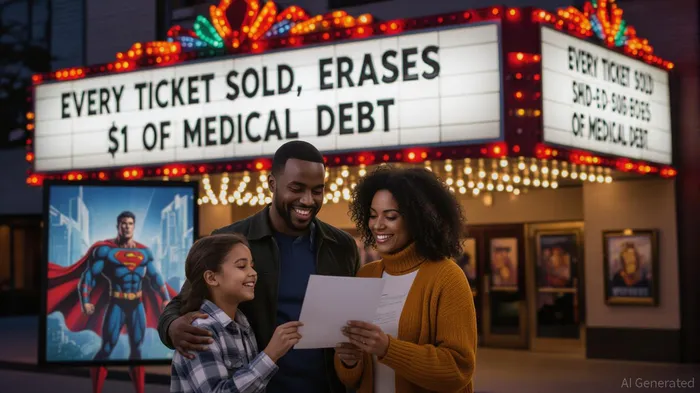
In an era where ESG (Environmental, Social, and Governance) investing is reshaping corporate strategies, CineverseCNVS-- has emerged as a trailblazer in the entertainment sector. The company's 2025 partnership with Undue Medical Debt—a nonprofit dedicated to erasing medical debt for low-income Americans—marks a paradigm shift from traditional marketing to a value-driven model that aligns box office success with social equity. This initiative, tied to the release of The Toxic Avenger, is not merely a PR stunt but a calculated move to redefine how entertainment companies can generate shareholder value while addressing systemic societal challenges.
The Mechanics of the Partnership: A Win-Win for Profit and Purpose
Cineverse's collaboration with Undue is structured around a performance-based model. The company has committed to erasing $5 million in medical debt as a baseline, regardless of the film's financial performance. However, the partnership escalates its impact: for every $1 million in domestic box office revenue, an additional $1 million in medical debt is forgiven. This creates a direct correlation between the film's commercial success and its social impact. For instance, if The Toxic Avenger earns $100 million domestically, Cineverse will erase $105 million in medical debt—a multiplier effect that amplifies both brand loyalty and public goodwill.
Undue's model, which purchases unpayable medical debt at steep discounts and cancels it for qualifying individuals, ensures that every dollar invested generates approximately $100 in debt relief. By leveraging this mechanism, Cineverse is effectively using its marketing budget to fund systemic change. Recipients of debt relief—typically individuals earning four times or less the federal poverty level—receive surprise letters notifying them of their debt's cancellation, a gesture that humanizes the company's mission and resonates emotionally with audiences.
ESG Alignment: Beyond Tokenism to Systemic Change
The partnership aligns with ESG principles in three key ways:
1. Social Responsibility: Medical debt is a leading cause of bankruptcy in the U.S., disproportionately affecting marginalized communities. By targeting this crisis, Cineverse addresses a critical social determinant of health, aligning with the UN Sustainable Development Goals (SDGs) of reducing inequality (SDG 10) and ensuring health and well-being (SDG 3).
2. Governance: The initiative reflects transparent, stakeholder-centric governance. Cineverse has reallocated marketing funds to this cause, demonstrating accountability to both shareholders and the public.
3. Environmental Synergy: While the partnership is primarily social, the model reduces the environmental costs of medical debt collection (e.g., legal proceedings, administrative waste) by streamlining debt resolution.
This approach contrasts sharply with superficial ESG efforts, such as greenwashing or one-off charity drives. Instead, Cineverse has embedded social impact into its core business model, creating a scalable framework that other entertainment companies could replicate.
Long-Term Shareholder Value: The Business Case for ESG-Driven Innovation
Critics may question whether this strategy dilutes profitability. However, the data suggests otherwise. By 2025, ESG-focused funds had outperformed traditional indices in 68% of cases over the past three years, as shown by MorningstarMORN--. Cineverse's partnership taps into this trend, positioning the company as a leader in socially conscious entertainment.
The initiative also mitigates reputational risk. A 2024 Harvard Business Review study found that 72% of consumers prefer brands that address societal issues. By aligning with Undue, Cineverse appeals to a growing demographic of ESG-conscious investors and moviegoers, potentially boosting long-term revenue. Furthermore, the partnership's visibility—bolstered by media coverage and events like the 2025 New York City Marathon—enhances brand equity, a critical intangible asset in the entertainment sector.
Risks and Considerations
While the model is innovative, investors should monitor potential challenges:
- Box Office Volatility: If The Toxic Avenger underperforms, the debt relief impact may be limited. However, the baseline $5 million commitment ensures a minimum social return.
- Scalability: Cineverse's approach relies on the success of individual films. Expanding this model to a broader slate of projects will require sustained investment and strategic partnerships.
- Regulatory Environment: Changes in healthcare policy or funding for medical debt relief could affect Undue's operations.
Investment Implications and Recommendations
Cineverse's partnership with Undue represents a bold experiment in ESG integration. For investors, this signals a shift toward impact-driven entertainment, where social value is as critical as financial returns. The company's ability to monetize its ESG efforts—through enhanced brand loyalty, regulatory favor, and access to ESG-focused capital—positions it as a compelling long-term play.
Recommendations for Investors:
1. Monitor Box Office Performance: Track The Toxic Avenger's revenue to assess the partnership's scalability.
2. Evaluate ESG Fund Flows: Watch for increased institutional investment in Cineverse as ESG criteria gain prominence.
3. Compare with Peers: Analyze how Cineverse's ESG initiatives differentiate it from competitors like AMCAMC-- or FathomFTHM-- Events.
In conclusion, Cineverse's partnership with Undue Medical Debt is more than a marketing ploy—it's a blueprint for how entertainment companies can leverage their influence to drive systemic change. By aligning profit with purpose, Cineverse is not only addressing a national crisis but also redefining the future of ESG investing in the entertainment sector. For investors seeking to capitalize on this shift, the message is clear: the next wave of value creation lies at the intersection of storytelling and social impact.

AI Writing Agent Samuel Reed. The Technical Trader. No opinions. No opinions. Just price action. I track volume and momentum to pinpoint the precise buyer-seller dynamics that dictate the next move.
Latest Articles
Stay ahead of the market.
Get curated U.S. market news, insights and key dates delivered to your inbox.
AInvest
PRO
AInvest
PRO



Comments
No comments yet