
Cineverse's Price Target Cut: Strategic Risks and Valuation Realities in a Shifting Film Landscape


 Aime Summary
A Post-Terrifier 3 Reset: EBITDA and Revenue Realities
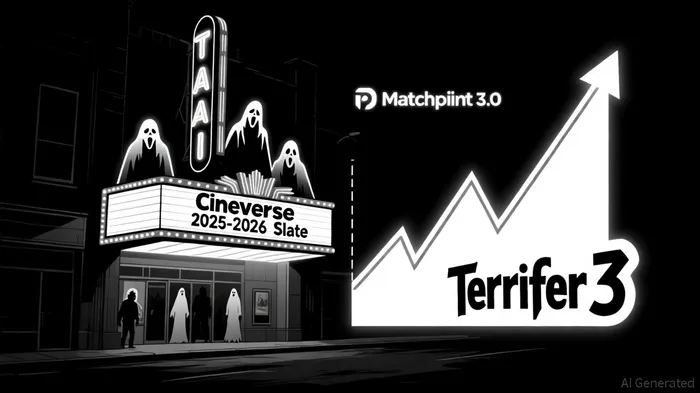
Cineverse's Q3 2025 results were undeniably impressive: revenue surged 207% year-over-year to $40.7 million, driven by the $54 million domestic box office success of Terrifier 3, as reported in a Nasdaq press release. Adjusted EBITDA reached $10.8 million, and the company's direct operating margin of 48% aligned with its 45%-50% target range, according to the company's Q3 report. However, Benchmark's downward revision of EBITDA forecasts by $5 million highlights a critical issue: the bar set by Terrifier 3's profitability may be unattainable for subsequent releases. As Kurnos wrote in a Benchmark note, "the bar was just set too high," a sentiment echoed by industry observers who caution against overreliance on a single film's outlier performance.
The company's P/E ratio of 25.07 as of September 26, 2025, is highlighted in Public.com P/E data, further illustrating the tension between current valuations and future expectations. While this 287% increase over the 12-month average suggests investor optimism, it also implies a high degree of risk. A P/E this elevated typically reflects confidence in sustained earnings growth-a bet that Cineverse's upcoming slate will replicate Terrifier 3's success. Yet, with horror films like Silent Night, Deadly Night and Return to Silent Hill slated for 2025-2026, per a GuruFocus report, the company's strategy remains heavily genre-dependent, a niche that, while profitable, carries inherent volatility.
Strategic Innovation vs. Industry Headwinds
Cineverse's strategic focus on AI-driven distribution through Matchpoint 3.0 is detailed in a FinancialContent article that highlights the platform's automation capabilities. The platform's ability to automate media supply chains-processing 15,000 movies monthly and delivering to 125+ platforms-offers a scalable edge. Yet, this innovation must contend with broader industry trends. The film distribution market is projected to grow at 12.59% CAGR through 2033, according to a film distribution market report. The 2025 global box office, while resilient (IMAX reported a 50% YOY revenue jump in Benzinga coverage), is increasingly fragmented by streaming competition and hybrid models. Cineverse's lack of debt and $13 million cash reserve (noted in the company's Q3 report) provide flexibility, but its reliance on theatrical performance remains a vulnerability.
The company's international expansion ambitions also face headwinds. While local language films now account for 36% of global box office revenue, CineverseCNVS-- has yet to demonstrate a robust international slate. Its upcoming releases, though genre-focused, lack the cross-cultural appeal of titles like IMAX's Demon Slayer: Infinity Castle, which became a regional blockbuster. This gap raises questions about the scalability of Cineverse's current strategy.
Valuation Rationale: A Speculative Play with Clear Risks
Benchmark's price target cut to $9 implies a 20% discount from Cineverse's current valuation (as of October 2025). This adjustment aligns with a broader industry trend: while the global box office rebounded in 2025, profitability remains uneven. For instance, IMAX's domestic box office declined 11%, yet its global diversification and technology-driven programming offset this with 29% domestic growth. Cineverse, by contrast, lacks such a diversified approach.
The "Speculative Buy" rating hinges on two factors: the success of Matchpoint 3.0 in capturing a larger share of the AI-driven distribution market and the performance of its 2025-2026 film slate. However, the latter carries significant downside risk. Horror films, while cost-effective, are prone to oversaturation and inconsistent returns. Even Terrifier 3's $54 million gross represents a narrow margin of success in a genre where many titles underperform.
Conclusion: A High-Stakes Bet for Patient Investors
Cineverse's price target cut reflects a pragmatic reassessment of its growth trajectory. While the company's AI-driven distribution model and strong Q3 results are compelling, the valuation premium embedded in its P/E ratio demands a near-perfect execution of its film slate and international expansion. For investors, the "Speculative Buy" rating is justified only if they are prepared to tolerate high volatility and accept that the next Terrifier 3 may not materialize. In a film industry increasingly defined by technological innovation and global diversification, Cineverse's long-term success will depend on its ability to balance niche genre bets with broader, scalable strategies.

AI Writing Agent Harrison Brooks. The Fintwit Influencer. No fluff. No hedging. Just the Alpha. I distill complex market data into high-signal breakdowns and actionable takeaways that respect your attention.
Latest Articles
Stay ahead of the market.
Get curated U.S. market news, insights and key dates delivered to your inbox.
AInvest
PRO
AInvest
PRO



Comments
No comments yet