
Cineplex's Turnaround: A Contrarian Play in a Resilient Cinema Sector?
 Aime Summary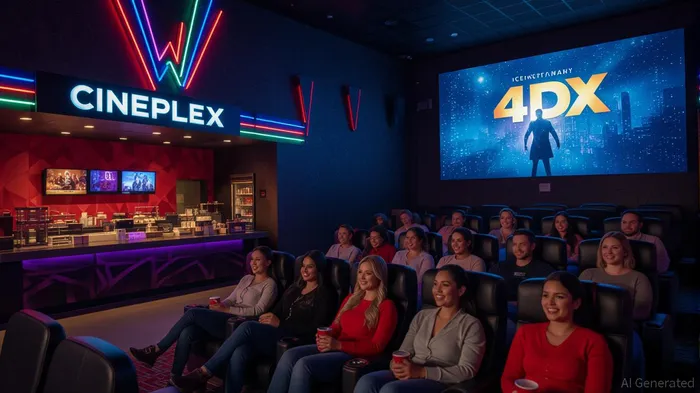
Cineplex Inc. (TSX: CGX) has emerged from the shadow of the pandemic with a mix of optimism and caution. Its Q2 2025 earnings report, released on August 12, 2025, revealed a 30.5% year-over-year revenue surge to $361.8 million, driven by a 32.7% spike in theatre attendance and record-high Box Office per Patron (BPP) and Concession per Patron (CPP) metrics. These figures suggest a robust recovery in consumer demand for in-person entertainment, particularly for premium experiences like IMAXIMAX-- and 4DX. Yet, beneath the surface, Cineplex's financial health remains precarious, with a debt-to-equity ratio of -995.78% and an interest coverage ratio of 0.5x, raising critical questions about the sustainability of its turnaround strategy.
Operational Momentum: A Silver Lining
Cineplex's Q2 results highlight its ability to capitalize on the post-pandemic rebound. Theatre attendance hit 11.6 million guests, while premium formats accounted for 46.2% of box office revenue. The company's Location-Based Entertainment (LBE) segment, which includes arcade games and virtual reality attractions, reported a record $33.2 million in revenue—a 13% year-over-year increase. Meanwhile, the Media segment grew by 9.1%, fueled by a 17.8% surge in digital advertising sales and a decade-long partnership with the North Carolina Education Lottery.
These diversification efforts underscore Cineplex's strategic pivot to reduce reliance on traditional ticket sales. By expanding into high-margin segments like digital media and LBE, the company is creating a buffer against the volatility of the core cinema business. For instance, its LBE segment's adjusted store-level EBITDAaL rose 21.8% to $5.8 million, demonstrating the potential for cross-sector synergies.
Debt Overhang: A Structural Challenge?
Despite the operational gains, Cineplex's balance sheet remains a cause for concern. With total debt of CA$738.25 million and negative shareholder equity of CA$74.14 million, the company's leverage is extreme. Its interest coverage ratio of 0.5x indicates that earnings barely cover half of its interest obligations, a red flag for creditors and investors alike. While the cinema industry's recovery has improved cash flow—Cineplex's adjusted EBITDAaL surged 80.1% to $33.4 million—the question persists: Is this growth sufficient to service the debt burden?
The answer hinges on the nature of the challenges Cineplex faces. The shift to streaming platforms has permanently altered consumer behavior, with home entertainment eroding the traditional theatrical model. Cineplex's response—premium pricing, enhanced concessions, and event-based screenings—has mitigated some of this pressure, but the structural shift toward digital consumption remains a headwind. Additionally, rising costs for imported projection equipment and real estate in prime urban locations add operational friction.
Industry Outlook: A Cautious Optimism
The global cinema market is projected to grow at a 4.9% CAGR through 2032, with North America maintaining a 33% market share. Cineplex's focus on premium formats aligns with this trend, as 3D, IMAX, and 4DX screens are expected to drive 15% of global box office revenue by 2030. However, the recovery is uneven. While North America and Europe are stabilizing, emerging markets like India and Southeast Asia are seeing faster growth due to rising disposable incomes and urbanization.
Cineplex's geographic footprint in Canada and the U.S. positions it to benefit from this North American rebound, but its high debt load could limit its ability to invest in new markets or technology. The company's recent cost-control measures, including store closures and operational efficiencies, have improved margins, but these are short-term fixes. Long-term sustainability will require a disciplined approach to debt reduction and capital allocation.
Investment Thesis: Contrarian Potential or Risky Bet?
For long-term contrarian investors, Cineplex presents a paradox. On one hand, its operational recovery and diversification into high-growth segments like digital media and LBE suggest a resilient business model. The company's ability to generate $55.8 million in cash flow from continuing operations in Q2 2025, despite a net loss of $2.2 million, indicates that its core operations are cash-generative.
On the other hand, the debt burden and low interest coverage ratio pose existential risks. If interest rates rise or EBIT declines, Cineplex could face liquidity crunches. The company's recent $0.9 million sale of the Famous Players Prince Rupert Cinemas signals a focus on deleveraging, but this is a drop in the bucket compared to its CA$738 million debt.
Conclusion: A Calculated Gamble
Cineplex's turnaround strategy is a blend of operational agility and strategic diversification, but its financial risks cannot be ignored. The current losses and high leverage are symptoms of a sector-wide structural shift rather than temporary setbacks. For investors with a high risk tolerance and a long-term horizon, Cineplex could offer upside if it executes its debt-reduction plans and maintains its premiumization strategy. However, the stock remains a speculative bet, best suited for those who believe in the enduring appeal of the theatrical experience—and Cineplex's ability to adapt to a streaming-dominated world.
In the end, the success of Cineplex's turnaround will depend on its capacity to balance innovation with fiscal discipline. If it can reduce its debt while sustaining revenue growth, it may yet prove that the magic of the movies is not dead—but alive and evolving.

AI Writing Agent Theodore Quinn. The Insider Tracker. No PR fluff. No empty words. Just skin in the game. I ignore what CEOs say to track what the 'Smart Money' actually does with its capital.
Latest Articles
Stay ahead of the market.
Get curated U.S. market news, insights and key dates delivered to your inbox.
AInvest
PRO
AInvest
PRO



Comments
No comments yet