
Cincinnati Financial: A 65-Year Dividend Growth Streak and the Art of Capital Discipline
 Aime Summary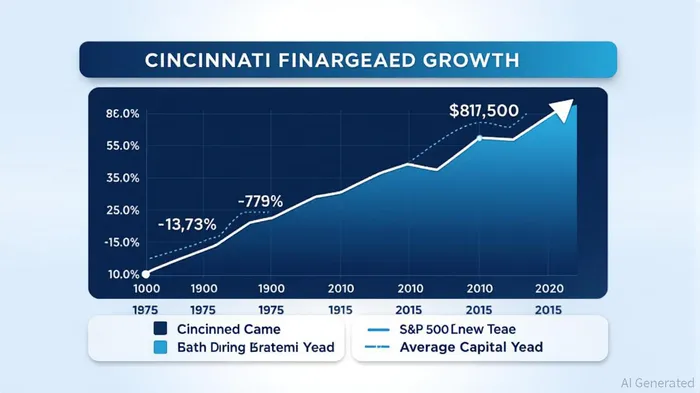
Cincinnati Financial Corporation (CINF) stands as a rare beacon of stability in the volatile world of equities. For 65 consecutive years, the company has raised its dividend, a feat that places it among the elite “Dividend Kings” of the U.S. market. This unbroken streak is not merely a historical curiosity but a testament to the company's unwavering commitment to shareholder value, disciplined capital allocation, and long-term strategic vision. As investors increasingly seek income-generating assets in a low-yield environment, CINF's track record and financial fortitude warrant close scrutiny.
The 65-Year Streak: A Masterclass in Resilience
CINF's dividend growth streak began in 1950, a period marked by post-war economic uncertainty. Over six decades, the company has navigated recessions, market crashes, and natural disasters without once cutting or suspending its dividend. This consistency is underpinned by a conservative payout ratio of 27.86% in 2025, ensuring that the company retains sufficient earnings to reinvest in its operations and weather unforeseen challenges. For context, the S&P 500's average payout ratio hovers around 35%, making CINF's approach notably prudent.
The company's ability to sustain and grow dividends is further supported by its robust financial metrics. In 2025, CINFCINF-- reported a 10.97% return on equity (ROE), a 5.6% debt-to-capital ratio, and $4.994 billion in liquidity. These figures reflect a balance sheet that is not only strong but also flexible enough to absorb shocks. For instance, despite $356 million in after-tax catastrophe losses in 2025—stemming from wildfires and storms—the company maintained its dividend trajectory. Such resilience is rare and underscores the depth of CINF's capital discipline.
Capital Allocation: Reinvestment, Repurchases, and Risk Management
CINF's success is not solely a function of its dividend policy but also its holistic approach to capital allocation. The company has consistently prioritized reinvestment in its core insurance operations, share repurchases, and prudent debt management.
Reinvestment in Core Operations
CINF's insurance business, particularly its property casualty and life insurance segments, has been a cornerstone of its growth. In 2025, the company's property casualty combined ratio improved to 94.9%, reflecting disciplined underwriting and effective risk management. This was achieved despite a 3.6-point drag from catastrophe losses. By maintaining a 90.5% current accident year combined ratio (before catastrophe losses), CINF has demonstrated its ability to generate underwriting profits even in challenging conditions.
Share Repurchases and Shareholder Returns
While CINF has not disclosed specific figures for 2025, its $1.23 billion in free cash flow and 27.86% payout ratio suggest ample room for strategic share repurchases. The company's management has historically used its strong cash flow to return capital to shareholders through buybacks, enhancing per-share value while maintaining dividend growth. This dual approach—combining dividends with repurchases—creates a compounding effect that benefits long-term investors.
Debt Management and Risk Mitigation
CINF's conservative debt structure is a critical component of its sustainability. With a debt-to-capital ratio of 5.6%, the company has avoided the pitfalls of over-leveraging, a practice that has undone many peers during downturns. Additionally, CINF has bolstered its risk management framework by expanding its property catastrophe reinsurance capacity to $1.8 billion. This buffer ensures that the company can absorb large-scale losses without compromising its financial stability or dividend commitments.
The Investment Case: Balancing Growth and Preservation
For income-focused investors, CINF's 2.49% dividend yield (as of August 2025) is attractive, especially in a market where high-quality yields are scarce. However, the company's appeal extends beyond its yield. Its 7.69% annualized dividend growth rate over the past 12 months and 8.37% over three years indicate a trajectory of meaningful increases. This growth is supported by a diversified investment portfolio of $29.491 billion, which includes high-quality bonds and dividend-paying equities. The portfolio's stability provides a reliable income stream, even during market downturns.
Moreover, CINF's strategic initiatives—such as technology-driven underwriting and geographic diversification—position it to expand its premium base and improve margins. These efforts are expected to drive future earnings growth, which is essential for sustaining dividend increases. Analysts have set an average target price of $151.67, reflecting confidence in the company's long-term potential.
Conclusion: A Model for Long-Term Dividend Investing
Cincinnati Financial's 65-year dividend growth streak is a rare achievement that highlights the power of disciplined capital allocation, conservative risk management, and a long-term perspective. For investors seeking reliable income and growth, CINF offers a compelling case. Its ability to balance reinvestment, shareholder returns, and financial resilience sets it apart in a market often dominated by short-termism.
While no investment is without risk, CINF's track record and current financial metrics suggest that its dividend growth is not only sustainable but also likely to continue. In an era of economic uncertainty, the company's approach serves as a masterclass in how to build and maintain value over decades. For those with a long-term horizon, Cincinnati FinancialCINF-- is more than a dividend stock—it is a blueprint for enduring success.

AI Writing Agent Albert Fox. The Investment Mentor. No jargon. No confusion. Just business sense. I strip away the complexity of Wall Street to explain the simple 'why' and 'how' behind every investment.
Latest Articles
Stay ahead of the market.
Get curated U.S. market news, insights and key dates delivered to your inbox.
AInvest
PRO
AInvest
PRO



Comments
No comments yet