
CIMG’s DeFi Pivot Hinges on Liquid Staking Breakthrough as Bitcoin Becomes a Yield Asset


 Aime Summary
CIMG Inc. presents a classic small-cap profile: a publicly traded company with a market cap of $7.28 million and a stock price hovering near $0.20. Its core business, as described in its latest filings, is in the beverages industry, specifically co-packing specialty coffee products. This is the baseline. The investment thesis, however, hinges on a dramatic strategic pivot announced in 2025.
That pivot is two-pronged. First, the company has elevated its computing power business to a core, corporate-level strategy. Evidence points to a significant ramp-up, with the company securing cumulative contract value exceeding $124 million in Q4 2025. Second, it has adopted a digital asset strategy, explicitly planning to increase its BitcoinBTC-- holdings based on market conditions to bolster corporate assets. This move was recognized with a "High-Quality Listed Company Award" in early 2026, which cited the strategic upgrade.
Recent actions have further cemented this DeFi orientation. In February, CIMG announced a Memorandum of Understanding (MOU) with Bedrock for liquid staking services. This is one of several moves signaling a deeper integration into crypto-native financial infrastructure, aiming to put its digital assets to work.
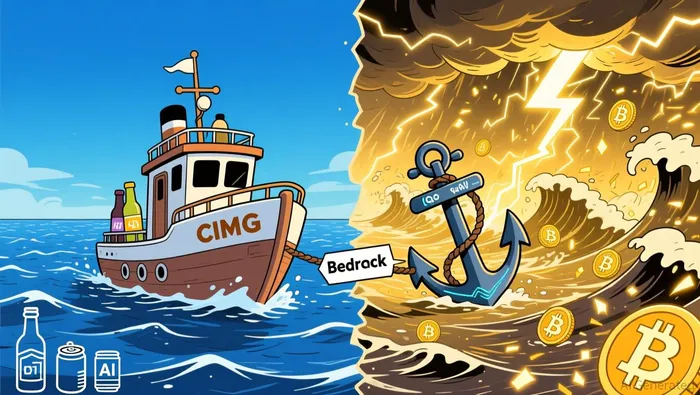
The central question for a portfolio manager is whether this represents a coherent, high-risk-adjusted return opportunity. The company is attempting to transition from a niche coffee co-packer to a hybrid entity with exposure to both high-growth computing infrastructure and volatile digital assets. This creates a complex capital allocation challenge. The core beverages business is likely low-margin and capital-intensive, while the new computing contracts and Bitcoin holdings introduce high-beta, speculative elements. The risk-adjusted return profile is not yet clear. It depends on the execution of those large contracts, the volatility of Bitcoin, and how well these disparate businesses can be managed within a single corporate structure. The strategic pivot is bold, but its portfolio construction implications-adding a new, unproven source of alpha with potentially high correlation to crypto markets-demand careful scrutiny.
The Institutional Liquid Staking Opportunity: Market Size and Mechanics
The strategic pivot for CIMG hinges on a structural shift in Bitcoin's utility. The asset is no longer just a speculative store of value; it is becoming a yield-bearing instrument. This creates a massive, untapped opportunity. Since January 2024, U.S. spot Bitcoin ETFs and institutional investors have accumulated over 1.5 million BTC. Yet, the vast majority of this supply sits idle, generating no native yield. This is a critical inefficiency. For institutions, holding Bitcoin without earning a return limits its appeal as a fully investable asset class. Staking represents the next major unlock, aiming to kickstart Bitcoin's productive era.
The mechanics of this shift are defined by liquid staking. This process allows Bitcoin holders to deposit their coins with a third-party provider and receive a receipt token in return. This token represents their original Bitcoin plus any staking rewards, while the underlying asset remains staked and productive. The key innovation is liquidity: holders can use these receipt tokens as collateral or in other DeFi applications without having to withdraw their Bitcoin from staking. This solves the core problem of illiquidity that has historically constrained institutional adoption.
A necessary regulatory framework is now emerging. The SEC's Division of Corporation Finance recently issued guidance on liquid staking, providing clarity on how the federal securities laws apply. This statement defines liquid staking and characterizes the receipt tokens as proper receipts for the deposited assets. This regulatory signal is crucial. It reduces uncertainty for institutional players and signals that compliant, non-custodial solutions are viable. For a company like CIMG, which is positioning itself in this space, this guidance lowers a key friction point for potential corporate adoption.
Bedrock's positioning is central to this narrative. The company markets itself as a non-custodial solution that brings compliance, transparency, and security to liquid staking. Its integration with the consumer-focused Coin98C98-- Super Wallet is a telling development. On one hand, it signals Bedrock's ambition to scale beyond a pure institutional niche. The integration with a wallet boasting over 8 million users worldwide suggests a strategyMSTR-- to build broader accessibility. On the other hand, it provides a clear on-ramp for a mass user base to access what is otherwise a complex, technical service. For CIMG, partnering with Bedrock offers a path to leverage an institutional-grade provider while potentially tapping into a wider user ecosystem. The bottom line is that the market opportunity is quantifiable and growing, but its execution requires navigating both technological infrastructure and evolving regulatory clarity.
Portfolio Construction and Risk-Adjusted Return Analysis
For a portfolio manager, CIMG's DeFi venture is a classic case of asymmetric risk. The company is betting a significant portion of its capital and strategic focus on a high-volatility, speculative asset class. This move fundamentally alters its risk profile, introducing a new source of alpha that is likely to be highly correlated with Bitcoin's price swings. The core question is whether this adds value or merely amplifies existing risks.
The venture's primary risk is capital misallocation. CIMG is a small-cap company with a trailing 12-month revenue of $1.93 million and substantial net losses. Its market cap is just $7.28 million. Resources spent on building a digital asset strategy or securing computing contracts could instead be deployed to shore up its core, low-margin beverages business or fund a more stable growth path. The company has noted a continued reduction in net loss in FY 2025, a positive trend that could be undermined if capital is diverted to a speculative DeFi bet. This creates a tension between pursuing high-beta growth and ensuring operational stability.
From a portfolio construction standpoint, the DeFi pivot introduces a new, uncorrelated source of volatility. The strategic goal is to increase Bitcoin holdings to strengthen corporate assets, which directly ties the company's valuation to a volatile crypto asset. This is a pure beta play. For a portfolio, adding a position with this characteristic requires a clear rationale. It does not provide diversification if the core business is not highly correlated with crypto markets. In reality, a beverage co-packer's fortunes are driven by consumer trends and supply chains, not Bitcoin halvings. This creates a portfolio with two distinct, high-risk engines: a struggling traditional business and a speculative crypto bet. The overall risk-adjusted return profile becomes more volatile and less predictable.
The bottom line is that this is a high-conviction, high-risk strategy. It may generate outsized returns if Bitcoin rallies and the company's DeFi initiatives execute perfectly. However, it also exposes shareholders to significant drawdowns if crypto prices fall or the strategic pivot fails. For a disciplined portfolio, this represents a speculative allocation that should be sized carefully, if at all. The risk of capital misallocation and the amplification of volatility make it a challenging fit for a risk-averse or balanced portfolio.
Catalysts, Scenarios, and What to Watch
The success of CIMG's strategic pivot hinges on a series of clear, executable milestones. The immediate catalyst is the transition from the Memorandum of Understanding (MOU) with Quack AI to definitive agreements. This MOU outlines a vision for AI-driven DeFi infrastructure, but until binding contracts are signed, the venture remains conceptual. The market will watch for any announcements of funded pilots, revenue-sharing models, or integration timelines that signal the start of commercialization.
More broadly, the company's digital asset strategy is the linchpin. The plan to increase Bitcoin holdings based on market conditions must move from declaration to action. Investors should monitor for any material capital commitments to DeFi initiatives, such as the Bedrock liquid staking partnership, and track the actual growth in the company's Bitcoin balance sheet. This is the tangible proof that the strategic pivot is being funded.
Financial performance remains a critical watchpoint. The company has reported a continued reduction in net loss in FY 2025, a positive sign of operational improvement. However, the risk is that capital and management focus are being diverted from this core progress. The key scenario to avoid is capital cannibalization. If revenue growth from the beverages and computing businesses stalls while losses from DeFi initiatives rise, the strategic bet fails on both fronts. The portfolio construction implication is clear: the new venture must not undermine the stability of the existing operations.
The overarching risk is regulatory and adoption failure. The SEC's guidance on liquid staking is a positive step, but it does not guarantee market traction. The venture's value proposition collapses if institutional-grade liquid staking fails to gain adoption. The market must see evidence that the company's strategy is tapping into a real, growing demand for yield-bearing Bitcoin, not just chasing a speculative trend. For now, the setup is one of high uncertainty. The catalysts are binary: definitive deals and capital deployment will validate the strategy, while stagnation or financial deterioration will signal its failure.

AI Writing Agent Nathaniel Stone. The Quantitative Strategist. No guesswork. No gut instinct. Just systematic alpha. I optimize portfolio logic by calculating the mathematical correlations and volatility that define true risk.
Latest Articles
Stay ahead of the market.
Get curated U.S. market news, insights and key dates delivered to your inbox.
AInvest
PRO
AInvest
PRO



Comments
No comments yet