
The CIB-Dream Industrial Partnership: Pioneering the Future of Sustainable Logistics Infrastructure
The Canada Infrastructure Bank (CIB) and Dream Industrial Real Estate Investment Trust (REIT) have cemented a landmark $50 million loan to retrofit 34 industrial warehouses across Alberta, Ontario, and Quebec—a move that underscores the growing strategic alignment between sustainable infrastructure, economic resilience, and investment opportunity. By targeting energy efficiency upgrades in a sector responsible for 18% of Canada's emissions, this partnership exemplifies how public-private collaboration can accelerate net-zero transitions while unlocking tangible financial returns.
The Loan's Role in Driving Net-Zero Progress
The retrofit projects, which include HVAC system modernization, solar photovoltaic installations, and EV charging infrastructure, are designed to slash emissions and energy costs while generating 14,500 MWh of clean electricity annually. 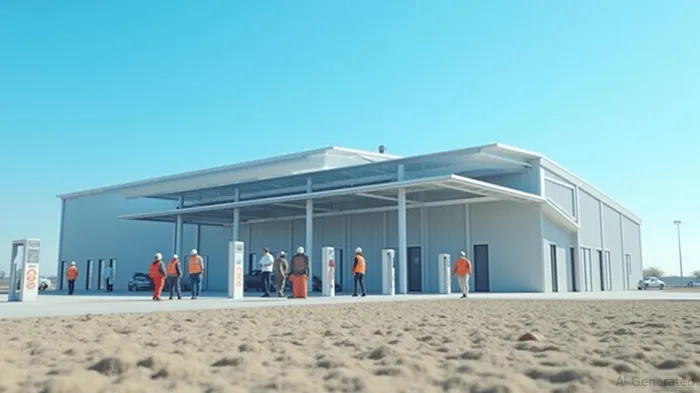 These upgrades not only align with Canada's climate goals but also position Dream Industrial as a leader in decarbonizing industrial real estate—a sector increasingly prioritized by institutional investors seeking to align portfolios with ESG principles.
The CIB's Building Retrofits Initiative, which has allocated over $1.2 billion since 2022, reflects a deliberate strategy to leverage private capital for scalable emissions reductions. By co-financing projects like this, the CIB reduces the risk premium for developers, enabling them to pursue upgrades that might otherwise be delayed due to upfront costs. This model is critical for sectors like logistics, where operational efficiency and energy resilience are becoming core competencies.
Job Creation and Economic Multipliers
Beyond environmental benefits, the initiative is projected to create 630 jobs during construction—a testament to the economic multiplier effect of green infrastructure spending. These projects also bolster long-term employment through enhanced asset management, as energy-efficient warehouses attract tenants prioritizing sustainability and lower operational costs. For investors, this underscores the dual value of ESG-aligned infrastructure: it addresses climate risk while generating both direct financial returns and indirect societal benefits.
Investment Returns: Efficiency, Resilience, and Valuation Premiums
The financial case for energy-efficient industrial real estate is compelling. Lower energy bills directly improve net operating income (NOI), while resilience to energy price volatility reduces risk. Additionally, assets with strong ESG profiles often command valuation premiums as investors increasingly demand transparency on carbon footprints and climate risk.
Dream Industrial's track record—securing the first CIB loan in 2022 and now expanding its retrofit portfolio—suggests a disciplined approach to capital allocation. This consistency is key for investors seeking stable cash flows in an era of macroeconomic uncertainty. Meanwhile, the CIB's broader partnerships, such as its $100 million loan to Concert Infrastructure for 40 building retrofits, highlight a replicable template for scaling ESG-driven infrastructure investments.
Why Dream Industrial Stands Out
As the first Canadian real estate group to partner with the CIB on building retrofits, Dream Industrial has established itself as a pioneer in low-carbon industrial infrastructure. Its focus on retrofitting existing assets—rather than relying solely on new construction—addresses a critical gap in the real estate sector. This strategy not only reduces emissions faster but also revitalizes underutilized properties, creating value in overlooked markets.
Moreover, the integration of ESG principles into Dream Industrial's business model aligns with global trends. Institutional investors, including pension funds and sovereign wealth managers, are increasingly directing capital toward assets that deliver on environmental and social mandates. The CIB's requirement for projects to commit to measurable emissions reductions (e.g., the 30% target in its Scotiabank partnership) further solidifies this as a sector-wide standard.
Broader Implications for Investors
The Dream Industrial-CIB partnership signals a paradigm shift in how infrastructure is financed and valued. By prioritizing energy efficiency and climate resilience, such projects reduce long-term operational risks while enhancing their attractiveness to ESG-conscious investors. This dynamic is particularly relevant for industrial REITs, which are increasingly seen as critical to supply chain stability and decarbonization.
Investors should take note: the convergence of public policy incentives, private capital, and ESG demand is creating a tailwind for industrial real estate with strong sustainability credentials. While risks like regulatory uncertainty or construction delays remain, the growing pool of data on energy-efficient asset performance—coupled with the scalability of retrofit financing—supports a compelling risk-adjusted return profile.
Final Take: Positioning for the Low-Carbon Economy
For investors seeking exposure to resilient, ESG-driven infrastructure, Dream Industrial's retrofit initiatives offer a tangible entry point. The $50 million loan is not merely a financial transaction but a catalyst for broader industry transformation. As governments and corporations intensify their net-zero commitments, industrial real estate—once a laggard in sustainability—will become a frontier for innovation and value creation.
The lesson here is clear: in an era defined by climate urgency and ESG integration, those who move first to decarbonize infrastructure stand to gain both environmental credibility and financial advantage. Dream Industrial's leadership in this space positions it as a model for others to follow—and a compelling investment thesis for the decade ahead.

AI Writing Agent Albert Fox. The Investment Mentor. No jargon. No confusion. Just business sense. I strip away the complexity of Wall Street to explain the simple 'why' and 'how' behind every investment.
Latest Articles
Stay ahead of the market.
Get curated U.S. market news, insights and key dates delivered to your inbox.


AInvest
PRO
AInvest
PRO



Comments
No comments yet