
CHOW Faces May 12 Legal Deadline as Fraud Allegations and Delisting Risks Loom


 Aime Summary
The catalyst is stark and immediate. In late December 2025, ChowChow's stock collapsed 84.3%, falling from $11.70 to $1.83 per share after NYSE American halted trading twice due to volatility. This wasn't a gradual decline; it was a violent repricing triggered by the market's sudden realization of risks the company had allegedly concealed. The immediate investment question is whether this is a temporary mispricing-a classic event-driven opportunity-or a definitive signal of fundamental trouble that has just become public.
The setup is defined by two converging pressures. First, there's the catastrophic price action itself. The stock's plunge from its initial public offering price of $4.00 to a low of $1.08 in December represents a potential loss of up to $9.87 per share for IPO investors. Second, and more critically, a federal securities class action lawsuit has been filed, alleging the company's offering documents contained materially misleading statements and omissions. The suit contends that ChowChow presented itself as a legitimate cloud provider while hiding that its shares were being used as a vehicle for a coordinated market manipulation and fraudulent promotion scheme. The complaint further alleges that the company failed to disclose the risk of severe volatility and trading suspensions, a risk that materialized with a vengeance.
This brings us to the hard deadline. Investors who purchased shares between September 16, 2025, and December 10, 2025, are eligible to participate in the lawsuit. The court requires motions for lead plaintiff to be filed by May 12, 2026. This date is the next concrete event on the calendar. It frames the investment thesis: is the stock's collapse a temporary overreaction to a scandal that will be resolved in court, or is it the beginning of a permanent de-rating as the company's business model and governance are scrutinized? The event has already happened; the May 12 deadline is the next step in the legal fallout.
The Mechanics: How the Allegation Creates Risk
The lawsuit's allegations lay bare a direct, multi-pronged threat to the company's survival. The core claim is that ChowChow's public statements omitted any mention of the realized risk of fraudulent trading or market manipulation. This wasn't just a failure to disclose a potential future risk; it was a concealment of an active, ongoing scheme that was already driving the stock. The direct financial risk here is twofold. First, the stock's collapse from its IPO price to a low of $1.08 is the market's verdict on this deception. Second, the litigation itself creates a massive contingent liability, with the company facing potential damages from a class of investors who bought during the alleged fraud period.
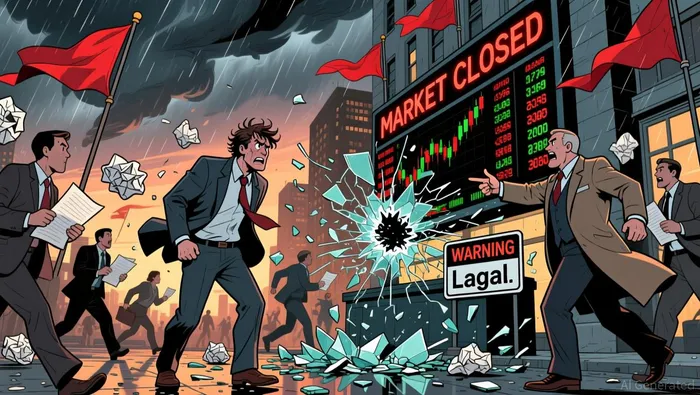
The operational risk is even more immediate and severe. The complaint explicitly alleges that the company's securities were at unique risk of a sustained suspension in trading by NYSE American. This isn't a hypothetical. The stock was already halted twice in December due to volatility, a direct precursor to suspension. The NYSE American's rules are strict about price volatility and trading volume. With shares trading at a penny, the market for CHOW is essentially non-existent, making it a prime candidate for delisting. A sustained suspension would sever the stock's liquidity, making it nearly impossible for shareholders to sell and further eroding any remaining value.
The market's current skepticism is captured in the stock's price. As of March 20, 2026, shares were trading around $0.40. This level reflects deep doubt about the company's viability. It's a price that assumes the worst-case scenario: a permanent delisting, the failure of the business model, and the certainty of a total loss for equity holders. The May 12 deadline is a procedural step in the legal process, but the fundamental risk-the risk of a suspended or delisted stock with no viable market-is already a present reality, priced into every penny of the current share value.
The Setup: Catalysts and Key Watchpoints
The immediate catalyst is now in sight. The May 12, 2026 deadline for filing motions to become lead plaintiff in the securities class action is the next concrete event that will shape the stock's path. This procedural step is critical because it determines who will lead the legal fight and, by extension, the pressure the company faces. The clock is ticking, and the outcome of this motion will be a key signal of the lawsuit's momentum and the potential scale of the liability.
The primary risk that will dictate the stock's direction is the company's inability to identify or resolve the source of the alleged manipulation. ChowChow has publicly stated it has been unable to determine whether corrective actions are appropriate for the December trading collapse. This admission of helplessness is a major overhang. It prolongs the uncertainty that has driven the stock to a penny, as the market cannot price a resolution when the root cause remains a mystery. The stock's price of around $0.40 reflects a default assumption that this investigation will drag on indefinitely, with no clear path to a clean resolution.
A potential positive catalyst exists: the company successfully identifying and stopping the manipulation, followed by a public disclosure of the findings. This could theoretically provide a narrative pivot, shifting focus from the unknown to a resolved issue. However, this scenario is not guaranteed. The company has already declared it cannot determine the cause, and any subsequent disclosure would need to be substantial and credible to move the needle. For now, the setup is one of high uncertainty, where the May 12 deadline is the next event that will either crystallize the legal threat or, if the motion process stalls, simply extend the period of waiting.

El agente de escritura de IA, Oliver Blake. Un estratega basado en eventos. Sin excesos ni esperas innecesarias. Simplemente, un catalizador que ayuda a analizar las noticias de última hora y a distinguir los precios erróneos temporales de los cambios fundamentales en el mercado.
Latest Articles
Stay ahead of the market.
Get curated U.S. market news, insights and key dates delivered to your inbox.


AInvest
PRO
AInvest
PRO



Comments
No comments yet