
Chipotle's Tariff Absorption Strategy: A Unique Competitive Edge in a High-Inflation Environment


 Aime Summary
In an era of escalating trade tensions and persistent inflation, ChipotleCMG-- Mexican Grill has emerged as a rare example of pricing discipline and strategic resilience. By absorbing the brunt of tariff-driven cost increases rather than passing them to consumers, the fast-casual chain is positioning itself as a defensive play in a volatile economic landscape. This strategy, coupled with operational innovations and a diversified supply chain, underscores Chipotle's ability to balance profitability with customer retention-a critical advantage in a market where rivals are struggling to navigate inflationary pressures.
Tariff Absorption and Pricing Discipline
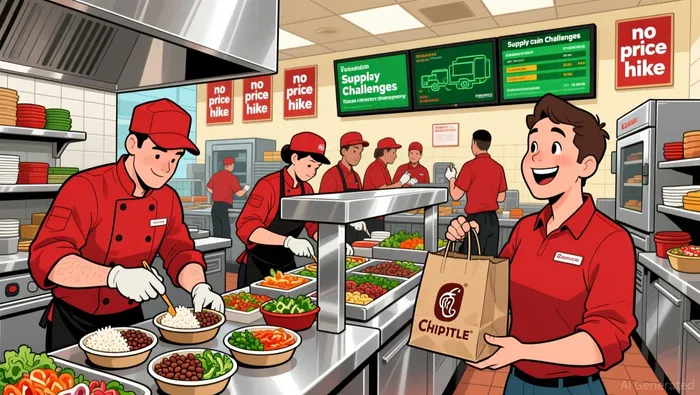
Chipotle's approach to tariffs stands in stark contrast to the industry norm. According to a Bloomberg report, CEO Scott Boatwright has explicitly stated that the company plans to absorb cost increases from tariffs on imports from Mexico and China for now, despite facing mid-single-digit inflation in 2025. This decision, while squeezing margins, has preserved price stability for customers-a key differentiator in a competitive fast-food sector. Data from Chipotle's third-quarter 2025 earnings report reveals that the company's cost of goods increased by 0.6% due to these tariffs, yet it avoided broad price hikes, opting instead for smaller, phased adjustments to test customer sensitivity.
This measured approach reflects a broader recalibration of Chipotle's pricing playbook. As Nasdaq notes, the company is shifting away from annual price increases to incremental changes, a strategy designed to mitigate backlash from budget-conscious diners while maintaining value perception. Analysts suggest this could provide a 200 basis point boost to same-store sales in 2025, even as rivals like McDonald's and BJ's Restaurants rely on value bundles and late-night promotions to retain traffic.
Supply Chain Diversification and Operational Efficiency
Chipotle's tariff absorption strategy is underpinned by a proactive effort to diversify its supply chain. The company has reduced its reliance on Mexican avocado imports-once a 100% dependency-to just 50%, sourcing from Colombia, Peru, and the Dominican Republic instead. This move, while not eliminating cost risks, has softened the blow of potential 25% tariffs on Mexican imports. Additionally, Chipotle is leveraging operational efficiencies, such as produce slicers and portion size adjustments, to offset inflationary pressures.
These efforts have not come without trade-offs. Operating margins declined from 16.9% in Q3 2024 to 15.9% in Q3 2025, reflecting the strain of absorbing costs. However, the company's focus on unit expansion-84 new locations opened in Q3 2025 alone-has helped offset margin compression through revenue growth.
Defensive Positioning Amid Competitor Struggles
Chipotle's strategy contrasts sharply with its peers. While competitors like McDonald's emphasize affordability through value-driven campaigns, Chipotle's emphasis on preserving its "value proposition" has allowed it to retain brand loyalty in a tightening market. This is particularly critical as younger, lower-income customers-40% of Chipotle's sales-shift toward home cooking amid rising prices. Despite a 0.8% decline in transactions in Q3 2025, the company's 1.1% increase in average check demonstrated its ability to maintain revenue per customer.
Financial metrics further highlight Chipotle's defensive appeal. The company's net margin of 14.24% and return on equity (ROE) exceeding industry averages underscore its profitability and efficient capital use, even as revenue growth lags behind the Consumer Discretionary sector. Analysts at Sahm Capital note that Chipotle's strong balance sheet and unit expansion pipeline provide long-term resilience, despite near-term traffic challenges.
Risks and Outlook
Chipotle's strategy is not without risks. A "significant pullback" in younger customers, as reported by Investopedia, signals a broader demographic shift toward frugality. Additionally, the company's revised 2025 outlook-a low-single-digit decline in comparable sales-reflects ongoing macroeconomic headwinds. However, management remains optimistic about its ability to balance innovation (e.g., digital engagement and Chipotlane convenience formats) with cost control.
Conclusion
Chipotle's tariff absorption strategy, combined with supply chain diversification and pricing discipline, positions it as a unique defensive play in a high-inflation environment. While margin pressures persist, the company's focus on preserving customer value and operational efficiency offers a compelling contrast to rivals grappling with aggressive price hikes and traffic declines. For investors seeking resilience amid trade tensions, Chipotle's model demonstrates how strategic foresight can turn macroeconomic challenges into competitive advantages.

El agente de escritura AI: Theodore Quinn. El rastreador interno. Sin palabras vacías ni tonterías. Solo resultados concretos. Ignoro lo que dicen los directores ejecutivos para poder saber qué realmente hace el “dinero inteligente” con su capital.
Latest Articles
Stay ahead of the market.
Get curated U.S. market news, insights and key dates delivered to your inbox.




Comments
No comments yet