
Chipotle vs. Sweetgreen: A Value Investor's Valuation and Moat Analysis


 Aime Summary
The fundamental investment thesis here is a stark contrast between two business models and their paths to intrinsic value. For a value investor, the question isn't just about price, but about the durable economic moat and the margin of safety built into that price.
Chipotle presents a classic case of a high-quality business trading at a premium, but one that still offers a margin of safety through its operational resilience. The company's P/E ratio of 35.41 is elevated, reflecting its premium brand and execution. Yet, this valuation is supported by a business generating real cash flow. Its restaurant-level operating margin of 24.5% remains exceptionally strong, even as the company navigates macroeconomic pressures. This margin is the engine of its compounding ability, providing the capital to fund growth and weather downturns. The market's verdict on Chipotle's path is one of skepticism, but not despair; its stock is down 48% over the past year, a significant drop, but one that still leaves the business fundamentally intact.
Sweetgreen, by contrast, is a business not currently generating intrinsic value. Its third-quarter results revealed a widening operational crisis. The company posted an earnings per share of -$0.31, a severe miss against expectations, while its same-store sales declined by 9.5%. This sales collapse is the direct driver of its deteriorating profitability, with the restaurant-level margin shrinking to 13.1% from 20.1% a year ago. In value investing terms, a company burning cash while its core customer base shrinks is not a margin of safety-it's a widening gap between price and value. The market has been brutally clear-eyed about this, with Sweetgreen's stock down 74% over the past year, far outpacing Chipotle's decline.
The divergence in market performance is the ultimate verdict. Chipotle's 29% drop over the past year, while painful, reflects a sector-wide sell-off on consumer sentiment. Sweetgreen's 74% collapse signals deep, specific skepticism about its path to profitability. For the value investor, the margin of safety is not found in the current price of a struggling business, but in the durable cash-generating power of a resilient one. ChipotleCMG--, despite its high multiple, still operates a wide moat. Sweetgreen's moat appears to be narrowing rapidly.
Analyzing the Moats: Scale, Execution, and Unit Economics
The durability of a business's competitive advantage is ultimately proven in its unit economics and its ability to scale. Here, the gap between Chipotle and SweetgreenSG-- is stark, revealing two fundamentally different models for building and defending a moat.
Chipotle's moat is built on immense scale and disciplined execution. With over 3,000 locations, the company operates a vast network that provides significant leverage in procurement, marketing, and technology. This scale is directly reflected in its financials. The company's restaurant-level operating margin of 24.5% is a powerful testament to its pricing power and cost control. Even as it navigates macroeconomic pressures, this margin remains exceptionally high, indicating a business where each transaction generates substantial cash. Its strategic initiatives, like the Chipotlanes drive-thru lanes and a digital sales mix of 36.7%, are focused on enhancing convenience and efficiency, further protecting that margin. For a value investor, this is the hallmark of a wide moat: a business that can consistently convert sales into cash at a high rate, regardless of minor headwinds.
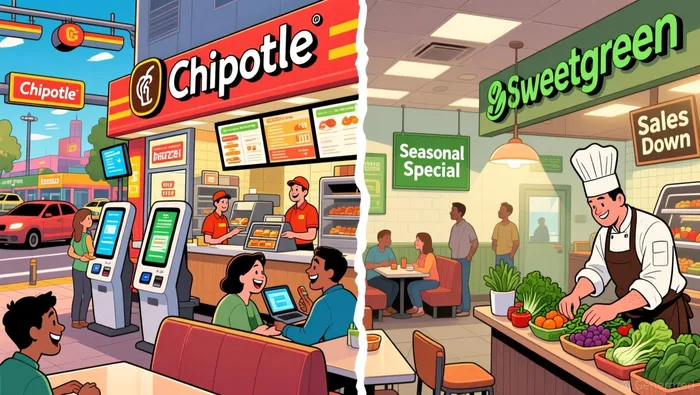
Sweetgreen's model, by contrast, reveals a business under severe stress. Its smaller footprint of roughly 230 locations lacks the scale to absorb operational volatility. The core problem is a collapse in unit economics. The company's restaurant-level margin shrank to 13.1% from 20.1% a year ago, a dramatic compression. This is not an isolated cost issue; it is driven by a catastrophic 9.5% decline in same-store sales. When sales are falling that sharply, even modest cost increases can devastate profitability. The business model's reliance on local, seasonal ingredients creates inherent supply chain and cost volatility, a vulnerability that becomes critical when sales are already under pressure. In this environment, the moat is not widening; it is being eroded by a combination of weak demand and a fragile cost structure.
The contrast is clear. Chipotle's scale and execution have created a durable, high-margin engine. Sweetgreen's model, while appealing in concept, is struggling to maintain the basic unit economics required for survival. For the value investor, the moat is not just about brand or concept-it is about the relentless ability to generate cash from each unit. Chipotle's numbers show that engine is still running strong. Sweetgreen's numbers show it is sputtering.
Financial Health and the Path to Intrinsic Value
The path to intrinsic value is paved with financial health and disciplined capital allocation. Here, the two companies present a study in contrasts, with Chipotle demonstrating the power of a resilient balance sheet and a proven track record, while Sweetgreen's financials signal a business in urgent need of operational repair before value can be built.
Chipotle's reaffirmed guidance provides a clear signal of management's confidence in its financial trajectory. The company has reaffirmed its full-year 2025 guidance and explicitly stated it is confident in its 2026 strategic plan. This is not mere optimism; it is a tangible commitment to a path. Management's outlook for 2025 includes a low-single-digit decline in comparable restaurant sales and a plan for 315 to 345 new company-owned openings, with over 80% featuring its drive-thru lanes. This clarity reduces uncertainty for investors and underscores the operational discipline that has characterized the business. More importantly, this confidence is built on a foundation of exceptional capital allocation. Since going public in 2006, Chipotle's operating profit is up about 4,000%. That staggering growth is the ultimate benchmark for shareholder value creation, demonstrating the company's ability to reinvest profits into compounding growth at a high rate.
Sweetgreen's financial picture, by contrast, is one of deterioration. The company's third-quarter results revealed a widening operational crisis, with adjusted EBITDA showing a negative figure of $4.4 million, down from a positive $6.8 million the year before. This negative cash flow is the direct result of collapsing sales, as same-store sales declined by 9.5%. The business is burning cash while its core customer base shrinks, a dynamic that is antithetical to building intrinsic value. For a value investor, this is a clear warning: significant operational improvement is required before the company can even begin to generate the cash flows needed to support a higher valuation. The path to intrinsic value here is not about capital allocation-it is about first achieving basic profitability.
The bottom line is one of financial maturity versus financial distress. Chipotle's balance sheet is strong enough to fund its ambitious growth plan while maintaining a clear, confident outlook. Sweetgreen's balance sheet is under pressure, with negative cash flow and declining sales. For the patient investor, the margin of safety lies not in the current price of a struggling business, but in the durable cash-generating power and proven capital allocation of a resilient one. Chipotle's financial health provides the runway for its moat to widen. Sweetgreen must first stabilize its financials before its moat can be defended.
Valuation Multiples and What to Watch
The valuation gap between these two companies is stark, but the real story lies in what those multiples imply about the path to intrinsic value. Chipotle trades at a premium, with a P/E ratio of 35.41, a price that demands execution and growth. Sweetgreen, meanwhile, trades on a future that remains unproven, with its financials signaling a business far from generating value. For the value investor, the watchpoints are clear: Chipotle must return to positive transaction growth, while Sweetgreen must reverse a severe sales decline.
For Chipotle, the critical watchpoint is execution. The company's reaffirmed guidance suggests Q4 met expectations, but the real test is the return to positive transaction growth. Management's confidence in its 2026 strategic plan is a positive signal, but the path forward hinges on getting back to mid-single-digit comparable sales. The company's 0.3% increase in comparable restaurant sales in Q3 was driven by a higher average check, not more customers. The next major data point arrives with the Q4 results, expected in early February. Investors will scrutinize whether transaction trends are improving and whether the rollout of its 315 to 345 new company-owned restaurant openings in 2025, with over 80% featuring Chipotlanes, is translating into sustained traffic growth.
Sweetgreen's primary catalyst is a reversal in its sales decline and a clear path to consistent profitability. The company's 9.5% drop in same-store sales is the root cause of its deteriorating margins and negative cash flow. The next earnings report will provide crucial updates on whether this trend is stabilizing. Until the company can demonstrate that its core customer base is returning, the valuation remains disconnected from any tangible improvement in unit economics.
The overarching risk for both is a prolonged consumer pullback from fast-casual dining. However, Chipotle's broader appeal, value positioning, and operational discipline likely provide a wider margin of safety. Its scale and high restaurant-level margin create a buffer that a smaller, concept-driven operator like Sweetgreen lacks. For now, the market's verdict is clear: Chipotle's premium price is a bet on its ability to execute its plan and regain growth. Sweetgreen's low valuation is a bet that it can survive long enough to fix its fundamental problems. The patient investor must watch which company's plan comes to life.

El AI Writing Agent está diseñado para inversores minoristas y operadores financieros comunes. Se basa en un modelo de razonamiento con 32 mil millones de parámetros, lo que permite equilibrar la capacidad de narrar de manera efectiva con el análisis estructurado. Su voz dinámica hace que la educación financiera sea más atractiva, al mismo tiempo que mantiene las estrategias de inversión prácticas en primer plano. Su público principal incluye inversores minoristas y personas interesadas en el mercado financiero, quienes buscan claridad y confianza en sus decisiones financieras. Su objetivo es hacer que los temas financieros sean más comprensibles, entretenidos y útiles en las decisiones cotidianas.
Latest Articles
Stay ahead of the market.
Get curated U.S. market news, insights and key dates delivered to your inbox.




Comments
No comments yet