
Chipotle Stock Falls 1.28% To $50.24 Amid Bearish Technical Signals
Generated by AI AgentAinvest Technical Radar
Monday, Jun 16, 2025 6:47 pm ET3min read
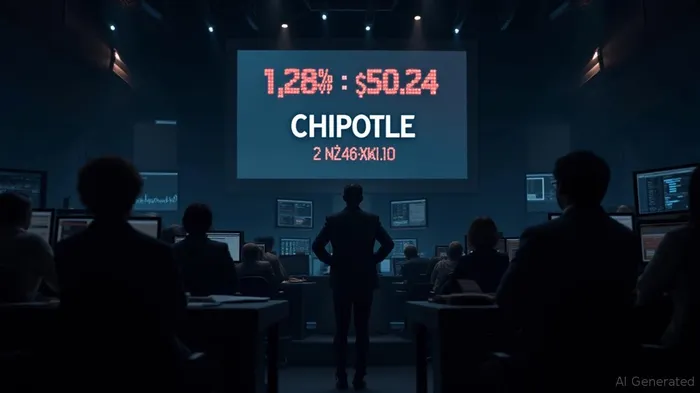
Chipotle Mexican Grill (CMG) concluded its most recent trading session at $50.24, a decline of 1.28%, marking the second consecutive down day and bringing the two-day loss to 2.99%.
Candlestick Theory
Recent price action for Chipotle Mexican Grill reveals significant bearish pressure. The session ending June 11th showed a strong bullish candle closing near its high ($51.79). However, this was immediately followed by a bearish engulfing pattern on June 12th, where the price opened higher but closed near the session low ($50.89) on increased volume, engulfing the prior day's body. This pattern signaled potential exhaustion of the prior uptrend. Subsequent sessions confirmed this weakness, with two further down days (June 13th closing at $50.24) forming a pattern suggesting a downtrend continuation. Key near-term support is observed around $50.00 (psychological level and recent lows near June 3rd close of $50.07). Resistance is now evident near the $50.90-$51.00 zone (recent closes/session lows from June 10th and 12th).
Moving Average Theory
Calculating key moving averages reveals deteriorating trends. The 50-day Moving Average (MA) is situated around $51.85. The price decisively broke below this level on June 12th and remains below it. The 100-day MA, near $52.60, and the 200-day MA, near $54.25, both slope downwards and lie well above the current price. This configuration – price below all key SMAs, with the shorter 50-day below the longer 100-day and 200-day, and all sloping down – indicates a firmly established short-to-intermediate-term downtrend (bearish orientation) with strong longer-term downward pressure. The 50-day MA itself now acts as a dynamic resistance level.
MACD & KDJ Indicators
The Moving Average Convergence Divergence (MACD) for Chipotle Mexican Grill is solidly bearish. The MACD line (12-day EMA - 26-day EMA) is negative and positioned below its signal line (9-day EMA of MACD). Crucially, the MACD histogram shows increasing negative bars, signifying accelerating downward momentum. The KDJ oscillator (particularly %K and %D) is hovering near the oversold territory. While this could suggest the potential for a short-term bounce if it crosses up from oversold, the clear dominance of the MACD signal currently overshadows this, indicating the prevailing downward force is strong, and oversold conditions could persist during a downtrend.
Bollinger Bands
Bollinger Bands (20-period, 2 standard deviations) show notable expansion following the period of consolidation seen around late May. The current price is pressing against the lower Bollinger Band ($50.00-$50.25 area), which is expanding downwards. This signals heightened downside volatility and a potential continuation of the bearish trend. Price persistently hugging or breaching the lower band highlights intense selling pressure. A move back towards the middle band ($51.60-$52.00) would be necessary to signal a potential stabilization or reversal attempt, which currently appears absent.
Volume-Price Relationship
Volume analysis strongly validates the bearish price action. The down day on June 12th (down 1.74%) was accompanied by significantly above-average volume (10.22 million vs prior average), indicating strong conviction behind the selling. Follow-through selling on June 13th (-1.28%) occurred on slightly lower, but still substantial volume (9.31 million). This combination – high volume down days – confirms the breakdown below support levels and reinforces the downtrend's sustainability. The lack of significant volume on up days within this recent decline further underscores the weakness. Volume is clearly favouring the bears.
Relative Strength Index (RSI)
Based on the provided price data, the 14-day RSI for Chipotle Mexican Grill is calculated to be approximately 34. This places it firmly in the oversold territory (<30). While oversold RSI readings can signal potential exhaustion in selling and a possible short-term bounce, it must be interpreted with caution during strong downtrends. The current reading is a warning sign of being oversold but does not automatically predict a reversal; price can remain oversold or even become more oversold in a persistent downtrend. It emphasizes downside risk has recently increased rapidly but requires bullish price confirmation to act as a reversal signal.
Fibonacci Retracement
Applying Fibonacci retracement to the latest significant move (from the swing low near $45.98 on April 8th to the peak near $52.60 on June 5th) provides key levels. The 61.8% retracement level lies near $48.60. The 50% level is around $49.30, and the 38.2% level coincides with the psychological $50.00 mark. The price has already breached the 38.2% support ($50.00) decisively and is threatening the next significant support at the 50% level ($49.30). Further vulnerability exists towards the 61.8% level ($48.60) if selling pressure persists. These levels offer potential downside targets or reversal zones.
Confluence and Divergences
A significant confluence of bearish signals exists. The breakdown below the $51.00-$51.50 support zone (candlestick) coincides with the price falling decisively below the 50-day MA, confirmed by high-volume selling. The bearish MACD, accelerating downward momentum, and the price pressing against the expanding lower Bollinger Band further reinforce this negative picture. The oversold RSI is the only notable counter-signal, but it is overshadowed by the confluence of other negative indicators and the lack of bullish reversal patterns. Currently, there are no significant bullish divergences (e.g., price making lower lows while an oscillator makes higher lows) suggesting underlying strength; all momentum indicators align with the price downtrend. The major divergence observed is between the oversold RSI warning and the strongly bearish confluence of price action, volume, MACD, and moving averages; the weight of evidence currently favours the bearish indicators meaning the downtrend remains dominant despite oversold conditions.

Si he logrado llegar a ciertos lugares, fue gracias a la ayuda de aquellos que han tenido un papel importante en mi desarrollo como persona.
Latest Articles
Stay ahead of the market.
Get curated U.S. market news, insights and key dates delivered to your inbox.


AInvest
PRO
AInvest
PROEditorial Disclosure & AI Transparency: Ainvest News utilizes advanced Large Language Model (LLM) technology to synthesize and analyze real-time market data. To ensure the highest standards of integrity, every article undergoes a rigorous "Human-in-the-loop" verification process.
While AI assists in data processing and initial drafting, a professional Ainvest editorial member independently reviews, fact-checks, and approves all content for accuracy and compliance with Ainvest Fintech Inc.’s editorial standards. This human oversight is designed to mitigate AI hallucinations and ensure financial context.
Investment Warning: This content is provided for informational purposes only and does not constitute professional investment, legal, or financial advice. Markets involve inherent risks. Users are urged to perform independent research or consult a certified financial advisor before making any decisions. Ainvest Fintech Inc. disclaims all liability for actions taken based on this information. Found an error?Report an Issue


ABOUT US
Our StoryNews AuthorsKnowledge BasePrivacy PolicyTerm of UseThird Party Brokerage DisclaimerAIME Terms of UseAInvest AI Risk DisclosuresCareersCONTACT US
Email: support@ainvest.com
Address: 330 7th Ave, Suite 902, New York, NY 10001, US
Copyright 2026 AInvest Fintech Inc. All rights reserved.


Comments
No comments yet