
Chipotle's Drone Delivery Partnership with Zipline: A New Era for Fast-Casual Logistics and Tech-Forward Consumer Stocks
 Aime Summary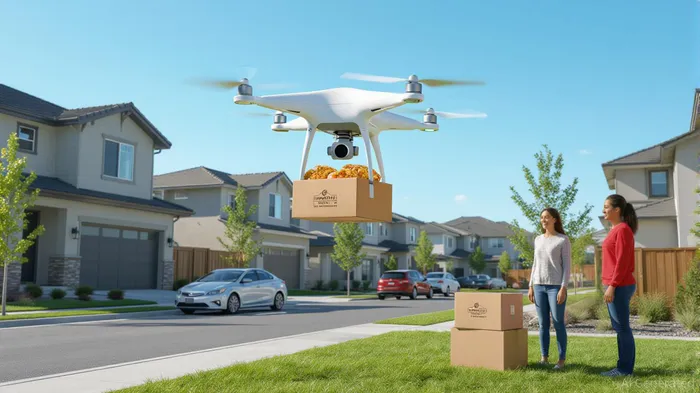
Chipotle Mexican Grill's partnership with Zipline to launch Zipotle, a drone-based delivery service, marks a pivotal moment in the fast-casual dining sector. By leveraging autonomous aerial delivery, ChipotleCMG-- is not only redefining convenience for consumers but also challenging the status quo of last-mile logistics. This initiative, now operational in Dallas, Texas, has far-reaching implications for tech-forward consumer stocks, particularly those integrating automation, sustainability, and AI into their value propositions.
Disruptive Logistics: How Zipotle Reshapes the Fast-Casual Landscape
Zipotle's core innovation lies in its ability to bypass traditional delivery bottlenecks. Using Zipline's Platform 2 drones—engineered to withstand rain, cold, and heat—Chipotle delivers orders in under 15 minutes, even to hard-to-reach locations like backyards and parks. The service operates via the Zipline app, with a flat $2.99 delivery fee and a 15% service fee capped at $6. This model reduces delivery costs by 30–40% compared to gig-worker-based delivery, while maintaining food quality and freshness.
The financial implications are compelling. If the Dallas pilot achieves a 10% adoption rate, it could generate $50 million in incremental annual revenue for Chipotle. Analysts project that the service could expand EBITDA margins by 200–300 basis points over three years, driven by reduced labor costs and operational efficiency. Zipline's proven expertise—100 million commercial miles flown and 1.6 million global deliveries—further validates the scalability of this approach.
ESG Alignment and Investor Sentiment
Chipotle's partnership aligns with its “Cultivate a Better World” mission, emphasizing sustainability. Zipline's zero-emission drones save up to 45 tons of CO2 annually per drone, equivalent to the carbon storage of 1,800 trees. This environmental benefit resonates with ESG-focused investors, a demographic expected to control $53 trillion in assets by 2025.
However, investor reactions have been mixed. Chipotle's stock (CMG) initially dipped post-announcement, reflecting skepticism about execution risks. Yet, analysts maintain a “Strong Buy” consensus, with a 12-month price target of $59.08 (a 37.52% upside from its 2025 price). The stock's long-term potential hinges on Zipotle's ability to scale and meet margin expansion targets.
Broader Industry Trends and Competitive Dynamics
The fast-casual sector is witnessing a surge in tech-driven delivery solutions. Competitors like Sweetgreen and Just Eat Takeaway.com are exploring drone and robot-assisted delivery, signaling a broader industry shift. For instance, Just Eat's AI-powered ground robots in Europe, capable of navigating stairs and curbs at 15 km/h, highlight the global push for autonomous logistics.
PwC's 2024 report, “Drone Deliveries: Taking Retail and Logistics to New Heights,” forecasts 808 million B2C drone deliveries by 2034, up from 5 million in 2024. This growth is driven by cost efficiency, convenience, and sustainability—factors that directly benefit tech-forward stocks. The market for drone delivery services is projected to grow from $1.51 billion in 2024 to $2.72 billion in 2025, with a CAGR of 31.3% through 2032.
Strategic Risks and Opportunities
While Zipotle's potential is vast, challenges remain. Regulatory hurdles, such as FAA approvals for extended operating hours or increased payload sizes, could delay expansion. Technical risks, including adverse weather or cybersecurity threats, also exist. However, Chipotle's phased rollout and Zipline's logistics expertise mitigate these concerns.
For investors, the key is to assess whether Zipotle can achieve its projected adoption rates and margin improvements. If successful, Chipotle could outperform peers like Shake Shack and Wingstop, which are focusing on traditional unit expansion. The integration of AI and drone technology into Chipotle's operations also positions it as a leader in the “digital-first” fast-casual” segment, a category expected to grow as Gen Z and millennials prioritize speed and sustainability.
Investment Thesis: A Buy for the Long-Term
Chipotle's Zipotle initiative is a calculated bet on the future of delivery. The service's alignment with ESG goals, cost efficiency, and brand differentiation makes it a compelling play for tech-forward consumer stocks. While short-term volatility is possible, the long-term upside—driven by margin expansion, revenue growth, and regulatory tailwinds—justifies a “Buy” rating.
Investors should monitor key metrics:
1. Adoption rates in Dallas and subsequent markets.
2. Regulatory progress for drone operations (e.g., extended hours, payload increases).
3. Competitor responses, particularly from chains like SweetgreenSG-- and Just Eat.
In a world where convenience and sustainability are paramount, Zipotle isn't just a delivery service—it's a blueprint for the next generation of fast-casual dining. For investors willing to bet on innovation, Chipotle's partnership with Zipline offers a high-conviction opportunity to capitalize on the logistics revolution.

Delivering real-time insights and analysis on emerging financial trends and market movements.
Latest Articles
Stay ahead of the market.
Get curated U.S. market news, insights and key dates delivered to your inbox.
AInvest
PRO
AInvest
PRO



Comments
No comments yet