
Chinese EVs Force Ford's Strategic Overhaul Amid Existential Threat and Tariff Woes


 Aime Summary
Ford CEO Jim Farley has issued a stark warning that Chinese electric vehicle (EV) manufacturers pose an "existential threat" to American automakers, calling their production capabilities and pricing strategies a "completely different level of risk" compared to historical competition from Japan in the 1980s, according to a Carsales report. This assessment comes as FordF-- announced a significant shift in its EV strategy, including the cancellation of a three-row electric SUV and a delay of its all-electric pickup truck to 2027, while prioritizing hybrids and commercial EVs, as Drive Tesla reported. The decision reflects the company's struggle to compete with Chinese rivals like BYD, which is rapidly expanding its production capacity and market reach.
BYD's Zhengzhou megafactory, for instance, has more than doubled in size since late 2023 and now dwarfs Tesla's Austin facility, according to satellite imagery and government documents, which show the factory produced 545,000 vehicles last year and plans to add 20,000 employees in early 2025, underscoring its aggressive growth, as Business Insider reported. 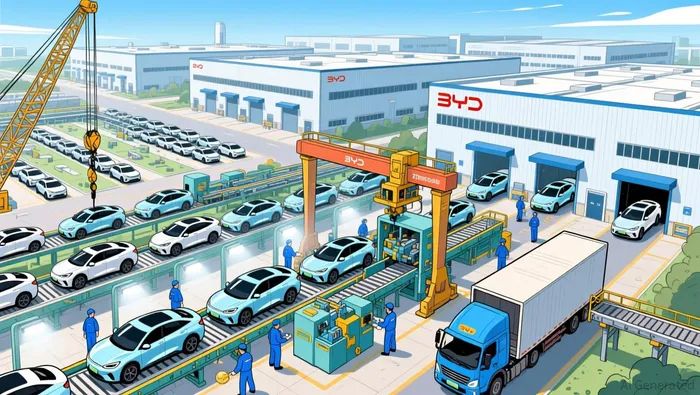 Farley acknowledged the scale of the challenge, noting that Chinese EVs could "put us all out of business" by serving the entire North American market alone, as the Carsales report noted. The CEO even admitted to driving a Xiaomi SU7, a Chinese EV, to study the competition, praising its "high quality" and digital features, as the Carsales report noted.
Ford's financial struggles further highlight the urgency of its strategic pivot. The company reported a $1.4 billion EV loss in the third quarter of 2024, contributing to an estimated $4.5 billion annual deficit, according to a MechHelp analysis. Tariffs on imported parts, some as high as 70%, have added $2 billion in costs-equivalent to 20% of Ford's global profit, forcing the company to absorb expenses that ultimately affect workers, as the Carsales report noted. Meanwhile, Tesla faces its own challenges, including a 3.68% stock decline despite shareholders approving a $1 trillion compensation package for Elon Musk, according to a Futunn report.
To counter Chinese competition, Ford is focusing on smaller, more affordable EVs and reviving iconic nameplates like the Capri. Farley also warned of "Trojan horse" tactics, where Chinese automakers rebrand their EVs under established names like Mazda or Nissan to infiltrate global markets, as the MechHelp analysis noted. The company's new strategy aims to balance cost efficiency with innovation, but Farley conceded the odds of sustaining American manufacturing are "getting slimmer by the day," as the MechHelp analysis noted.

Stay ahead of the market.
Get curated U.S. market news, insights and key dates delivered to your inbox.
AInvest
PRO
AInvest
PRO



Comments
No comments yet