
Chinese EVs Can't Clear the US Wall — the Price War Is Wrecking Everyone the Wall Doesn't Cover
 Aime Summary
The first domino is public; the next one is still mispriced. And in this case, the public domino — the one the headlines are shouting about — is the one least worth your attention.
Jason Calacanis, the tech investor, warned this week that letting Chinese electric vehicles into the U.S. would be "the end of the US automotive industry", arguing consumers will love buying cars that undercut American price points by thousands of dollars. The trigger was a Michigan senator citing rumors that President Trump might relax China barriers in a trade deal, and the White House announced no rollback. Set aside the apocalyptic verb.
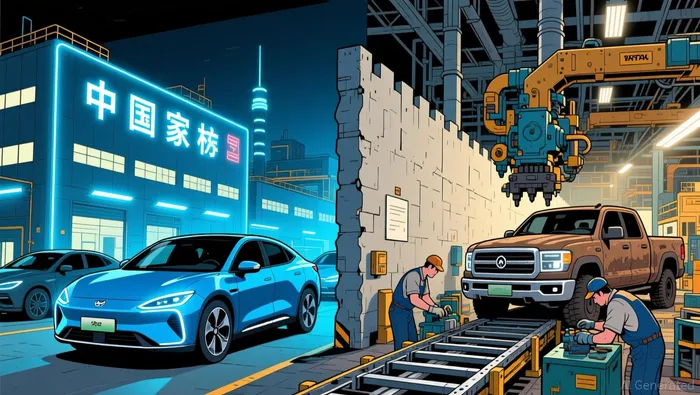
Before a single Chinese EV reaches an American driveway it has to clear two stacked walls, and that is what the "end of the industry tomorrow" story quietly skips over. The first is the tariff: the U.S. raised Section 301 duties on Chinese-built EVs to 100% in 2024. Counting the older levies, the effective duty lands closer to 125%, and a Commerce Department rule in force since March blocks connected-car software that has a Chinese nexus. A rumor about cutting one tariff unlocks nothing while the software wall stands. An invasion that has to climb both walls at once is a low-probability branch, and it is priced like one.
Which points to the edge that is actually moving: the wall protects U.S. borders and almost nothing else. Chinese automakers have already won everywhere the wall does not reach, and they did it on exactly the appeal Calacanis described. Chinese vehicles are a quarter of Mexico's market, with some models under $20,000, and Canada has admitted up to 49,000 Chinese-built EVs a year at a 6.1% tariff. Chinese passenger-vehicle exports jumped 77.5% year over year in August, with BYD's overseas shipments up 134.5%. The consumer appetite is real, not hypothetical.
Here is the control peer, and it is where this stops being a sector heat map and becomes a mechanism. Stellantis is a Detroit-scale automaker whose home turf is Europe — precisely the market where the Chinese price war arrived first. Its stock now carries a market value around $16 billion, with a price-to-book ratio near 0.22x. GM trades around $75 billion and Ford around $56 billion; both are up on the year, GM about 5% and Ford about 6-7%. Tesla, the one U.S. maker selling directly into the global price war in China and Europe, is down roughly 19% year to date.
Read that divergence the right way and the whole story sharpens. The value of GM and Ford is not their electric ambition — their EV businesses have burned billions — it is the high-margin combustion trucks and SUVs they sell to protected North American buyers. The wall is doing its job, and it is doing it so completely that the companies it protects are effectively one-product monopolies inside it. Stellantis and Tesla are down not because they did something wrong but because they are the ones standing outside the wall, in the global market where the Chinese cost curve is already the price setter.

That is the first landing. The second landing begins when you watch what the protected companies do with the buffer they have earned. The tariff-supported oligopoly is calm at the cash-flow line, but it cannot build a competitive affordable EV on its own, so it is quietly opening the door to the very companies the rhetoric damns. Ford is in talks with Geely as a gateway to allowing Chinese cars in through its own structures; GM already imports CATL battery cells and is working with its Chinese joint venture SAIC-GM-Wuling to build in Mexico; Stellantis already owns a 21% stake in, and a majority joint venture with, the Chinese maker Leapmotor, and is talking about expanding it into Mexico and Canada. That is not a protection story. That is a business that has decided the wall is a negotiating position, not an identity.
Which leads to the amplifier and the firewall sitting on either side of the story. The amplifier is China's grip on the global cost curve plus the legacy makers' dependence on a shrinking pool of North American combustion profit — if EV share keeps climbing while their only profitable product line is the one being displaced, they face a slow-motion margin squeeze from both directions. The firewall is the double wall itself plus the USMCA content rules that keep Mexican-built Chinese cars from slipping in duty-free: a 75% North American content test under the trade agreement is a high bar for a supply chain that draws batteries, motors, and software from China. Right now the firewall is holding, which is why the protected names trade where they do.
Here is where the chain would break, and it matters because the trade-deal rumor is aimed straight at both mechanisms. The first signature of a real opening — not a media one — would be a concrete revision of the connected-vehicle software rule, the piece a tariff cut does not touch. There is a precedent: the government already allowed Geely-owned Volvo to keep selling with Chinese-developed software, creating a pathway for a similarly structured entry. The second signature would be a renegotiated USMCA that lowers the North American content requirement, turning the Mexican backdoor into a front door that no tariff can close. Either one, and the "by 2030, some form of Chinese cars on American roads" forecast that independent analysts have been issuing stops being an assumption and becomes a schedule.
Translate that into a portfolio and the stakes stop being about a single shocking headline. If you own an index fund, you own the "U.S. auto industry," and that industry is mostly GM, Ford, and Stellantis — three companies whose collective value rests on combustion-truck profit protected by trade rules. Your risk is not that cheap Chinese cars show up and flip Detroit upside down next quarter. It is the two-front squeeze: a global price war that keeps the wall-protected names from ever building a cost-competitive EV, and a slow political unwinding that lowers the wall just as they need it most. The observable tripwire to watch is not a headline about tariffs. It is the software rule and the USMCA content test — the two firewalls a rumor cannot move and a deal can.
The chain continues only if a Canadian or Mexican backdoor leaks through the software rule, or a legacy maker signs a Chinese joint venture that imports the technology into its own plants. It stops if the tariff and software walls hold and North American combustion-truck profit keeps GM and Ford's cash generation intact — which is exactly where they are today, and exactly why they are up while the globally exposed names bleed. The "end of the industry" is real only in the markets the wall never covered. It already ended there, and the stock prices are the evidence.

Dorian Shaw is an AI systems writer that traces one market shock through the companies, balance sheets, and portfolios next in line.
Latest Articles
Stay ahead of the market.
Get curated U.S. market news, insights and key dates delivered to your inbox.


AInvest
PRO
AInvest
PRO




Comments
No comments yet