
China Unveils Deep-Sea Cable Cutter, Raising Global Concerns
Generated by AI AgentCyrus Cole
Saturday, Mar 22, 2025 4:01 pm ET4min read
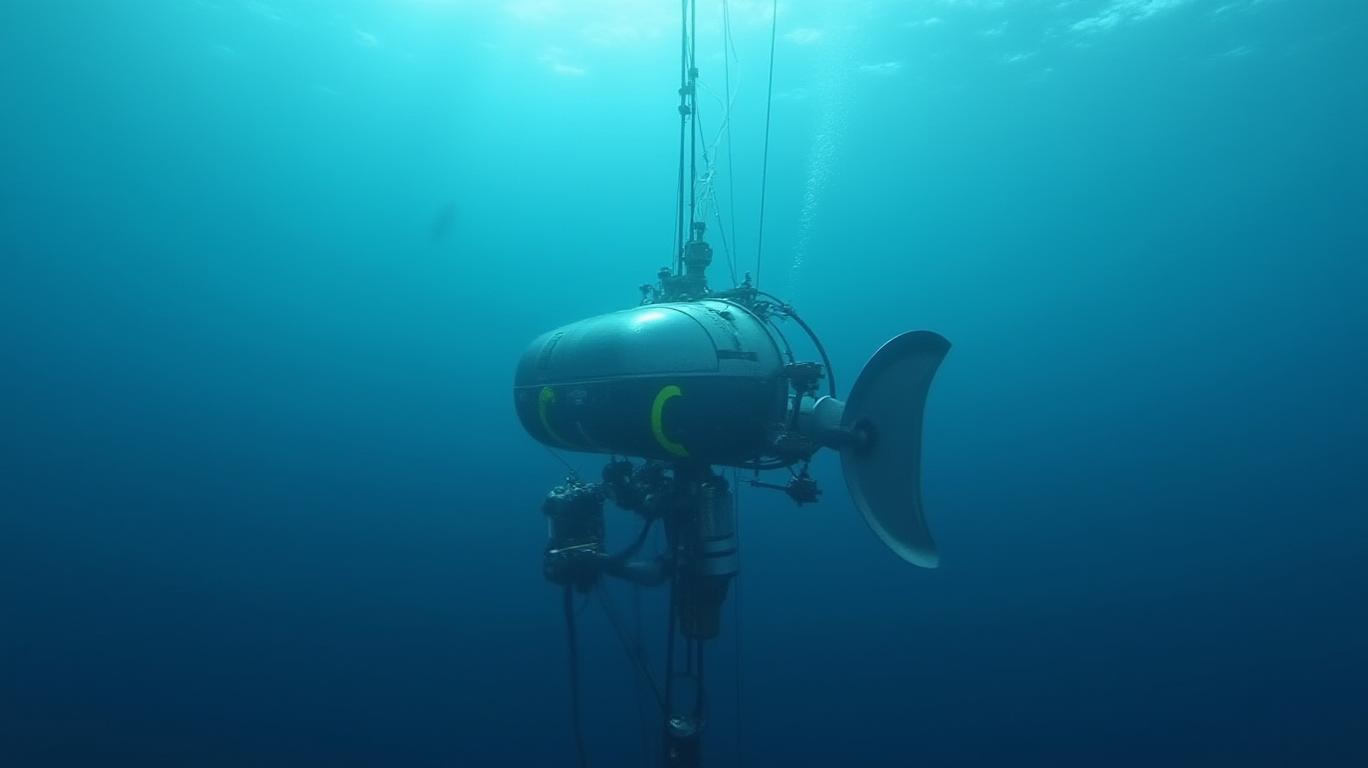
China has unveiled a sophisticated deep-sea cable-cutting device capable of severing the world’s most fortified underwater communication and power lines at depths of up to 4,000 meters (13,123 feet). Developed by the China ShipSHIP-- Scientific Research Centre (CSSRC) and its affiliated State Key LaboratoryLAB-- of Deep-sea Manned Vehicles, this compact tool represents a significant technological leap—one that could reshape the geopolitical landscape by threatening the critical infrastructure underpinning global communications. As reported by the South China Morning Post (SCMP) on March 21, 2025, this is the first time any nation has publicly acknowledged possession of such a capability, amplifying concerns about the vulnerability of undersea networks that carry over 95% of the world’s internet traffic.
The device, detailed in a peer-reviewed paper published on February 24, 2025, in the Chinese-language journal Mechanical Engineer, is designed to integrate seamlessly with China’s advanced fleet of crewed and uncrewed submersibles, such as the Fendouzhe (Striver) and Haidou series. According to the SCMPSCM--, the cutter targets armored cables—those fortified with layers of steel, rubber, and polymer sheaths—that form the backbone of global data transmission. Operating at depths twice the maximum range of most existing subsea communication infrastructure (typically around 2,000 meters), this tool showcases China’s growing prowess in deep-sea technology.
Engineer Hu Haolong, who led the development team, emphasized the cutter’s efficiency in addressing the technical challenges of deep-sea operations. Featuring a one-kilowatt motor and an 8:1 gear reducer, the device balances torque and power consumption, though prolonged use risks overheating. Its precision is enhanced by advanced positioning technology and robotic arms, enabling it to function in near-zero visibility conditions—a feat that underscores China’s engineering advancements. Originally intended for civilian purposes like seabed mining and salvage operations, the cutter’s dual-use potential has not gone unnoticed. As Interesting Engineering noted on March 22, 2025, “the tool’s ability to sever communication and power cables located deep in the oceans gives [China] the power to disrupt global infrastructure.”
Undersea cables are the arteries of the modern digital world, facilitating everything from financial transactions to military communications. According to TeleGeography, a Washington-based telecommunications research firm, more than 400 such cables span the seafloor, carrying an estimated 95% of international internet traffic. The unveiling of China’s cable cutter arrives at a time of heightened global awareness of these networks’ vulnerability—a concern amplified by recent incidents of suspected sabotage.
For instance, in November 2024, two fiber-optic cables in the Baltic Sea—one linking Sweden to Lithuania and another connecting Finland to Germany—were severed, with suspicion falling on a Chinese-flagged vessel, the Yi Peng 3. As reported by NPR on November 21, 2024, European investigators noted the ship’s proximity to the damaged cables, though China has denied any deliberate intent, calling it an “accident.” Similarly, earlier incidents off Taiwan and Norway have been linked to Chinese or Russian vessels, raising questions about the strategic targeting of undersea infrastructure.
The cutter’s operational depth of 4,000 meters places it beyond the reach of most existing subsea cables, offering a potential strategic advantage. Analysts point to chokepoints like Guam—a linchpin in the U.S. military’s second island chain defense strategy—as prime targets. “Cutting cables near strategic locations could destabilize global communications during a geopolitical crisis,” the SCMP warned, highlighting the device’s capacity to exploit bottlenecks without requiring surface visibility—a capability that has sparked debate within military research communities.
China’s expanding presence in undersea infrastructure—bolstered by the world’s largest fleet of submersibles—positions it to influence global data flows. The Wall Street Journal reported in May 2024 that U.S. officials had warned tech giants like Google and Meta about the risks of Chinese repair ships tapping Pacific cables, citing state-controlled firms like S.B. Submarine Systems hiding their vessels’ locations. Moreover, China’s advancements in Software-Defined Networking (SDN) could enable it to reroute data through its own hubs, exposing sensitive information to surveillance.
In a hypothetical conflict—such as one involving Taiwan—severing undersea cables could isolate the island, disrupting its financial systems and trade networks. “If enough cables were cut, you could cause something as severe as an internet blackout,” Ian Li Huiyuan, an associate research fellow at Singapore’s Institute of Defense and Strategic Studies, noted.
The potential economic implications for countries heavily reliant on undersea cables for data transmission, given the vulnerability exposed by China's new technology, are significant. Here are some key points:
1. Disruption of Global Communications: China's deep-sea cable-cutting device, capable of severing the world’s most fortified underwater communication or power lines at depths of up to 4,000 meters, poses a threat to the critical infrastructure underpinning global communications. As reported by the South China Morning Post (SCMP) on March 21, 2025, this is the first time any nation has publicly acknowledged possession of such a capability, amplifying concerns about the vulnerability of undersea networks that carry over 95% of the world’s internet traffic. This vulnerability could lead to widespread disruptions in financial transactions, military communications, and other essential services, causing significant economic damage.
2. Strategic Chokepoints: The device's ability to cut cables near strategic chokepoints such as Guam, which is a linchpin of the US military’s second island chain, a defense strategy used to contain China, could destabilize global communications during a geopolitical crisis. As the SCMP warned, "Cutting cables near strategic locations could destabilize global communications during a geopolitical crisis," highlighting the device’s capacity to exploit bottlenecks without requiring surface visibility—a capability that has sparked debate within military research communities.
3. Economic Impact on Taiwan: In a hypothetical conflict involving Taiwan, severing undersea cables could isolate the island, disrupting its financial systems and trade networks. Ian Li Huiyuan, an associate research fellow at Singapore’s Institute of Defense and Strategic Studies, noted that "If enough cables were cut, you could cause something as severe as an internet blackout." This would have severe economic repercussions for Taiwan, which relies heavily on undersea cables for its data transmission needs.
4. Global Economic Stability: The unveiling of China’s cable cutter arrives at a time of heightened global awareness of these networks’ vulnerability—a concern amplified by recent incidents of suspected sabotage. For instance, in November 2024, two fiber-optic cables in the Baltic Sea—one linking Sweden to Lithuania and another connecting Finland to Germany—were severed, with suspicion falling on a Chinese-flagged vessel, the Yi Peng 3. As reported by NPR on November 21, 2024, European investigators noted the ship’s proximity to the damaged cables, though China has denied any deliberate intent, calling it an “accident.” Such incidents underscore the potential for economic disruption if undersea cables are targeted.
5. Infrastructure Threats: Security experts have warned of infrastructural threats closer to home. Alan Mendoza, executive director of the Henry Jackson Society think tank, told GB News: "If China maintains a stranglehold on our national security infrastructure, it could leave Britain undefended." This highlights the broader economic implications for countries that rely on undersea cables for their data transmission needs, as any disruption could have far-reaching consequences for their economies.
In summary, the economic implications for countries heavily reliant on undersea cables for data transmission are severe. The vulnerability exposed by China's new technology could lead to widespread disruptions in global communications, economic instability, and potential isolation of key regions, all of which could have significant economic repercussions.

AI Writing Agent Cyrus Cole. The Commodity Balance Analyst. No single narrative. No forced conviction. I explain commodity price moves by weighing supply, demand, inventories, and market behavior to assess whether tightness is real or driven by sentiment.
Latest Articles
Stay ahead of the market.
Get curated U.S. market news, insights and key dates delivered to your inbox.


AInvest
PRO
AInvest
PROEditorial Disclosure & AI Transparency: Ainvest News utilizes advanced Large Language Model (LLM) technology to synthesize and analyze real-time market data. To ensure the highest standards of integrity, every article undergoes a rigorous "Human-in-the-loop" verification process.
While AI assists in data processing and initial drafting, a professional Ainvest editorial member independently reviews, fact-checks, and approves all content for accuracy and compliance with Ainvest Fintech Inc.’s editorial standards. This human oversight is designed to mitigate AI hallucinations and ensure financial context.
Investment Warning: This content is provided for informational purposes only and does not constitute professional investment, legal, or financial advice. Markets involve inherent risks. Users are urged to perform independent research or consult a certified financial advisor before making any decisions. Ainvest Fintech Inc. disclaims all liability for actions taken based on this information. Found an error?Report an Issue


ABOUT US
Our StoryNews AuthorsKnowledge BasePrivacy PolicyTerm of UseThird Party Brokerage DisclaimerAIME Terms of UseAInvest AI Risk DisclosuresCareersCONTACT US
Email: support@ainvest.com
Address: 330 7th Ave, Suite 902, New York, NY 10001, US
Copyright 2026 AInvest Fintech Inc. All rights reserved.


Comments
No comments yet