
China's Typhoon Belt Is An Inflation Tailwind You're Ignoring - And That's The Point
 Aime Summary
Do you know what scares me more than the market assuming inflation is returning to 2%? The list of structural forces keeping it higher that no one is discussing.
I've written about deglobalization, demographics, the energy transition, and fiscal dominance as reasons why policymakers may increasingly tolerate inflation above their stated target. There's another driver sitting in plain sight right now, one that ties directly to supply chains, freight costs, and the companies that can and cannot pass higher prices on to customers.
It's called extreme weather in China's industrial heartland.
Super Typhoon Bavi - a Category 5-equivalent cyclone - tore through eastern China in mid-July. It forced the temporary closure of Shanghai and Ningbo, the world's first and third busiest container ports. Almost two million TEU of container capacity were delayed. Vessel queues outside Shanghai more than doubled to well over 120 ships within a week. Recovery is measured in weeks, not days.
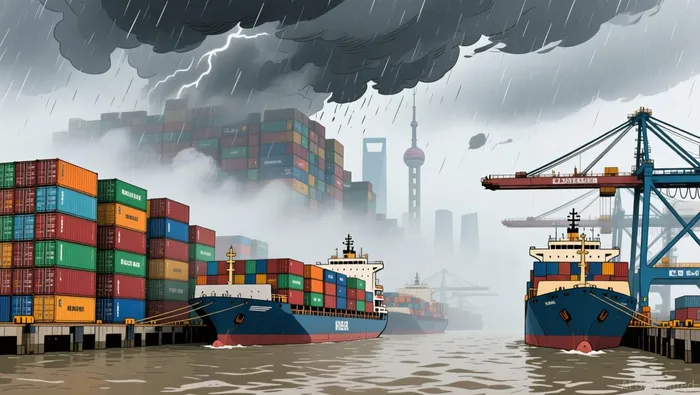
That was just one storm. Now Typhoon Dolphin, the 13th typhoon of 2026, is tracking toward the eastern coast with potential landfall between August 1st and 15th. Meanwhile, catastrophic flooding across Sichuan province has displaced more than 922,000 residents since mid-July.
Scientists at the National Climate Center in China expect up to six typhoons to form in the Northwest Pacific and South China Sea in July alone, well above the historical average of 3.8. Up to three could make landfall. The UN weather agency recently raised its forecast for a strong El Nino emergence in the coming months, which shifts typhoon tracks westward toward China's coast and fuels more intense storms.
Benjamin Horton, dean of the School of Energy and Environment at City University of Hong Kong, put it bluntly: "The magnitude of these events is increasing and there is no time to recover and become resilient. This is just going to repeat and repeat and repeat."
This matters because I believe weather-driven supply chain disruption is becoming a structural component of inflation, not a temporary blip the market can dismiss.
Here's what's happening beneath the surface.
China's manufacturing base is already in contraction
The official manufacturing PMI fell to 49.2 in July from 50.3 in June, marking the first contraction since February. The new orders sub-index dropped to 48.5, the lowest reading in 38 months. The private-sector RatingDog PMI, compiled by S&P Global, came in at 50.9, down from 51.7 in June - growth but at a four-month low. Input price inflation slowed to a six-month low while output prices were broadly flat, meaning manufacturers are absorbing cost pressure rather than passing it on.
A National Bureau of Statistics spokesperson attributed part of the PMI weakness directly to the recent spate of typhoons. Construction PMI slumped to a record low of 47.0. Q2 GDP growth came in at 4.3%, missing the lower end of Beijing's 4.5% to 5% annual target.
When the manufacturing engine is already sputtering, a weather event that shuts down the ports feeding that engine doesn't just create noise. It amplifies an existing weakness and forces the entire global logistics network to reroute around the disruption.
Freight rates are already elevated - weather adds fuel to an active fire
Trans-Pacific freight rates surged 33% to 37% month-over-month in May 2026, before the typhoon season fully arrived. As of May 2026, a 40-foot container from China to a US West Coast port cost between $3,015 and $3,685. As of May 2026, Xeneta data shows US West Coast and East Coast import rates from the Far East have increased roughly 50% since geopolitical tensions escalated in late Q1.
The structure behind these rates isn't a single shock. Carriers are deliberately restricting capacity through blank sailings after reporting operating losses in late 2025. Importers are front-loading shipments ahead of tariffs and peak season. Equipment repositioning has created asymmetric shortages across container sizes. Then you layer on a storm that closes the world's two busiest ports simultaneously.
Every delayed vessel must still be berthed, unloaded, and reloaded. Delayed vessels at Shanghai show up late at their next port, creating congestion in Rotterdam, Los Angeles, or Hamburg weeks after the storm has passed. The Cleveland Federal Reserve documented this mechanism clearly: supply chain disruptions lasting a month or longer occur every 3.7 years on average, and they contribute significantly to inflation pressures.
US inflation is sticky, not solved
The June CPI came in at 3.5% year-over-year, down from 4.2% in May. The June PCE price index was 3.7%, down from 4.1%. That's progress from the April and May peaks, but it's not 2%. Energy inflation spiked to 15.7% year-over-year in June before falling back in the monthly print. Core services inflation - shelter, medical care, transportation services - remains in the 2.9% to 3.4% range.
I don't think the market's base case assumes that these numbers drift down to 2% in a straight line. The June drop was driven largely by a one-time energy reversal - the energy index fell 5.7% in June after rising 3.9% in May. That's not a structural improvement. That's a base effect unwinding.
When you add weather-driven supply chain shocks to a regime where energy prices are volatile, freight costs are already elevated, and domestic services inflation hasn't budged, the arithmetic becomes clear. The path back to 2% is full of obstacles the market isn't pricing in.
What this means for portfolio positioning
This is where the thesis connects to the real question: which companies can operate through this environment without their margins getting crushed?
The answer is the same one that matters across every macro regime shift I've analyzed: pricing power. If a company cannot raise prices without losing customers, it cannot grow its dividend through inflation. Period. Weather-driven supply chain costs are a classic test of that filter.
Companies with pricing power pass through higher input and freight costs. Their margins hold. Their cash flows compound. Their dividends grow. Companies without it absorb the hit, see margins compress, and eventually either cut their payout or fall behind inflation.
This is why I focus on the real economy over the financial economy. Energy companies, industrials, logistics operators, defense contractors, midstream infrastructure - these are TOLL stocks, not FANG. They provide what the economy literally cannot function without. They have oligopolistic market positions. Their customers don't walk away when costs rise because there's no substitute.
The equity yield curve framework becomes more relevant in this environment. The sweet spot - moderate yields of 2% to 4% with strong dividend growth of 8% to 15% - becomes the vehicle that protects purchasing power while compounding income. When weather and supply chain disruptions inflate short-term volatility, these quality businesses can see their yields temporarily spike, creating the entry point the framework describes. You accept cyclical risk for superior long-term returns.
The counterargument is worth hearing
The strongest case against reading too much into these storms is simple: supply chains have become more resilient. Companies have diversified suppliers, built regional inventories, and invested in redundancy since the pandemic. A typhoon that disrupts Shanghai for a week doesn't shut down global trade anymore the way it might have a decade ago. The PMI contraction is also driven primarily by weak domestic demand and a property crisis, not by weather. The June CPI drop, while base-driven, still represents real cooling in goods prices.
I accept all of that. But resilience is not immunity. When Bavi delayed nearly two million TEU and vessel queues doubled within a week, the market absorbed it without a dramatic freight rate spike - yet. The real test comes when disruptions compound: weather on top of geopolitical risk, on top of carrier capacity management, on top of front-loaded demand, on top of an already-weak manufacturing sector that can't simply ramp production to clear the backlog. At some point, the compounding frictions show up in prices, and when they do, the companies with pricing power are the ones that win.
The conclusion is straightforward
I believe inflation is likely to remain more persistent than the market's base case assumes. Deglobalization, demographics, the energy transition, fiscal dominance, and now weather-driven supply chain shocks are all pointing in the same direction. These aren't arguments for a higher growth rate. They're arguments for a higher price level.
That doesn't mean every high-yield stock is attractive. The winners still need pricing power, balance-sheet strength, and a payout profile that can survive a full cycle. The point isn't to chase yield - it's to compound income in a regime where inflation may not disappear, where supply chain friction is a recurring feature, and where the real economy companies you can actually count on are the ones that matter most.
The storms over China won't dictate your portfolio. But the inflation regime they reinforce should.

Stay ahead of the market.
Get curated U.S. market news, insights and key dates delivered to your inbox.


AInvest
PRO
AInvest
PRO




Comments
No comments yet