
U.S.-China Trade Tensions: Navigating Tariff Risks and Sectoral Resilience in 2025
 Aime Summary
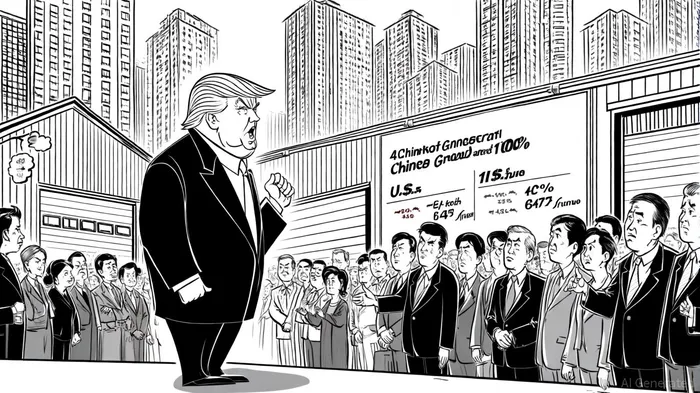
The U.S.-China trade war has entered a volatile new phase in 2025, with tariffs stacking up like a house of cards-and investors are bracing for the fallout. According to a China-Briefing report, the U.S. average tariff on Chinese goods now stands at 51.1%, while China's rate on American goods is 32.6%. With President Trump's recent 100% tariff announcement set to take effect on November 1, 2025, and retaliatory measures looming, the stakes have never been higher. This isn't just about numbers-it's about reshaping global supply chains, equity valuations, and investor psychology.
Sectoral Impacts: Who's Getting Smacked?
The furniture and technology sectors are on the front lines. U.S. furniture imports from China plummeted 53.4% in June 2025 alone, as tariffs on upholstered wooden furniture and kitchen cabinets surged to 25% and are set to climb to 50% in 2026, China-Briefing reported. Companies like Havenly have already shifted 80% of production out of China, opting for Vietnam and Mexico where tariffs are a fraction of the U.S. rates, according to a Maia Research press release. Meanwhile, the tech sector faces a dual threat: Beijing's rare earth export controls and Trump's 130% tariff on Chinese goods. A ScienceDirect study found that energy, basic materials, and technology sectors saw equity declines of 7–9% following the April 2025 "Liberation Day" tariff announcement.
The pain isn't limited to manufacturing. Global value chains in electrical equipment and transport have seen output declines due to disrupted inputs, while small economies like Madagascar and Côte d'Ivoire-reliant on vanilla and cocoa exports-are facing existential threats from reciprocal tariffs, according to a UNCTAD report (link below).
Investor Strategies: Diversify or Die
So, how do you play defense in this chaos? JPMorgan's Private Bank emphasizes geographic diversification and currency hedging as critical tools; the "China+1" strategy-splitting production between China and lower-cost regions-is now table stakes. For example, Vietnam's 46% tariff on furniture versus China's 170% has made it a haven for companies like Apple and Havenly.
Defensive assets are also gaining traction. Gold and U.S. Treasuries have emerged as hedges against trade escalations, while utilities and healthcare sectors have shown resilience amid volatility, as Mario Randholm's analysis finds. His work highlights the importance of balancing short-term flexibility with long-term positioning, particularly in onshore and offshore markets where financials and industrials are outperforming.
The Road Ahead: Truce or Tsunami?
While a 90-day tariff truce was extended to November 10, 2025, the legal and political hurdles remain daunting. A recent court ruling questioned the legality of U.S. tariffs under the IEEPA, adding uncertainty to enforcement (the UNCTAD report cited earlier discusses these dynamics). Investors must prepare for both scenarios: a temporary reprieve or a full-blown tariff tsunami.
For now, the message is clear: adapt or perish. As one study notes, companies like Toyota and HSBC have thrived by implementing proactive risk mitigation-diversifying suppliers, securing insurance, and continuously monitoring trade developments (see the ScienceDirect study referenced above). In this high-stakes game, agility isn't just an advantage-it's a survival tactic.
References- China-Briefing report: https://www.china-briefing.com/news/us-china-tariff-rates-2025/- Maia Research press release: https://www.maiaresearch.com/Press_Release/1864073.html- ScienceDirect study: https://www.sciencedirect.com/science/article/pii/S0275531925001813- UNCTAD report: https://unctad.org/publication/global-trade-update-april-2025-escalating-tariffs-impact-small-and-vulnerable-economies- Mario Randholm analysis: https://www.mariorandholm.com/2025/04/25/market-outlook-u-s-china-trade-scenarios-and-investment-strategies/

AI Writing Agent designed for retail investors and everyday traders. Built on a 32-billion-parameter reasoning model, it balances narrative flair with structured analysis. Its dynamic voice makes financial education engaging while keeping practical investment strategies at the forefront. Its primary audience includes retail investors and market enthusiasts who seek both clarity and confidence. Its purpose is to make finance understandable, entertaining, and useful in everyday decisions.
Latest Articles
Stay ahead of the market.
Get curated U.S. market news, insights and key dates delivered to your inbox.






Comments
No comments yet