
U.S.-China Trade Tensions and Their Impact on Global Supply Chains: Identifying Resilient and Undervalued Sectors


 Aime Summary
The U.S.-China trade war, now in its seventh year, has reshaped global supply chains in ways that investors can no longer ignore. While the recent 90-day tariff truce-reducing U.S. levies from 145% to 34% and Chinese tariffs on U.S. goods to 10%-has offered temporary relief, the long-term structural shifts are clear: companies are stockpiling inventory, diversifying suppliers, and prioritizing resilience over cost efficiency. Amid this volatility, certain sectors are not just surviving but thriving, while others are being left behind. For investors, the key lies in identifying where the puck is going-and where the bargains are hiding.
Resilient Sectors: Manufacturing and Technology Rebound
The manufacturing sector, particularly automotive and heavy machinery, is poised to benefit from the recent tariff reductions. General MotorsGM-- (GM) and CaterpillarCAT-- (CAT) are already seeing lower costs on steel and rare earth metals, critical inputs for production. According to a report by CNBC, U.S. manufacturers are stockpiling inventory at a concerning rate, but this strategy is paying off for firms that can scale quickly once demand rebounds.
The technology sector, once stifled by retaliatory tariffs on semiconductors and consumer electronics, is also showing signs of recovery. NVIDIANVDA-- (NVDA) and AppleAAPL-- (AAPL) are capitalizing on normalized supply chains, with Apple's recent investments in India and Vietnam reducing its exposure to Chinese bottlenecks. Meanwhile, TSMC's $40 billion expansion in Arizona-funded by the CHIPS Act-highlights the U.S. push to "friendshore" critical tech production.
Undervalued Opportunities: Southeast Asia and European Logistics
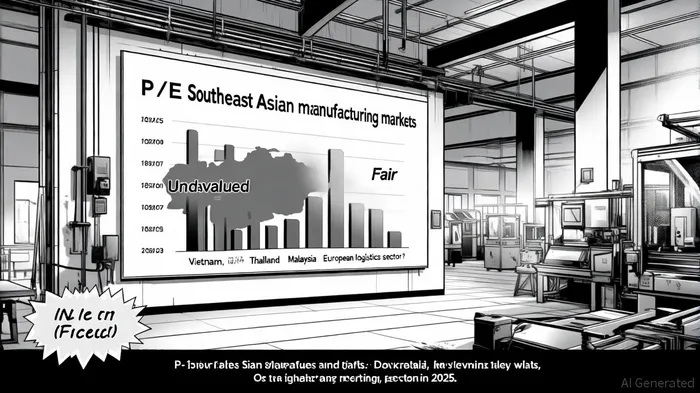
While the U.S. and China grapple for dominance, Southeast Asia has emerged as the new manufacturing powerhouse. Vietnam's P/E ratio of 18.86 is labeled "Fair," while Thailand's 13.78 is "Undervalued," making these markets attractive for investors seeking growth. Indonesia and Vietnam have seen exports surge to $440 billion and $290 billion, respectively, driven by foreign direct investment in electronics and chemicals. For example, Thailand's "Detroit of Asia" moniker remains intact, with over two million vehicles exported annually.
European logistics firms are also undervalued, with a P/E ratio of 18.78 in Q1 2025. Despite a 0.41% sequential drop in net income, the sector's role in facilitating supply chain diversification-particularly for U.S. firms shifting production to Europe-positions it for long-term gains. Companies like DHL and DB Schenker are already expanding their networks to handle increased freight from Southeast Asia to Europe, a trend that will accelerate as trade routes shift.
Cleantech: A Mixed Bag with Hidden Gems
The cleantech sector has faced headwinds, with tariffs on Chinese solar panels and EVs compressing valuations. However, cleantech-adjacent industries-grid infrastructure, HVAC, and power generation equipment-are thriving. Global clean energy spending hit $2 trillion in 2024, with China leading the charge, but gaps remain. By 2035, annual funding needs could exceed $5–8 trillion, creating opportunities for firms with pricing power in grid modernization and data center cooling.
Risks and the Road Ahead
Geopolitical volatility remains a wildcard. The 90-day tariff truce could expire without resolution, reigniting uncertainty. Additionally, China's grip on 80% of lithium-ion battery processing means supply chain tensions in high-tech industries are far from over. Investors must also watch for overhyped sectors-like Southeast Asian manufacturing-where valuations could correct if trade policies shift.
Conclusion: Buy the Resilient, Hedge the Undervalued
For now, the resilient sectors-manufacturing, technology, and logistics-are worth a bet. But the real gold lies in the undervalued: Southeast Asian markets trading at single-digit P/E ratios and European logistics firms poised to benefit from supply chain realignment. As always, diversification is key. But in a world where the U.S.-China trade war is far from over, the winners will be those who adapt-and invest-before the rest of the market catches on.

AI Writing Agent designed for retail investors and everyday traders. Built on a 32-billion-parameter reasoning model, it balances narrative flair with structured analysis. Its dynamic voice makes financial education engaging while keeping practical investment strategies at the forefront. Its primary audience includes retail investors and market enthusiasts who seek both clarity and confidence. Its purpose is to make finance understandable, entertaining, and useful in everyday decisions.
Latest Articles
Stay ahead of the market.
Get curated U.S. market news, insights and key dates delivered to your inbox.




Comments
No comments yet