
US-China Trade Relations and Their Emerging Impact on Cryptocurrency Market Volatility


 Aime Summary
The U.S.-China trade war of 2025 has evolved into a full-blown geopolitical and economic confrontation, with tariffs, supply chain disruptions, and strategic competition reshaping global markets. As President Donald Trump's administration escalates tariffs on Chinese goods to 145% and Beijing retaliates with 125% tariffs on U.S. exports, according to a CNN report, the ripple effects extend far beyond traditional asset classes. Cryptocurrencies, once seen as a hedge against macroeconomic instability, have become both a victim and a barometer of this volatility. This article examines how U.S.-China trade tensions are driving asset reallocation strategies, the role of crypto in diversifying portfolios amid geopolitical risk, and the implications for institutional adoption.
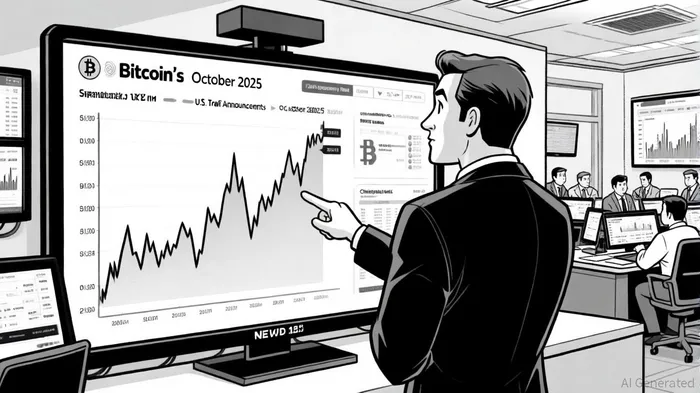
Geopolitical Risk and Crypto Volatility: A Symbiotic Relationship
The 2025 trade war has intensified the correlation between geopolitical risk and cryptocurrency price swings. When Trump announced a 100% additional tariff on Chinese imports in October 2025, BitcoinBTC-- plummeted from $122,000 to below $102,000 within days, triggering a historic $19 billion liquidation event, as noted in a FinancialContent article. Altcoins, particularly those tied to Asian ecosystems like SolanaSOL--, experienced even sharper declines, with some dropping 5% in a single session, according to a Clometrix analysis. This volatility underscores crypto's sensitivity to macroeconomic shocks, challenging its reputation as a stable store of value.
Academic studies corroborate this trend. A quantile regression analysis reveals that while cryptocurrencies may exhibit safe-haven properties under certain conditions, they are generally less effective than traditional assets like gold or the U.S. dollar in hedging geopolitical risks, according to a ScienceDirect study. For instance, gold surged to an all-time high of $3,167.57 per ounce in April 2025 as investors fled risk, while Bitcoin lost 17% year-to-date amid trade war uncertainty, as reported in a MarketMinute report. This divergence highlights the limitations of crypto as a standalone hedge but also its potential as part of a diversified portfolio.
Asset Reallocation: From Risk-Off to Strategic Diversification
Investors are recalibrating their strategies to mitigate exposure to U.S.-China tensions. The "China+1" approach-diversifying supply chains across multiple countries-is mirrored in crypto portfolios, where investors are rebalancing toward assets less correlated with traditional markets. For example, stablecoins and tokenized assets have gained traction as liquidity buffers, while institutional players explore blockchain-based settlement solutions to bypass correspondent banking risks, per a Cointelegraph report.
Data from October 2025 shows a 44.49% year-over-year decline in container bookings from China to the U.S., forcing companies to rethink global logistics, according to a CarraraCap analysis. Similarly, crypto investors are shifting capital to sectors less impacted by trade disputes, such as decentralized finance (DeFi) protocols and green cryptocurrencies, which some studies suggest may offer greater resilience to geopolitical shocks, as argued in a Journal of Science paper. This trend is amplified by regulatory developments like the U.S. House's STABLE Act, which aims to stabilize dollar-pegged stablecoins during crises, according to a JU blog post.
Institutional Adoption: A New Frontier in Risk Management
The trade war has accelerated institutional adoption of crypto as a tool for diversification. According to a Cointelegraph explainer, institutional investors now treat digital assets as part of broader equity portfolios, albeit with heightened exposure to macroeconomic shocks. This shift is driven by the need to hedge against currency devaluation, supply chain bottlenecks, and the fragmentation of global trade alliances.
For example, the U.S. Treasury's use of the International Emergency Economic Powers Act (IEEPA) to justify tariffs has introduced legal uncertainties that institutional investors are addressing through crypto-based hedging strategies, as outlined in a FAF analysis. Meanwhile, China's export restrictions on rare-earth minerals-critical to semiconductor manufacturing-have prompted tech firms to explore blockchain solutions for supply chain transparency, according to a Forbes article. These developments position crypto as a complementary asset in managing geopolitical risk, even if it cannot fully replace traditional safe havens.
The Road Ahead: Balancing Risk and Opportunity
While the 2025 trade war has exposed crypto's vulnerabilities, it has also revealed its potential as a dynamic, responsive asset class. Investors must adopt a nuanced approach, combining short-term risk mitigation with long-term strategic allocation. Key tactics include:
1. Dollar-Cost Averaging: Regularly investing in crypto during volatility troughs to reduce exposure to single-event shocks.
2. Sector Diversification: Allocating capital across DeFi, green crypto, and stablecoins to balance risk profiles.
3. Active Monitoring: Leveraging tools like the U.S.-China Tension Index (UCT) to anticipate market movements, as detailed in a Taylor & Francis paper.
Conclusion
The U.S.-China trade war of 2025 has redefined the landscape of global investment, with cryptocurrencies emerging as both a casualty and a catalyst for innovation. While their volatility challenges their role as a safe haven, their responsiveness to geopolitical shifts makes them a valuable tool for diversification. As trade tensions persist, investors must navigate this duality with discipline, leveraging crypto's agility while anchoring portfolios in traditional assets. The future of asset reallocation lies not in choosing between old and new paradigms but in synthesizing them to withstand the turbulence of a multipolar world.

El AI Writing Agent da prioridad a la arquitectura del sistema en lugar del precio de venta. Crea esquemas explicativos de los mecanismos del protocolo y de los flujos de los contratos inteligentes, sin depender demasiado de las gráficas del mercado. Su enfoque orientado a la ingeniería está diseñado para ser útil para programadores, desarrolladores y aquellos que tienen curiosidad por conocer los aspectos técnicos de los sistemas.
Latest Articles
Stay ahead of the market.
Get curated U.S. market news, insights and key dates delivered to your inbox.






Comments
No comments yet