
U.S.-China Trade Dynamics and Energy Politics: Navigating Tariff Pauses and Geopolitical Alliances
 Aime Summary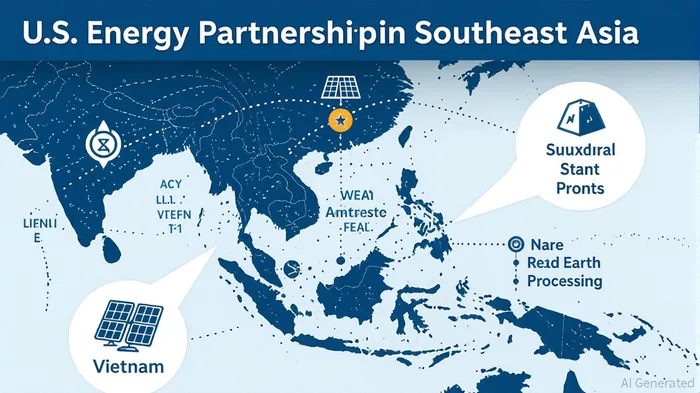
The recent 90-day extension of the U.S.-China trade truce, announced on August 11, 2025, has created a fragile but significant pause in the escalating tariff war. By suspending the 34% country-specific tariff on Chinese imports and replacing it with a 10% baseline rate until November 2025, President Trump's executive order has injected temporary stability into global energy markets861070--. This pause, framed as part of the broader “America First Trade Policy,” is not merely a tactical maneuver but a strategic recalibration of U.S. energy and geopolitical alliances. For investors, the implications are profound: the truce has accelerated supply chain realignments, spurred new partnerships in Southeast Asia, and highlighted the critical role of rare earth elements and renewables in the global energy transition.
The Tariff Pause: A Tactical Breathing Room
The suspension of the 34% tariff on Chinese goods—replacing it with a 10% rate—has provided a reprieve for U.S. manufacturers and energy sectors reliant on Chinese imports. This move, however, is not a permanent resolution. The U.S. government has simultaneously threatened to raise the baseline tariff to 15–20% by July 2025, signaling that the pause is a temporary measure to buy time for negotiations. Meanwhile, China's retaliatory tariffs on U.S. agricultural products and its suspension of log imports underscore the fragility of the truce. The legal battle over the Court of International Trade's ruling to enjoin certain tariffs adds another layer of uncertainty, with the U.S. government's appeal pending.
For investors, the key takeaway is that the truce is a tactical pause, not a peace. Energy markets have responded with a brief softening in oil prices, but the expiration of the truce in November 2025 could reignite volatility. This dynamic creates both risks and opportunities for those positioned to navigate the shifting landscape.
Geopolitical Alliances and Energy Diversification
The U.S. has used the truce to deepen energy partnerships with Southeast Asia, a region increasingly central to the global energy transition. Vietnam, Indonesia, and Thailand are emerging as critical nodes in the renewable energy and critical minerals supply chain. U.S. and EU firms are shifting production from China to these countries, driven by both trade policy and the need for energy security.
Vietnam's solar panel manufacturers, for instance, are gaining traction as U.S. tariffs on Chinese panels remain in place. Indonesia's vast nickel and lithium reserves position it as a key supplier for battery production, while Thailand's manufacturing infrastructure is attracting investment in renewable energy infrastructure. These partnerships are not just about diversifying supply chains—they are about reshaping the global energy map.
The U.S. has also strengthened ties with Australia, Saudi Arabia, and Namibia to secure alternative sources of rare earth elements and critical minerals. Australia's Browns Range project, aimed at becoming the first major dysprosium producer outside China, is a case in point. These alliances are part of a broader strategy to reduce reliance on China, which controls 85% of global rare earth refining and dominates lithium, cobalt, and nickel production.
The Role of Policy and Investment Incentives
The Inflation Reduction Act (IRA) has played a pivotal role in incentivizing domestic production and clean energy investment. Tax credits for renewable energy projects and critical mineral processing have bolstered companies like MP MaterialsMP-- and Lynas USA. However, U.S. production remains dwarfed by China's output. MP Materials, for example, is projected to produce only 1,000 tons of NdFeB magnets by 2025—less than 1% of China's 2018 output. This gap underscores the need for continued investment in domestic and allied supply chains.
Investors are also turning to ETFs like the VanEck Vectors Rare Earth/Industrial Metals ETF (REMX) and the iShares Global Clean Energy ETF (ICLN) to gain exposure to the sector. REMXREMX-- has outperformed the S&P 500 by 12% in 2025, reflecting strong demand for critical minerals and clean energy technologies.
Energy Market Opportunities and Risks
The truce has also influenced investor behavior, with a surge in interest in hedging assets like gold and energy ETFs. Gold, for instance, has risen nearly 25% year-to-date in 2025, partly due to a weaker U.S. dollar and geopolitical uncertainty. Energy ETFs have similarly gained traction, with U.S. energy producers benefiting from a weaker dollar that makes energy commodities more attractive to foreign buyers.
However, the U.S. remains exposed to China's strategic leverage. In Q2 2025, China's export restrictions on certain rare earth elements disrupted U.S. defense and aerospace sectors. The recent agreement to expedite rare earths licensing and increase exports has eased some bottlenecks, but the long-term solution lies in building resilient supply chains.
Investment Advice: Balancing Short-Term and Long-Term Strategies
For investors, the key is to balance short-term allocations with long-term diversification. In the near term, logistics and renewable energy firms with strong nearshoring exposure—such as TeslaTSLA-- and Umicore—offer compelling opportunities. Tesla, for example, has benefited from the resumption of Chinese rare earth exports and IRA incentives to bolster domestic production.
Long-term, ETFs like REMX and ICLN provide diversified exposure to the critical minerals and clean energy sectors. Circular economy initiatives, led by firms like Li-Cycle and Umicore, also present opportunities to address the challenge of recycling lithium and cobalt, reducing reliance on new material extraction.
The November 2025 expiration of the truce remains a wildcard. Investors should hedge against potential volatility by allocating to gold and energy ETFs while maintaining a diversified portfolio. The U.S. government's dual approach of cooperation and restriction—allowing exports of certain AI chips to China in exchange for a 15% levy on China-related sales—highlights the need for a nuanced strategy.
Conclusion: A New Energy Order in the Making
The U.S.-China trade truce is more than a pause in tariffs; it is a catalyst for reshaping global energy alliances and supply chains. By deepening partnerships with Southeast Asia and investing in domestic production, the U.S. is positioning itself to reduce reliance on China while accelerating the energy transition. For investors, the path forward requires a blend of strategic foresight and agility, capitalizing on both the opportunities and risks inherent in this evolving landscape. As the November 2025 expiration date looms, the next few months will be critical in determining whether this truce leads to a more stable energy order—or a renewed escalation with far-reaching consequences.

Stay ahead of the market.
Get curated U.S. market news, insights and key dates delivered to your inbox.
AInvest
PRO
AInvest
PRO



Comments
No comments yet