
U.S.-China Trade Decoupling Fuels Semiconductor Sector Opportunities: TSMC and Applied Materials Lead the Reshoring Surge
The escalating U.S.-China trade war has reshaped the global semiconductor landscape, with tariffs, export controls, and supply chain shifts creating both risks and opportunities. As the world's two largest economies navigate a fragile truce amid geopolitical tensions, companies with diversified manufacturing bases and strategic ties to government subsidies are emerging as top investment plays. Taiwan Semiconductor Manufacturing Company (TSMC) and Applied MaterialsAMAT-- (AMAT) stand at the forefront of this transformation, capitalizing on reshoring trends and irreplaceable technical expertise.
The New Trade Reality: Tariffs, Truces, and Technological Dividends
The latest developments underscore a volatile yet predictable pattern. The U.S. has lifted export restrictions on China's access to critical EDA software—a concession to ease rare earth disputes—while maintaining punishing tariffs averaging 55% on Chinese goods. Meanwhile, Section 232 tariffs on steel and aluminum have surged to 50%, spilling into supply chains for appliances and semiconductors.
The truce, set to expire in August 2025, hinges on unresolved issues like Taiwan's tariff status and potential 100% tariffs on critical components. This uncertainty has accelerated a global reshoring race, with the U.S. CHIPS Act allocating $52 billion to domestic semiconductor production and Japan/ASEAN nations attracting $30 billion in joint investments.
TSMC: The Indispensable Middleman in a Decoupled World
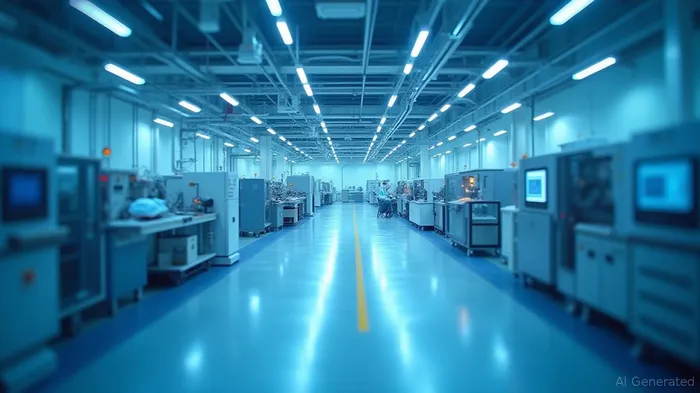
TSMC (TSM) is uniquely positioned to thrive in this fractured landscape. Its $12 billion Arizona factory—funded in part by CHIPS Act subsidies—is a strategic bet on U.S. reshoring, while its Taiwanese and Singapore facilities serve Asian markets. TSMC's dominance in 5nm and 3nm nodes (used in AI chips and advanced 5G devices) ensures it remains indispensable to companies like AppleAAPL--, NVIDIANVDA--, and QualcommQCOM--, even as trade barriers rise.
Crucially, TSMC's scale and technical prowess allow it to navigate geopolitical risks. While U.S. tariffs on Chinese chips threaten competitors like SMIC, TSMC's global footprint and partnerships with both Washington and Taipei insulate it from full-scale decoupling.
Investors should note TSMC's 15% revenue growth in 2024 and its AI-driven demand, which could push 2025 earnings to $80 billion. The stock's 10% dividend yield adds stability, though geopolitical volatility may cause short-term dips ahead of the August truce deadline.
Applied Materials: The Equipment Giant Powering Reshoring
While TSMCTSM-- builds factories, Applied Materials (AMAT) supplies the tools to keep them running. As the world's largest semiconductor equipment maker, AMATAMAT-- dominates markets for deposition, etch, and metrology systems—critical to chip fabrication at all nodes.
The CHIPS Act directly benefits AMAT, as U.S. foundries like IntelINTC-- and TSMC's Arizona plant rely on its gear. Additionally, $15 billion in global subsidies for chip plants (e.g., in Germany and Japan) are driving AMAT's 20% revenue growth in 2024. Its $100 million expansion in Texas highlights its commitment to U.S. reshoring.
AMAT's $150 billion market cap reflects investor confidence in its secular growth. Risks remain, such as overcapacity from subsidies, but AMAT's 80% market share in atomic layer deposition and its AI-driven process control software give it a durable moat.
The ASEAN Play: Diversification Without Compromise
While U.S. reshoring grabs headlines, Southeast Asia is quietly becoming a hub for low-cost, high-yield chip manufacturing. Singapore's $15 billion Temasek-Arizona partnership and Malaysia's $5 billion Intel expansion are luring companies like TSMC and Samsung. Investors can access this growth via ETFs like the iShares MSCI Singapore ETF (EWS) or direct stakes in regional suppliers like ASM Pacific Technology (ASMPT).
Investment Thesis: Play the Dividends, Not the Diplomacy
The U.S.-China trade war is here to stay, but investors can profit by focusing on three pillars:
1. Reshoring Leaders: TSMTSM-- (TSM) and AMAT (AMAT) are beneficiaries of CHIPS Act subsidies and global demand for advanced nodes.
2. Geopolitical Resilience: Companies with diversified supply chains (e.g., TSMC's tri-continentalTY-- setup) and irreplaceable tech (like Applied's etch systems) will outperform.
3. AI/5G Demand Surge: The $800 billion global AI chip market by 2030 ensures long-term tailwinds for semiconductor leaders.
Risks to Monitor:
- August 2025 Truce Deadline: A breakdown could trigger 100% tariffs on critical components, spiking costs for all players.
- Overcapacity: $200 billion in global subsidies risk oversupply in 2nm chips; focus on companies with pricing power.
Final Take:
In a world of fractured supply chains, TSMC and Applied Materials are the ultimate “decoupling plays”—combining geopolitical resilience, CHIPS Act tailwinds, and AI-driven demand. While short-term volatility may persist, their dominance in critical technologies positions them to profit from the new normal of global trade.
Action Items for Investors:
- Buy TSM on dips below $150/share (current: $160).
- Allocate 10–15% of tech portfolios to AMAT, targeting $180+/share.
- Use ASEAN ETFs (EWS) for geographic diversification.
The semiconductor sector's future is anything but certain—but for investors who bet on the right players, the rewards will be substantial.

Stay ahead of the market.
Get curated U.S. market news, insights and key dates delivered to your inbox.
AInvest
PRO
AInvest
PRO



Comments
No comments yet